How the Taliban conduct ‘peace talks’ is just not cricket
They have continued to bomb, kill, and maim, even as they have met with the Afghan government to discuss an end to violence, says
At the recent cricket World Cup in England, a plucky Afghani-stan team, composed mainly of former refugees, was surprisingly good, including in matches against their neighbours, India and Pakistan.
Unfortunately, the same cannot be said of two other Afghan teams — the Taliban and the government — that met in Doha, Qatar, earlier this month to agree on a “road map for peace”.
The Afghan government officials could not even claim to be what they were, because their interlocutors, a murderous band of fanatics, do not recognise the Afghan government.
Instead, the delegation was politely described as a group of representatives from Afghanistan, but without it being said whom they represented.
After two days, the participants agreed on eight points, prompting Zalmay Khalilzad, the US special representative for Afghanistan Reconciliation, to tweet that the talks had “concluded on a very positive note”.
He congratulated the participants “for finding common ground”.
Observers in India — Afghanistan’s second-largest aid donor, after the US — could be forgiven for a dose of scepticism. For one thing, the two sides had agreed in Doha to reduce “civilian casualties to zero”.
But even while they were meeting, their ‘common ground’ — the soil of Afghanistan — was being soaked in blood from relentless attacks by the Taliban, who had rejected a ceasefire for Eid al-Fitr, the traditional Muslim holiday at the end of the holy month of Ramadan.
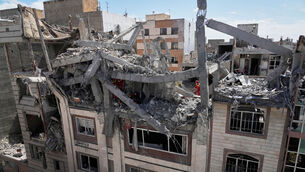
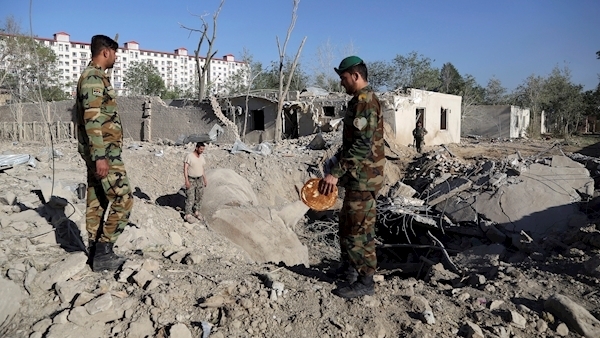
The violence has not abated since, with Taliban attacks killing dozens and injuring hundreds in recent days. On July 1, Taliban fighters killed 40 people in an attack on a government compound in Kabul.
Six days later, a Taliban suicide bombing of a national intelligence complex, in central Ghazni province, killed a dozen people and wounded 180.
In both attacks, buildings were damaged, including schools, and children were killed and maimed.
According to the New York Times’s weekly Afghan war casualty report, the death toll between June 28 and July 4 was the highest so far in 2019, with 264 government personnel and 58 civilians killed.
The conflict shows no signs of ending. Winston Churchill reportedly argued that “jaw-jaw is better than war-war”, but the Taliban have perfected the art of talking while fighting.
They have made no secret of their desire to restore their Islamic emirate, which brutalised Afghanistan from 1996 to 2001, until it collapsed under a hailstorm of US bombs in the wake of the September 11, 2001, terrorist attacks.
With that successful assault on a vicious regime, the US inherited the problems the Russians had tried to solve during their disastrous occupation of Afghanistan from 1979 to 1989.
With the Soviet Union’s departure, Afghanistan was plunged into years of civil war and fratricidal killing, culminating in the Taliban’s takeover and establishment of a strict Islamic theocracy, featuring frequent executions, amputations, and stonings.
Girls were barred from school, and women, forbidden to venture out of their homes without a male guardian, were rendered publicly invisible by the burka.
Cinema, television, and music were abolished. Under the tutelage of Pakistan’s military, the Taliban brought peace to Afghanistan, but it was the peace of the graveyard.
A month after 9/11, the US-led Nato mission, Operation Enduring Freedom, destroyed the Taliban government. The hope was that freedom would endure without a US presence in Afghanistan.
However, with assistance from their Pakistani patrons, the Taliban regrouped and embarked on a well-resourced campaign to take back their country from the occupiers.
Eighteen years later, the US is still there, albeit under a new banner: ‘Operation Freedom’s Sentinel,’ adopted in 2015. The international coalition hasincurred some 3,500 casualties, and many of the countries that had been press-ganged by the US into participating have pulled out.
The US would dearly like to do the same, rather than incurring more casualties, with no end in sight. But to withdraw under Taliban assault would be an admission of defeat.
Now, however, that calculus has evidently changed. Like his predecessor, Barack Obama, US president Donald Trump campaigned on a promise to withdraw American troops from the country.
Unlike Obama, however, Trump is determined to cut his losses, and has embraced peace talks with the Taliban. The purpose is the complete withdrawal of US forces from Afghanistan.
India has watched with concern. The Taliban’s Islamic emirate was involved in the hijacking of an Air India plane to Kandahar in 1999, resulting in the loss of Indian lives and even greater loss of prestige, as India’s government acceded to the hijackers’ demand for the release of three Pakistani terrorists.
The last thing India wants is the return of an Islamist Taliban regime in its neighbourhood.
India’s alarm is understandable. Encouraged by the security established by the international coalition forces, India has invested more than €2bn in Afghanistan.
It has helped build the country’s largest hospital for women and children, erect schools, construct the Afghan-India Friendship Dam (formerly known as the Salma Dam), carve the Delaram-Zaranj Highway across the country’s southwest (to open trade routes to the West), ensure uninterrupted electricity in Kabul, and even build the new parliament.
But no-one in India believes the Afghans are anywhere near ready to manage their security without any international presence. After all, Taliban attacks have killed 1.5m Afghans since 2001.
The fact that the US is talking to the group, and even pressing the Afghan government to do so, without any credible assurances that the Taliban will lay down its weapons, is deeply dismaying, to say the least.
India’s objective has been to stabilise Afghanistan’s democracy and strengthen its civil society, so that Afghans are better able to take control of their own destiny.
This is also why cricket-obsessed India gave Afghanistan’s national team a home and watched, in admiration, as the players demonstrated their excellence at the World Cup. The last time the Taliban ruled, they banned cricket, too.
CONNECT WITH US TODAY



Be the first to know the latest news and updates