Persistence and a political strategy needed to counter IS
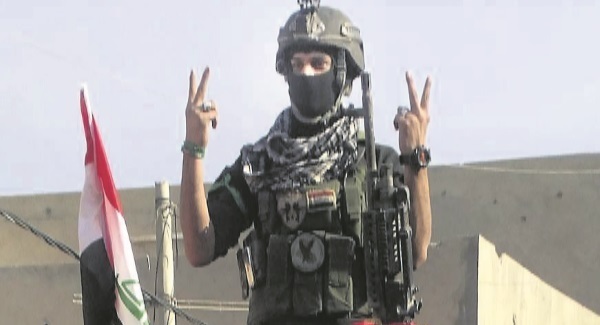
The November 13 terrorist attacks in Paris — which struck at the heart of France and of Europe as a whole— brought the terrorist threat posed by Islamic State (IS) to the forefront of the foreign-policy agenda. For me, the answer to such assaults cannot be to lock our doors and board up our windows. To surrender the way we live, to give up on our open societies, would be to play into the terrorists’ hands.
However, our response needs to be, first and foremost, a political one: More vigilance at home and more intensive co-operation with our partners’ security authorities. We in the West must show resolve in battling the social exclusion that breeds alienation, which implies stepping up our efforts to integrate Muslim and other immigrants at all levels. At the same time, we must tackle the evil of IS in the places where it began — Iraq and Syria.
On the night of the Paris attacks, Germany promised France that it would stand at its side. We decided recently that our responsibility to keep this promise includes a military contribution to the fight against IS.
We all know, of course, that terrorism cannot be defeated by bombs alone. But we also know the threat posed by IS will not be overcome without military means, and that, unless IS is countered militarily, after a year there may be nothing left on which to build a political solution for either Syria or Iraq.
I spent two days in Iraq recently. In the past year, IS has been successfully pushed out of a quarter of the territory it once controlled there. But the most difficult tasks in confronting IS lies ahead of us. Three components are crucial to the success of our strategy.
The first component is support for those confronting IS. Germany’s decision last summer to provide the Kurdish Peshmerga with arms and munitions was not without risk, but it was the right move. In November, also thanks to German support, the Peshmerga liberated the city of Sinjar, where IS carried out horrific massacres of Yazidis last summer. The advance by IS could not have been stopped without the Allies’ air strikes.
Second, we know from previous conflicts how important it is to restore public confidence in areas liberated from IS. That is why we are investing in stabilising these regions and rebuilding police forces, schools, electricity grids, and water supplies. Thanks to German help, more than 150,000 people were able to return to their homes after the city of Tikrit was liberated.
The strategy’s third component is the most difficult to realise and yet the most important. In the long term, the conflicts and chaos that enabled IS to spread in the first place can be overcome only if all population groups in Iraq and Syria have a shared political perspective.
Iraqi prime minister Haider al-Abadi has launched a courageous reform programme to pave the way toward greater participation by Sunnis.
German foreign policy is at the forefront of these efforts. I have had countless ( often difficult) talks in Riyadh, Tehran, Ankara, Beirut, Amman, and Vienna in the last year to help bridge the divide between countries in the region — and thus rein in their proxy forces battling one another in Syria.
I am heartened by the fact that, for the first time, after almost five years of civil war, we brought all key states to the negotiating table in Vienna and agreed on a roadmap for a ceasefire and a political transition process.
It’s too early to celebrate, but there is finally a minimal consensus — shared not just by Russia and the US, but also by Iran and Saudi Arabia — on a way forward to resolve the Syria conflict. The meeting of Syrian opposition groups in Riyadh in December was the first step on this path.
Achieving a political agreement will be a long and arduous journey, and the outcome is not entirely in our hands. Some of the partners who we need on board are pursuing interests different from ours. Some are at loggerheads with one another.
But complaining about the complexity of the situation in Syria is no substitute for action. The fact that some political realities do not fit the friend-foe template cannot be an excuse to sit back and wait until the region’s antagonisms and conflicts resolve themselves — or until there is no Syrian state or institutions left to save.
Successful negotiations to contain Iran’s nuclear programme showed persistent good-faith diplomacy can work. In Libya, too, with an experienced German diplomat at the helm of talks being held under the auspices of the UN, we have the opportunity to find a political route back to an ordered state.
As foreign policymakers, we must face up to reality, with all of its uncertainties, and take responsibility for both our actions and our inaction — even when there are no guarantees of success either way. This makes it all the more important that we are certain of our bearings.
We will not be able to counter IS and the threat posed by Islamist terrorism by pulling up the drawbridge; what we need is persistence and a political strategy that carefully integrates military, humanitarian, and diplomatic engagement.
CONNECT WITH US TODAY



Be the first to know the latest news and updates