Past climate changes as an analogue for our future world
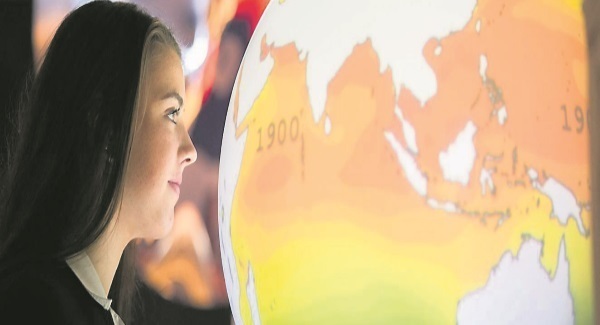
A UN conference on climate change takes place next year, and must learn from the nature of past climate changes, writes Conor Purcell
Past climate changes as an analogue for our future world

IMAGINE the average temperature of Ireland increasing by 10C in just a few decades. This would be an extraordinarily dangerous change, and is much larger than predicted by climate models simulating global warming.

Astonishingly this kind of change has happened in the not-so-distant past on multiple occasions, demonstrating the fragile nature of the climate system in which we live and thrive. Unlike the current increase in global temperatures and sea level, owing to human-induced greenhouse gas emissions, these past temperature swings were due to the natural variability of the planet’s climate itself — but could happen again in the future. This will be outlined to the governments of 190 nations who will convene at COP21 — the UN Conference on Climate Change — next month.

How do we actually understand so much about the nature of past climate changes? The investigation of past climates is performed by combining our raw knowledge of the Earth with modern computational simulation and analysis. Since we have no thermometer readings — no observations — of past weather and climate, lifeless organic and inorganic matter found in ocean sediments and the ice caps are used as climate proxies for otherwise unknown climate details.

A climate proxy is a recorder of past climate states. Well-known examples of these include the width of tree rings as indicators of good conditions for photosynthesis and plant growth, and the oxygen in ice cores as indicators of past temperatures. These planetary sources, along with computer modelling, today allow breakthroughs in our understanding of the changing climates of the geological past, and help us to understand the future.

The extreme and abrupt 10-degree temperature changes mentioned above occurred during the last ice age — approximately the period between 80,000 and 10,000 years ago. Humans occupied a lot of Eurasia during this time, and the sharp temperature shifts acted as an important driver of the migration of people across the northern hemisphere, throughout Europe and Asia, and to the Americas. What is startling about these abrupt climate changes is that, although not human induced, they were caused by relatively small changes, such as slight adjustments in the ice sheet height. For example, they did not require massive Arctic sea-ice melt, like that which we now see annually.

This sends a clear message to us that the climate system can respond massively to relatively small triggers, and could in the future drive massive human migrations which are likely to cause political instability and international tension on a scale comparable with, say, the past two world wars.

Just think of the current European migration crisis. Multiply it by a thousand.

So which particular past climates best represent our future? It depends on which point in our future we consider — 50 years from now, 100 years, 500 years? If carbon emission rates remain as they are today, on an ever increasing trend, our future world will gradually experience steadily increasing degrees of warming which resemble past warm worlds, such as the Pliocene epoch (between 5.3m years and 2.6m years). However, unlike today, there were no human beings back then who had to deal with these massive changes.

Moreover, we know that many past climate changes go hand in hand with mass extinction. In fact the current ongoing mass extinction even has a name — the Holocene extinction — with some estimates outlining that the present rate of extinction may be up to 140,000 species per year. Might the species homo sapiens eventually end up as such a statistic? The answer to that question depends highly on the outcome of COP21 — the UN Conference on Climate Change – meeting from November 30 to December 11, when international governments meet to hopefully grasp a major opportunity: For the first time in 20 years to hammer out a legally binding agreement on lowering greenhouse gas emissions.

Let’s hope they do so, because our current future pathway looks rather bleak indeed. And when they do so, we shouldn’t forget that the science that has guided their knowledge about the future, has relied heavily on insights from the past.

Conor Purcell is a postdoctoral researcher at University College Dublin. He has specialised in both past and future climate change.

x

More in this section

Revoiced

Newsletter

Sign up to the best reads of the week from irishexaminer.com selected just for you.

Cookie Policy Privacy Policy Brand Safety FAQ Help Contact Us Terms and Conditions

© Examiner Echo Group Limited