Where does the future of Europe lie?
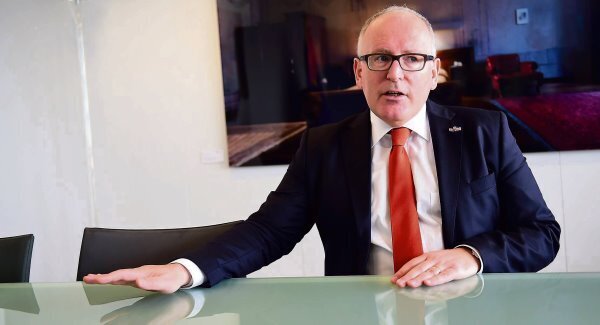
A lot of things are moral issues for Frans Timmermans, the second most powerful person in the European Commission.
He can sound a little like a Catholic bishop as he glides from subject to subject, spreading understanding and empathy. And when he addresses speakers in their own language — he speaks seven — you begin to wonder if he is for real.
But Franciscus Cornelis Gerardus Maria Timmermans has had a very successful career so far and has been judged by Europe’s leaders to be a safe pair of hands, capable of taking over the job of Commission president if the incumbent should decide to leave early.
He is also trusted by those on both the right and the left to keep the EU on the right track, and that includes backing an EU-US trade agreement with a trade court to decide disputes, and putting it up to member states to agree a comprehensive migration policy that includes a fair sharing out of refugees.
The 54-year-old former Dutch civil servant and politician shot to international attention when he made an impassioned speech to the UN after Russia-aligned forces were suspected of bringing down the Malaysian Airlines Flight 17 last July.
A Russian speaker and scholar, he urged all to help bring the bodies of the 194 Dutch nationals home.
His interview with the Irish Examiner was in the context of the annual meeting between the Commission and religious leaders and a second with representatives of non-confessional groups such as humanists and atheists.
“We should not underestimate the moral challenges we face as Europeans,” he begins. “How we organise society, poverty, unemployment, tackle radicalism — is there a link between them, the rise in anti-semitism across the EU, hatred against Muslims — is it linked? Where there are differences you need to analyse it. Talking to representatives helps understand their standpoint.”
Meeting the religious, with their lack of female representation and their less than sympathetic views on LBGT matters, does not mean compromising principles. “We give our view, they give theirs, and that is the only way you can have a dialogue,” he says.
The strife in the Middle East and with Christians fleeing for their lives and Muslim minorities suffering the same fate is a conflict within Islam, he says. “The interesting question will be whether religious moral leaders can develop an Islam that is compatible with the law, human rights — that is going to be a fascinating development to watch,” he says with a nod to Europe’s enlightenment and separation of church and state.
He sidesteps the Sharia issue where that rule of law would not recognise concepts such as the equality of all irrespective of gender or creed. “That is for the Arab world… But in the EU we make sure that law permeates religious law and thinking,” he says.
Talking about the role of religion in society, he refers to his Catholic grandparents, for whom religion was not a choice. “They couldn’t have imagined leaving the Church. It would have been like being an outlaw, out of society completely… To remove themselves from the Catholic Church was almost like a death sentence. This is the same for Muslims but how to get from there. Emancipation should come from inside the community and outside conditions can help.”
His Dutch Catholic forebears isolated themselves, using external factors to justify their isolation, saying Dutch society did not want them, seeking solace in the arms of mother Church that offered to take care of them.
“It took two generations to understand that was not the case,” he says.
He believes it will be similar for young Muslims who will come to understand society and be able to make a more informed choice.
The shootings of the cartoon artists in Paris reminded Timmermans of the observation that man’s capacity to become immune to certain things is limited — such as hatred — with a look back at the atrocities of the Nazi death camps.
Dialogue with religious and non-religious is essential to find a common analysis of the problem.
“In Europe, we have reduced man to an economic factor much too often, and the moral dimension of humanity is always present and not to a debate,” he says. “In politics, discussing the moral, people are a bit uncomfortable.”
But is the Commission being too conciliatory, too aware of populist parties on the rise? Timmermans refutes such a suggestion, recalling his undiplomatic response last month to Hungary’s prime minister Victor Orban over his various plans, and on the Commission’s proposals to deal with migration.
“Give me a better answer and I will listen to you,” he says. “No is not a better answer. It will not solve the problem — we all work in the same political context.”
The near violent reaction to the plan for EU countries to be obliged to take a specific number of refugees, based on a carefully calculated key of population and wealth, was not a surprise, he says. EU leaders agreed the humanitarian crisis in the Mediterranean was unacceptable.
“One minute of silence at the European Council does not mean you want to be silent on the issue,” he says.
“We will have to come up with realistic solutions, it ain’t rocket science. But the Commission will not take back the proposals — it is up to the Council to find a solution.”
It will mean spreading the burden among member states, tracking those as they arrive and sending back home those who do not have a right to asylum. The anti-migrant rhetoric reflects the mistrust of people in the current policy that does not always see people sent home. It will also filter through to the traffickers and would-be migrants that it might not be worth the risk.
He acknowledges that part of the problem is that of moral hazard — the same as with the euro question — do member states trust one another to play their part, for instance in finger-printing and tracing migrants rather than just sending them over the Alps?
The question of Greece, its austerity programme, and bailout loans also has a moral dimension, he says.
“There is a moral issue — in a sense that if the image is constantly confirmed that there is no need for this crisis, that it is the fault of the Finns, Dutch, etc, and the extreme groups gain from this, but it is a misrepresentation of the facts, and if people are in dire poverty as people are in parts of Greece, and people have no prospect of jobs — this is also a moral issue, but there are no quick fixes.”
This danger of seeing things as black and white, the constant criticism of the EU without acknowledging its merits and considering the alternatives, is a danger. Timmermans warns nothing should be taken for granted.
“The fork in the road is never that clear, except in hindsight, but I believe that Europe has an opportunity now. As someone said, a revolution is unthinkable the day before, and the day after we say it was inevitable.”
Timmermans acknowledges that the economic crisis has been extremely difficult, and led many to lose faith in the EU and in the future.
“It is a well-known medical fact that if a person loses the ability to dream he dies,” he says. “Under the crisis,many lost the capacity to dream, to see a future that is bright, that reflects their values and then very quickly you are in the embrace of nostalgia, longing for a past that never was, and dreaming of a future that will never be.
“I believe what we need is to take a step back, look at Europe from a bigger perspective — is Putin’s vision of society an alternative for the Europe? I think not… Is a Chinese type of society an alternative for us? I don’t think so. This triangular position — of democracy, rule of law, respect for human rights is not just for the past but it is also where our future lies.
“But for that to be guaranteed we need to be organised, to stick together and then there is no challenge we cannot face — migration, climate change, and geo-political challenges. If we give Putin the opportunity to tick off one member state after the other we will be weak — and he is trying to. If we stick together we can talk to him at the same level.
“I strongly believe that this idea that our society is based on democracy, which is almost uniquely European and it is of the greatest value, it has brought us the longest lasting peace on this continent and can for the future.”
This triangular position — of democracy, rule of law, respect for human rights —is not just for the past but it is also where our future lies.
CONNECT WITH US TODAY



Be the first to know the latest news and updates