The war to end all wars only led to new conflict
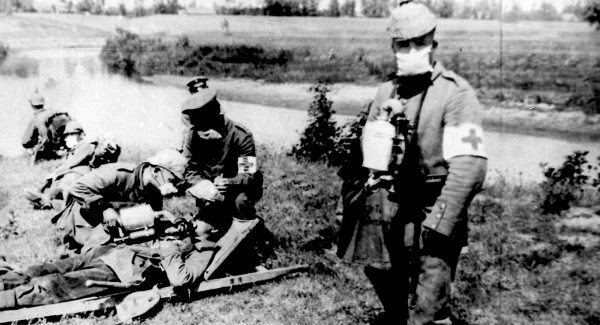
It was to be the war that ended all wars. Instead it was the opening chapter in a new kind of war, one that could annihilate people and place, replace manpower with metal and for the first time employ chemical weapons.
A hundred years ago this week, the German army opened 6,000 canisters of chlorine gas after days of waiting for the wind to blow adequately and in the right direction, suffocating thousands of bewildered French and British troops.
It was a pilot project, an experiment to appease a convinced amateur scientist, with the bottles fixed at the mid-way line of the division between German and allied troops outside the Belgian town of Ypres.
DISCOVER MORE CONTENT LIKE THIS
The green-yellow cloud rolled over the fields towards the two French divisions — Algerian and Brittany. “The major impact was the surprise — they did not know what it was or how to deal with it. And they more they tried to run away from it the worse the effect”, said Franky Bustyn, a military historian who grew up in the area.
The Germans were not expecting the success it brought — breaking the front line that had been in stalemate for months and lengthening a war that was to have been over by Christmas according to those whose idea of warfare was based on the staged battle of Waterloo a hundred years before.
While the French troops retreated, creating a 4km gap in the famous 100km long ‘salient’, the Germans did not have troops to march through to Ypres — and their goal of the coast, Dunkirk and Calais. Some students in the Allied forces identified the gas as chlorine from its smell and that breathing through a wet rag would keep you safe. Soldiers were advised to urinate on a piece of cloth and cover their mouth with it before gas masks and products were devised and distributed.
British, Indian and Canadian troops filled the gap left by the French but for the next two years no ground was ceded by either side, continuing the stalemate. Flamethrowers, stronger gas such as phosgene and mustard was used here too, some for the first time, but to no avail.
A year later as the Easter Rising was under way in Ireland, chlorine gas contributed to the deaths of an estimated 500 Irish soldiers fighting as part of the British army in France.
DISCOVER MORE CONTENT LIKE THIS
How many in total were killed by this new chemical warfare is unknown but official estimates say 1.2 million on both sides were gassed, with more than 91,000 people dying. In the first attacks, a few thousand were affected, according to My Bustyn, but many of the deaths were over months or years as the effect on their lungs and the blisters on the skin gradually took their toll.
“It disabled people and affected them for the rest of their lives — it’s a gruesome weapon against soldiers and civilians,” he said.
Fewer than 1% of the eight million deaths were caused directly by the gas. But it had an indirect effect on battle outcomes as wearing gas masks meant soldiers were immobilised. However, not one single battle was won by the use of gas, he adds.
More than 50 million shells, about 5% of them filled with toxic gas, rained down on this region in just 100 days of the war. One third of them did not explode, instead lying in the sticky mud slowly rising to the surface, turned up by farmers ploughing their fields or unearthed by road and housebuilding.
Local farmers know not to touch them but collectors and others are more foolish. Just a few months ago on a building site nearby, one man was killed and another injured when they decided to try to remove the bomb’s fuse themselves.
Still as lethal as when they were first dropped 100 years ago, the Belgian military are on call around the clock, collecting, identifying, neutralising, sorting and destroying them, and evacuating civilians when necessary.
Safety and security is paramount with soldiers changing jobs ever year and neutralising processes kept secret. It costs €2 million a year to make these devices safe, as they are obliged to under international treaties, according to Lt Col Guy De Decker, who is in charge of the operation.
About a third of the shells are German, a quarter being French and 12% British in this area.
Commander Glen Nollet, in charge in Poelkapells, one of three sites where devices are dealt with in Belgium, says their job will not be complete any time soon. They receive 4,000 calls a year on average to deal with bombs — mostly from the first world war in the Ypres region. Some calls refer to just one device while others could be about multiple finds. In all they deal with about 300 tons a year.
At this rate they estimate it will take another 100 years before all the devices are located and neutralised.
After the wars, countries simply dumped their left-over explosives, in the sea or lakes or buried them on land. They have recovered many of these and have been gradually destroying them — the chemical ones in special chambers and the shrapnel and others by burying them deep in the secure zones and blowing them up.
The process is a long, slow one. X-rays identify what exactly each shell holds and those with toxic gas are destroyed one at a time — no more than 15 in a day.
Belgium has just purchased a new machine for €16.7m that will automate much of the work. It is still dangerous work — a grain of sand contaminated by mustard gas that got into the glove of a soldier recently gave him a burn that took weeks to heal.
Franky Burstyn, who grew up among what was once these killing fields, is not so much interested in the technical aspects of these weapons as he is in their effect on his neighbours and on the countryside. He has written eight books mostly on the topic.
The fields still stretch out, flat and fertile, in this part of Flanders that led to the battle stalemate that claimed so many lives a century ago. Huge tractors, spraying machines and trucks dominate the ploughed fields this month, their verges filled with red, yellow and purple flowers.
There is no hint of the fact that the entire population was evacuated to France, mostly to Normandy, in 1914. The half that returned found nothing to remind them of home — the church that marked the village centre, the copses that gave form to the flat land — all had disappeared, the land turned into a kind of moonscape, he said.
“They came back with nothing and even most of the promised payments to help them level the land did not come through. By 1930 — 12 years later — everything was reconstructed, the fields repaired, the ground cleared, ready for ploughing.”
There is little to remind of the mass destruction a century ago, other than the daily calls to retrieve the latest discovery of the first chemical weapons.