Ancient Assyrians would have understood IS’s methods
WHAT are the benefits of cruelty? This question occurred to me after forcing myself to watch some of the slickly produced propaganda videos of the group that calls itself the Islamic State (IS).
The now-infamous productions often show the cruel killing of helpless captives in the most horrifying ways imaginable. It’s hard not to wonder about the intent of the filmmakers. It’s also hard not to wonder who the target audience is.
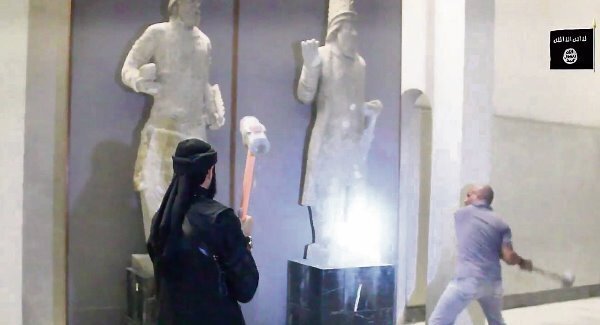
I also watched recent video of IS members in a museum smashing archaeological relics from the very ancient Mesopotamian past. I felt a certain sense of historical irony while doing so. I wondered, as I watched them use sledgehammers and power drills on a 3,000-year-old Assyrian statue, if they realised that they were following the ancient Assyrian playbook as they tried to erase the region’s past.
Within sight of the IS-controlled city of Mosul lie the ruins of the great Assyrian capital at Nineveh. The Assyrians of that era were masters at the art of atrocity marketing. The concept of publicising horrific cruelty to cow and intimidate subjects or opponents has a long history, and only fell out of style relatively recently (and not everywhere). Lacking the 21st-century media tools IS possesses, earlier peoples were forced to use different materials. The Assyrians used stone as the vehicle for their marketing of atrocity.
“I built a pillar over his city gate and I flayed all the chiefs who had revolted, and I covered the pillar with their skin. Some I walled up within the pillar, some I impaled upon the pillar on stakes, and others I bound to stakes round about the pillar… And I cut the limbs of the officers, of the royal officers who had rebelled… Many captives from among them I burned with fire, and many I took as living captives. From some I cut off their noses, their ears, their fingers, of many I put out the eyes. I made one pillar of the living and another of heads, and I bound their heads to tree trunks round the city. Their young men and maidens I burned in the fire.”
That is the boasting of Ashurnasirpal II, an Assyrian king who lived almost 3,000 years ago. He was one of many Assyrian monarchs in the biblical era of history that enforced their rule with almost unbelievable brutality.
The cruelty of the Assyrian Empire’s actions were publicised via text, coloured wall paintings, and carvings in stone. The historian Arthur Ferrill compared them to photos of Nazi concentration camps, and said they had few parallels in history.
Artwork showing the skin being cut off of living captives, the impaling of prisoners on stakes, mass forced deportations of conquered peoples, captives being burned or having their tongues torn out and, everywhere, piles upon piles of human heads are highlighted. One can only imagine what Ashurnasirpal might have done had he possessed video technology.
However, the Assyrians were more the norm than the exception throughout most of world history.
The ancient Romans, for example, also knew how to make a point by marketing atrocities. One of their citizen-generals, Marcus Crassus, famously had the slaves that survived the famed Spartacus revolt crucified along the Appian Way.
The 6,000 victims died suspended on either side of the busy Roman road, at evenly spaced intervals. The bodies were left in place for months. Is this the ancient equivalent of posting horrifyingly violent acts on the internet? Or is it a twisted, bloody version of a modern freeway billboard campaign? It certainly wasn’t unusual. Publicised cruelty was all the rage throughout most of history, and was common in most places until quite recently.
It’s only in the last century or so that public executions, for example, have become rare. Having people view a burning, beheading, or hanging (with or without a torture appetiser) was thought to be something that reinforced law and authority and demonstrated that justice was being carried out.
Often it was thought an edifying thing to have children watch. Had there been video and the internet two centuries ago, would that mentality have supported the idea that it would be good to post such events online for all to see?
This old-style marketing of atrocity and object lessons seems to contrast sharply with the modern approach. In the 20th century, the architects of mass atrocities usually tried to disguise or cover up their cruelty. One can only assume that they felt that human sensibilities had become more refined and that widespread exposure of their deeds would reflect badly upon them.
How would the German public living in the Third Reich have reacted to IS-like, slickly produced films showing the scenes inside a death camp gas chamber while people were dying? Even in a nation brainwashed by state-fostered anti-Semitism, it’s hard to imagine the reaction being anything the Nazis would have considered positive.
The fact that the Islamic State’s marketing gurus feel otherwise is interesting. Perhaps its more evidence bolstering the idea that IS seeks to return to the values of an earlier, much more harsh historical era. If so, we might be seeing a visual and visceral example of what our ancestors might have done with a good TV studio.
If online video existed in the Middle Ages, does the burning of Joan of Arc go viral? Would it go viral today?

CONNECT WITH US TODAY



Be the first to know the latest news and updates