The tide of Russian revolt rolls out again
âFIRST they shot down a Boeing in Ukraine and we thought nothing could be worse and now this nightmare, also a huge crash for Russia,â Olga Riabova, a designer, insists, sitting round a table with her friends under a crystal chandelier in a glamourous Moscow restaurant. âNobody should dare to gun down people by the Kremlin wall â this is unacceptable.â
The night Russian opposition leader Boris Nemtsov was shot, the women and their friends rushed to the murder scene. âWe were so furious, ready to begin a Maidan revolution,â Anastasia Kozhayeva, an illustrator, recalls. âRussia is very much ready for a change but Russians grow cold fast. They should be motivated while they are still angry. See, today we are not so ready for the revolution any longer,â she says, laughing bitterly.
The friends wondered if Nemtsovâs murder could wake up Russia; whether the violent interruption of a passionate and bright life could become a turning point for the realisation that violence has reached a boiling point, both in Ukraine and at home.
The women doubted that Nemtsovâs murder would weaken Putinâs power but agreed his death had shaken up the resistance, which from now on would be just growing stronger, they hoped. Nemtsov was âa hot-blooded, sincere guyâ says logistics manager Elena Gudatsyrenova, âwhose heart hurt for his country, that he loved dearlyâ.
And the womenâs hearts hurt for Nemtsov, a playboy opposition leader, admired for his passionate charisma. They conclude Russia will win its freedom as soon as it grows brave again.
It is an emotional time for the Russian opposition. Whether the Kremlin wants it or not, in the eyes of the public, Nemtsov made it onto the list of âPutin-era assassinated victimsâ.
âHe is just as irreplaceable for our anti-Putin struggle as Anna Politkovskaya was for journalism,â says Vladimir Ryzhkov, a prominent opposition leader.âWith Anna passing away, we stopped understanding what was happening in Chechnya and with Boris gone we have lost the key organiser of public rallies, the key co-ordinator. He was able to pass messages between some of our leaders, who cannot stand each other.
âMedvedev wanted us to participate in conducting reforms of Russia, but Putin put an end to all that co-operation.â
Ryzhkov sweeps away all official suspects suggested by investigators, including Islamic and Ukrainian radicals.
âToo many strange accidents happened at the same time: None of three federal security cameras worked on the light pole above the murder scene. Iâm inclined to think special services were involved in his murder,â says Ryzhkov. He remembers an episode in August 2014, when some activists hung a big Ukrainian flag on the same bridge. Police detained the pro-Ukrainian protesters within seconds.
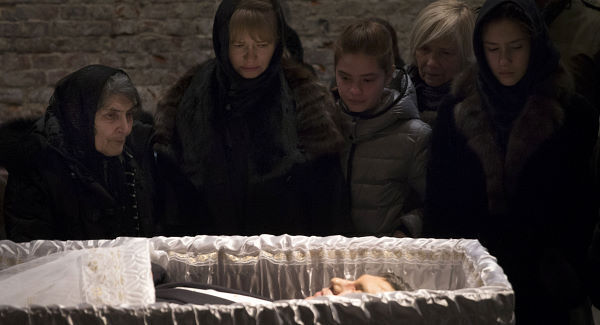
Outside the restaurant, a thick crowd of demonstrators marched against fear. An endless stream of people stretched along Moscow river, carrying âI am not scaredâ signs and âPropaganda killsâ posters, alongside thousands of Nemtsov portraits. Most of the thousands of demonstrators who took to the streets the weekend after Nemtsovâs murder came out in revolt against political terror. They were Russiaâs intellectuals, members of the artistic or business elite.
If Nemtsov were alive, many of them would have ignored the event. âI am one of the many people who wouldnât have joined the march that Nemtsov spoke of organising, hours before he was shot,â says Putinâs former adviser and now his critic, Gleb Pavlovsky.
âBut his cynical murder is a different cause. This is a historical, crucial moment. Nemtsov wanted it to be the turning point and it has become, but the question is where to â there is no good successor to replace Putin.â
An endless stream of people carrying blue-red-white state flags slowly moved under pale, rainy skies towards the Kremlin. The morning after Nemtsovâs murder, many said they woke up in a different country. The Kremlin wall, usually associated with Leninâs Mausoleum and the graves of Soviet leaders is now the place where the blood of the most notorious Putin critic was spilled. It was Nemtsovâs dream to return the Russian tricolour to the opposition.
âIt always upset him that Putinâs supporters used the flag, that he and other democrat leaders rallied with against communists during [80s reform movement] Perestroika,â says Nemtsovâs closest friend in the opposition, Ilya Yashin. âBorya often repeated: âThe one who takes the flag carries it. Our job is to make all his dreams come true.â â
At the weekend, Olga Bychkova, editor-in-chief of Echo radio in St Petersburg, arrived by train to Moscow to pay tribute to Nemtsov. On reaching Kitai Gorod station, she was amazed to see that the queue to get out of the underground stretched from the train doors to the exit. It reminded her of another sad post-Perestroika event that made a difference in Russian thought: The funeral of a famous Soviet dissident and physicist Andrei Sakharov.
âWalking that day in December 1989 to say goodbye to academic Sakharov, we clearly understood that a certain chapter in the history of our country had ended,â says Bychkova. âToday we say goodbye to Nemtsov and look forward to a new chapter again.â
People agree that the scale of Nemtsovâs courage was underestimated when he was alive and now everyone looks up to the âguy with brass ballsâ, as one of his old colleagues, Olga Kurnosova, said recently.
Kurnosova, a key organiser of anti-Putin rallies in St Petersburg, recently fled from Russia to Ukraine after unknown people followed her around three apartments that she changed. But not everyone is willing to give up their lives in Russia and run. âWe must continue the struggle, as the last thing that Boris would have wanted to see is us giving up the fight,â another opposition leader and economist, Vladimir Milov, said in his video message to the opposition, suggesting that they must regroup and plan new strategies.
Demand for change is voiced not only on the streets of Moscow and in restaurants, but also at the offices of some high-rank state officials. Putinâs friend from his FSB past, Victor Ivanov, complains about the ineffective bureaucratic system after recently having sanctions placed on him by the West.
âWe cannot blame America for everything, for our ineffective state system or for corruption,â says Ivanov. âThe process of banning the selling of codeine-based drugs in Russian pharmacies required dozens of letters to various institutions. We succeeded but it took months of waiting for answers.
âIf we improve our economy and system of management, all countries would want to be our allies.â
Ironically, Russiaâs Channel One, which usually ignores the opposition or refers to it as a pro-Western threat of Maidan-type of revolutionaries, not only aired the march for Nemtsov in Moscow, but also recalled all the positive things he did for Russia, as a governor, deputy prime minister, and Duma deputy. And NTV channel cancelled a propagandistic documentary discrediting the opposition. At least for a few days, change visited Russia.
âTo make Russia a happy country, as Nemtsov wished, we all have to come out of our inner exile. It is easy to hide behind his back â he had to clean up all our ugliness for us, like an icebreaker,âsays Anna Stepanova, head of the Nizhny Novgorod Parnas party branch and Nemtsovâs colleague. âBut thatâs it, there is no icebreaker left. We have to make the way for our ships ourselves.â