The crisis that helped change Pope Francis
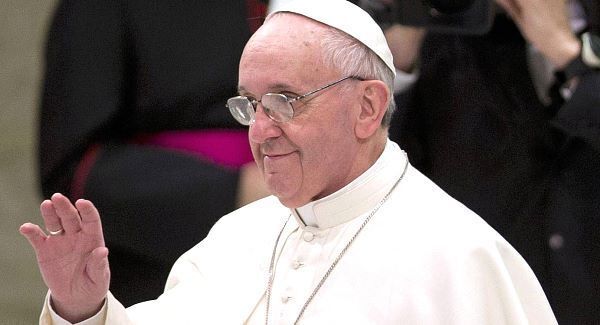
HE WAS not what she was expecting, in several ways. The man who would one day be Pope Francis had come to hold a service far from the grandeur of the great cathedral of Buenos Aires.
He had travelled — taking the subway train and then the bus — to arrive in one of the shanty-towns, which Argentines call villas miserias — misery villages. He had picked his way down crooked and chaotic alleyways, criss-crossed with water pipes and dangling electricity cables, along which open sewers ran as malodorous streams when the rain came. There, amid ramshackle houses of crudely-cemented terracotta breezeblock, he fell into conversation with the middle-aged mother.
She told him of life in an impoverished slum, terrorised by gangs peddling paco — the cheap chemical waste product left over from processing the cocaine sent to Europe and the United States, or sold to the affluent middle classes of the Argentinian capital.
Dealers mix the residue with kerosene, rat poison or even crushed glass and sell it for a dollar a hit to the people of the slums. So addictive is the drug that one day’s free supply is enough to get hooked, creating a short-lived high followed by an intense craving, paranoia and hallucination. The dealers target the children of the poor and adolescents who hang around because there is no work to be had.
The woman looked at the prince of the Church and apologised to him for the fact that her son, amidst all that, had stopped going to Mass. The man, who as Pope was to take the name of Francis — the great saint of the poor — looked into her eyes as though she were the only person in his world. “But is he a good kid?” the priest asked.
“Oh, yes, Fr Jorgé,” she replied, eschewing the grander titles of the cardinal archbishop. “Well,” pronounced the prelate, “that’s what matters.”
At the recent Extraordinary Synod of Bishops of his pontificate, his aim appeared to be to persuade the leaders of the Catholic church to adopt the same approach he had demonstrated to the mother in the slum — and which has characterised his ministry for the past three decades. It is that the care of individuals takes priority over doctrine. “Realities are greater than ideas”, as Francis said in his first major document, Evangelii Gaudium (The Joy of the Gospel), which sets out his prioroties like a manifesto for his papacy.
More than half of the Catholic Church’s leaders voted for changes — in attitudes to gay and divorced people — in harmony with the approach of the new pope. But a minority of conservatives prevented the changes from receiving a two-thirds majority. It seems that Francis has some way yet to go to bring the whole Catholic Church into line with his new inclusive approach.
The grounds on which he chose to wage this struggle for the soul of Catholicism were revealing. There were many pressing items on his list that he might have put before the 250 bishops, theologians, lawyers, and lay men and women he handpicked to attend the synod.
It could have been the reform of the dysfunctional Vatican bureaucracy. Or the sex abuse sandal which has bedevilled the Church for the past two decades. Or how to make the secretive Vatican Bank more accountable. But instead Francis, who has begun to deal with all those issues in other ways, chose a subject which directly touches everyone of his flock: The family. Boldly, it confronted the issue of why large swathes of the faithful chose to ignore official Church teaching on contraception, pre-marital sex, cohabitation, divorce, and homosexuality.
Yet there is more to the notion of family than that for the man who was born Jorgé Mario Bergoglio in Flores, a lower middle-class district of Buenos Aires, in 1936. Though he was by birth an Argentine, the future Pope was raised on pasta and in a distinctively Italian culture and faith tradition.
His grandparents and father had emigrated to Buenos Aires from Piedmont in the north-west of Italy six years before he was born. They had no liking for the dictatorship of Mussolini and their older sons had left a few years earlier.
Jorgé was the first of five children and, to give his mother some respite, Bergoglio’s grandmother Rosa took him to her home nearby every day. His grandparents spoke Piedmontese to one another and he learned it from them, which is why he is fluent in Italian as well as Spanish. His family had no car and could not afford holidays, but the house was filled with relatives, cooking, opera, laughter, and love.
The family’s chief legacy to the boy was its faith. Nonna Rosa told him stories of the saints and taught him the rosary. The family prayed together every evening. It was a religion that rejoiced in popular pieties, processions, novenas, and shrines. Today he retains a special place in his heart for the simple faith of ordinary people.
His mother was angry when she found that he was not studying medicine, as she had been told, but theology.
“I didn’t lie to you,” the future Jesuit responded with the casuistry for which his order has been notorious. “I’m studying medicine — but medicine of the soul.” His mother was so upset she refused to go with him when he entered the seminary three years later, aged 19. It took her years to accept that her notion of family should accommodate her eldest son becoming a priest.
For Bergoglio, the notion of family extended to embrace the Jesuits, the religious order founded in the 16th century by the soldier-turned-mystic Ignatius Loyola. After being taught philosophy and theology by Jesuits at seminary he decided to enter the order who saw themselves as “contemplatives in action”.
The Jesuits in Argentina were riven in the 1960s and ’70s with the arrival of Liberation Theology, which wanted the Church to work for the economic and political enfranchisement of the poor. Progressive Jesuits, including their leader, Fr Ricardo O’Farrell, embraced this. But conservatives wanted to stick to their traditional job of educating the children of the rich. They complained to Rome about O’Farrell and the Jesuit leadership in Argentina replaced him with a young conservative — Jorgé Mario Bergoglio, who was made Jesuit Provincial at the young age of 36.
However, Bergoglio did not heal the split in the Jesuit family. He made it worse with his inexperienced autocratic style. So deep was the division that one senior Jesuit wrote privately, on the eve of the papal election, that a Bergoglio papacy would be “a catastrophe” for the Church, concluding: “We have spent two decades trying to fix the chaos that the man left us.”
So divisive were his 15 years as Jesuit kingpin in Argentina that, when it ended in 1986, he was sent into exile by Jesuit leaders in Rome. He went first to Germany, where the leitmotif of family once again emerged. In a church in Augsburg he discovered a painting that had been commissioned to celebrate the work of a wise old Jesuit who had rescued the failing marriage of a 17th-century Bavarian aristocrat. Entitled Mary Untier of Knots, it showed the Virgin Mary untangling the knots in the long ribbon used to celebrate the wedding of the nobleman and his wife.
The painting spoke to Bergoglio about the tangles he had exacerbated among Argentina’s Jesuits through his inexperienced leadership style which, he later admitted, was hasty and authoritarian and led to him being perceived as ultraconservative. He returned to Argentina only to be sent into two years internal exile in the remote city of Córdoba, 650km from Buenos Aires, where he underwent what he later described as “a time of great interior crisis”.
Bergoglio has always been a man of deep prayer. For many years his habit has been to rise at 4.30am to 5am every day to spend two hours in silent prayer before the tabernacle before his working day begins. It is in that period of prayer that he makes his big decisions, one of his aides told me. He would also in Córdoba have undertaken the set of spiritual exercises devised by the Jesuits’ founder.
At the heart of these is a process of discernment which helps the practitioner to strip away his layers of self-justification and self-delusion, and penetrate through to the inner core of his behaviour and motivation.
What is clear now is that Bergoglio emerged from that spiritual crisis an utterly different man.
He developed a new model of leadership, one which involved listening, participation, and collegiality. When he arrived at his next job, as an assistant bishop in Buenos Aires, the old Bergoglio had vanished. He had transmuted from an authoritarian reactionary into the figure of radical humility who is today turning the Vatican upside down.
Returning to the city of his birth as a bishop meant that Bergoglio embraced an even larger family. He went to the villas miserias and spent long hours with the poorest of the poor. He became known as the Bishop of the Slums.
Over his 18 years as bishop and then archbishop in Buenos Aires, one priest told me, Bergoglio talked personally to at least half the people in his slum. He would turn up, wander the alleyways, chat to the locals, bless their children and their homes, and drink maté tea with them.
“He doesn’t see the poor as people he can help but rather as people from whom he can learn,” said Fr Guillermo Marcó. “He believes the poor are closer to God than the rest of us.”
Many were staggered at the transformation. One of his former Jesuit pupils, Fr Rafael Velasco, who is now Rector of the Catholic University of Córdoba, told me: “Bergoglio had been so very conservative that I was rather shocked years later when he started talking about the poor. It wasn’t something which seemed at the top of his agenda at the time but clearly became so as a bishop. Something changed.”
Over the next two decades Bergoglio transformed the face of the Church in Buenos Aires. He quadrupled the number of priests serving in the slums. He became concerned with the water pressure in the pipes as much as the holy water in the churches. He backed self-help groups, co-operatives, and politicised organisations – exactly the kind of work he had condemned two decades earlier.
The man who was once the scourge of Liberation Theology among Argentina’s Jesuits now helped form a union among the cartoneros — some of the poorest people in Buenos Aires who make a living sorting through rubbish each night to find and sell recyclable materials.
He even embraced much of the economic analysis that had led Liberation Theology to fall foul of the Vatican under the anti-Marxist Polish pope, John Paul II. Bergoglio began to use the language of Liberation Theology, condemning oppressive economic systems as “structures of sin”.
When Argentina became the biggest debt defaulter the world had ever seen in 2001, almost half the population was plunged below the poverty line. Bergoglio responded by denouncing the “unjust distribution of goods”. What the poor needed was not charity but justice.
But if Bergoglio’s contact with the direct poor was making him a political radical — and enemy of the Peronist governments of Néstor Kirchner and then his wife, Cristina Kirchner — it was also affecting his attitudes to the way the Church should minister to people. The hard life of the teeming slums created high levels of unemployment, crime, drug use and prostitution, which brought high levels of divorce, remarriage, and cohabitation.
The future Pope did not alter his doctrinal orthodoxy on matters like the Church’s ban on divorced and remarried Catholics taking Communion. But he did not allow Church doctrine to overrule his priority of pastoral care for the troubled folk he met in the slums.
After Pope Benedict resigned last year, the cardinals articulated two priorities for his successor. He should reform the scandal-hit Vatican Bank and the dysfunctional Vatican bureaucracy known as the Curia. And he should restore a sense of collegiality to the governance of the Church so that it was run by bishops collectively rather than by the pontiff behaving like a medieval monarch.
Francis acted swiftly to reform the bank and the bureaucracy, bringing in teams of top management consultants, sacking ineffectual regulators, and closing over a 1,000 dodgy accounts. He set up a Council of Cardinal Advisory as a counterweight to the Curia; its members came from every continent, and included conservatives as well as moderates, but all had in common that they had previously been fierce critics of the Vatican’s haughty centralism.
The Pope could have simply announced he was delinking the practice of receiving Communion from the doctrine of the indissolubility of marriage. Instead he began by sending out a questionnaire to ordinary Catholics asking their views on church teaching on contraception, pre-marital sex, cohabitation, divorce and homosexuality. It was an unprecedented move.
Next he made the responses — many of which were highly critical — the basis for the agenda of the Synod discussions. Then on the eve of the Synod he announced that discussion must be frank and fearless — the opposite of the climate under previous popes where dissent was discouraged or supressed.
He got what he wanted. There was free and fierce debate between liberals and ideological conservatives (the most strident of whom, US Cardinal Raymond Burke, has been going round claiming that the Pope is about to sack him from his post as the Holy See’s most senior canon law judge). Pastoral conservatives have divided between the two sides. Yet the vote on welcoming gays failed by just two votes to get the two-third majority.
Change is clearly on the march. A series of documents were drawn up – an interim report, small group reports and a final report which was less welcoming to gays and the divorced than Francis wanted. These are now the subject of a year’s intense debate. Then there will be a larger Synod on the family next October after which the pope — who concluded by warning against “hostile rigidity” by traditionalists and “destructive good will” by liberals — has the final word.
It could get rather messy. But then family life is like that. And Pope Francis is, above all else, a family man.