Leinster House finally awakens to plight of homeless
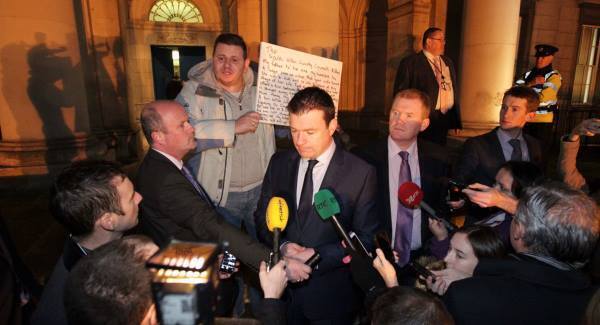
HEATED talk about belated action inside the Dáil sparked by concern for a cold corpse found outside it.

Leinster House finally awakens to plight of homeless

The death of rough-sleeper Jonathan Corrie, atop steps across the road from Leinster House’s gates, was just too close to political power for people to ignore, tut how awful it was, and move along — like we all did, after we heard that 700 children were homeless last month.

When asked about that, at the time, Environment Minister, Alan Kelly, who has special responsibility for housing, said it was “unacceptable” — but he is the one accepting it.

A few weeks on, the number of children in hotel rooms and emergency accommodation has increased to 800 — 680 in Dublin— as a grim Christmas looms for them and with little hope of a brighter new year.

As the death of Mr Corrie dominated the Dáil, Taoiseach Enda Kenny cut an uneasy, awkward figure in the chamber, as he insisted that funding was not the only issue; addiction and mental-health problems exacerbated the situation and some people wanted to be on the streets.

Does he seriously think any of those 800 children want to be in a cramped B&B?

Surely, homelessness may be the cause of mental-health issues for some of those children in the future?

Rough-sleeping has increased worryingly in the past two years, with 160 people on the street in Dublin.

In Cork, the Simon Community recorded a huge rise, to 174 rough sleepers in the city, during 2013. Finally, Mr Corrie’s death has forced action, and a pledge to get people off the streets and into emergency accommodation within three weeks, but why did it take so long?

And what then?

Do not fear, Mr Kenny insisted in the Dáil, because hope is coming — the only problem is that it’s going to take five years to get here.

That is when the Government plans to have upped building to provide the number of flats and houses needed to eradicate long-term homelessness.

But it will be at least 18 months before the first of these units is habitable, and a half-decade before we reach the target — and, given this Government’s record of incompetence and slippage, who knows when that day will actually arrive?

Leaving aside the obvious question of why it has taken four years for this Government to wake up to the basic idea that the building of social housing is both good for society and an economic driver out of recession, what is supposed to happen in the meantime?

Many of the children forced into homelessness are there because their parents were priced out of the private housing market, due to spiralling rents.

Mr Kenny turned a tin ear, in the Dáil, to pleas to amend the rent-supplement scheme and increase its cap, which has been out-stripped by price inflation.

Focus Ireland is among those demanding action: they dealt with 45 homeless families in October this year, compared with eight families the same month last year, and say that the impact of homelessness on a child is often far greater than on an adult.

But Mr Kenny just shrugged his shoulders and said that if the rent cap went up, then so would rents.

Well, what about rent controls? Claims from the private sector that they would be unconstitutional? Well, what about a referendum?

Mr Kelly says the system is under review and there is leeway for agencies to negotiate with landlords, but the grim evidence of priced-out tenants suggests this is patchy at best.

At least it is a boon for the cheap hotel and B&B industry, as more families are evicted and must exist in whatever emergency accommodation is available.

But, as with the slow-motion medical-card withdrawal scandal, why does it take the Government so long to wake up to unnecessary hardship on its watch?

Hardship for children, but those other juniors — junior bondholders — have gotten an early Christmas wink from ministers.

The bond-holder boys and girls are, once again, gathering to feast on the rotting carcass of Anglo.

As we remember from the crash course in economic-crash talk we all went through, as the last Government flushed €25bn of our money down the Anglo toilet — and this administration welshed on its election pledges to stop the rot — the junior bondholders are the biggest, most reckless cowboys of casino capitalism, and often invest with no collateral, and are thus left to the back of the queue for a pay-out if the company they hoped to make a quick killing on goes bust.

When it was announced that Anglo, and Nationwide, renamed as IBRC, were to be liquidated last year, the Government assured us it was “unlikely” the juniors would get any cash from the ashes.

Now, suddenly, Finance Minister Michael Noonan has been adopting a different tone, as he blithely told the Dáil the wind-up had gone so well there was now a surplus and, if the junior bondholders had a valid case, they would be “legally entitled” to money, so long as there was some left after other creditors were paid.

UK and Irish juniors have to apply by March 31, and the opposition was quick to note this is unfortunately close to the issuing of the first water bills at the beginning of April.

Yes, you will be hit with the ‘tap tax’ from April Fool’s Day onwards, and — just look at that — at the same time that junior bond-holders will be seeking to suck up to €280m out of Anglo, the Government will be moving to lift almost the exact same sum, €275m, from households via the water-charge regime.

Despite the fact that any junior bond-holders who get some of their money back will not actually get it until much later, the juxtaposition of the application deadline and the bills has been seized-on by the anti-water-charge movement and will be used to add more fuel to the fire of rage they hope to ignite outside Leinster House, at a mass rally, next Wednesday.

That rally will pass the make-shift memorial to Mr Corrie, which was put in place by well-wishers on the spot where he died.

There is nothing like having to step around the body of a dead man to focus TDs’ minds on the homeless.

But if Jonathan Corrie had not died on the ornate steps of a Georgian building across from the Dáil, would we ever have heard his name at all?

And, despite the fact he died where he did, how many of us will remember his name this time next week?

More in this section

Revoiced

Newsletter

Had a busy week? Sign up for some of the best reads from the week gone by. Selected just for you.

Cookie Policy Privacy Policy Brand Safety FAQ Help Contact Us Terms and Conditions

© Examiner Echo Group Limited