Does the rise house prices mean we are headed for another property bubble?
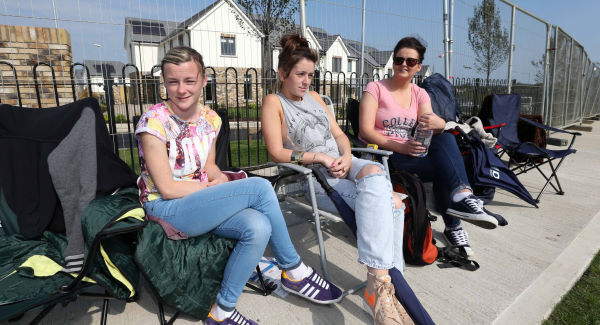
DEJA vu, anyone?On Thursday, the front pages of national newspapers covered a story most felt had been consigned to the pre-recession era.
Despite still being in the grips of austerity and recession, people were queuing four days early for the chance to buy a home in a new development in Swords, north county Dublin.
While their tents and sleeping bags caught the national eye, the crowd — which ultimately amounted to no more than a dozen — was far smaller than the initial shock suggested.
However, the underlying issue which brought them out was still clear: Ireland, the land which was almost destroyed by a boom and bust property crisis, is obsessing again over... property.
The spectre of rising prices and the apparent need to snap up “bargains” costing hundreds of thousands of euro has all the hallmarks of a questionable reboot of the Celtic Tiger price bubble.
However, while the development has grabbed public attention, the 2014 version of the issue has one key difference at its core: although at a national level property and rental prices are surging forward, the total figures are being skewed by a supply-and-demand problem which is currently most felt in Dublin and a small number of nearby commuter counties as well as pockets of Cork.
And while the capital is where the problem is most apparent, experts believe other areas will soon face a similar “uncomfortable boom” dilemma.
Detailed figures provided by property website www.daft.ie from the end of July show that, nationally, house prices have risen by an average of 9%, or €15,431, in the past 12 months.
However, the rate does not provide a true account of the situation, with Dublin’s average rate increasing by 21.2%, or €50,285, during the period, compared to a 0.7% (€1,134) average rise in all other cities and declines of 1.7% (€2,504) and 4.4% (€5,483) in Munster and Connaught.
As the county-by-county changes show, all six Dublin areas have witnessed a 15.9%-24.6% (€32,631 to €82,194) house price rise in the past 12 months — and are up 17%-37.8% (€34,698 to €121,299) from their lowest point since the recession began.
However, in the remaining 29 areas examined — 25 counties and four cities — 16 have suffered year-on-year price declines of 0.3%-8.7% (€394 to €10,881).
They include 12 of the 16 areas outside Leinster — such as Limerick City, where prices remain at their lowest since the crash — with only Cork City, Galway City, Galway county and Leitrim reporting marginal rises.
Of the 13 non-Dublin areas to witness an increase just one — Wicklow (13.4%) — has reached double figures, with almost all of these locations being traditional commuter belts to the capital.
Speaking to the Irish Examiner, University of Limerick economist Dr Stephen Kinsella explained, the current property rise news is linked directly to a Dublin and nearby areas market where supply is poor, with less than 0.5% of properties for sale being unoccupied.
As such, he said the only way to view the issue fairly must be from the perspective of a housing shortage in that region instead of through the frame of economic recovery or a carbon copy repeat of the Celtic Tiger-era bubble.
“What’s driving the house prices [in Dublin] is demographics, so for example people in their early 30s looking for houses near schools.
“That is a niche demand in a region where there is low supply.
“So in a sense the rise has nothing or at least very little to do with employment or an improving economy; if you go back on the job market after a period of unemployment the first thing you might buy is a car, not a house,” he said.
The view is shared by www.daft.ie managing director, Kieran Harte, who said the current rising trend in Dublin and the surrounding area is not a repeat of what has happened in the past.
While the property specialist said small rises are apparent in some other counties, he warned that any disproportionate increase in property prices in other parts of the country not affected by supply issues in order to keep up with the Dublin trend could spell trouble for hopes of a stabilising economy.
“The last bubble was created by access to credit, every man and his dog could get a 100% mortgage. But now it’s about supply, and in a specific area,” Mr Harte said.
“The current rise is a bit unhealthy because the actual volume of houses being sold is not anywhere near as dramatic, so it is a very different scene to what happened before.
“The Dublin rises are to do with supply and demand and to a lesser extent an improving jobs market. But for your Waterfords and Limericks, the same issues are not there,” he said.
While the current rise is focussed on the capital and to a lesser extent the surrounding counties, that is not to say the same issue behind the surge in prices will not become apparent elsewhere.
Having examined the figures, leading expert Dermot O’Leary, chief economist with Goodbody Stockbrokers, said the supply issue at the heart of the current Dublin price rises is also apparent in Cork city and Galway city.
While these two areas have yet to see any rise in prices other than a sensible, staggered growth in the past 12 months, he said in both locations approximately 1% of property for sale is vacant — meaning unless action istaken now a near identicalproblem is imminent for the cities.
“It is not as if it is Dublin, and then the rest of the country is an homogenous area. Cork City and Galway City are starting to show the signs Dublin showed in 2012 and 2013, and the real story in all this for me is that these two areas will see the same situation in about 18 months,” he said.
“Some areas, like the border and north west, are still way over-supplied [with unsold homes] so there isn’t any real increase in prices.
“But in Cork and Galway cities the excess vacancy rate is a lot lower.
“The problem is there’s very little property stock still available in those locations. So I would say within 18 months you will see the same property price increases and demand problems currently in Dublin happening in Cork city and Galway city,” he said.
Goodbody has described the current Dublin situation as an “uncomfortable boom”, as it is based on not enough properties being available and new home builds running at a third of what is required.
Speaking on RTÉ on Wednesday, Tánaiste and Social Protection Minister Joan Burton said the “critical” issue that now must be examined “to increase supply in terms of social and affordable housing” in order to keep house prices sensible.
Mr O’Leary agreed, saying any such plan should involve more Nama properties being placed back on the market and increasing new home builds from the current 10,500 a year rate to 30,000.
He said a similar move must also be considered for Cork City and Galway City in order to address the problem before it becomes apparent.
“Property markets and individuals’ income are very rarely in equilibrium. Economists talk about this as ‘development lags’, and in this case that means you have to address demand now before the market moves.
“Someone needs to come in to fill up the gap.”
A highly focussed construction strategy in a small number of key areas, he said, is now needed to ensure the property market does not spin out of control again.