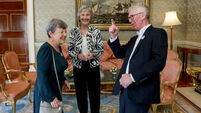
Breaking the mould to stamp out racism

He remains modest about his achievements, but Imran Khan’s tireless work to combat racism in England was groundbreaking, writes Dan Buckley

Breaking the mould to stamp out racism

IF YOU happen to be chatting with Imran Khan, make sure he’s the right one. Don’t make the embarrassing mistake of the CNN reporter, who interviewed the young Bollywood heart-throb thinking he was the 59-year-old Pakistani cricketer-turned-politician, noting “you look very young for your age”.

In fact, there are three notable Imran Khans and, says Imran Khan — lawyer and human rights campaigner — there are even more than that but he doesn’t want to confuse me. In return, I promise not to confuse him with either the heart-throb or the cricketer — although with a pleasing countenance, a Pakistani’s passion for the sport, and being a natty dresser, he could pass for both.

This particular Imran Khan is very much his own man and doesn’t think he is any way remarkable, despite having done more than any single individual in the past 20 years to challenge ingrained racism in Britain. That’s not false modesty, but a genuine puzzlement at the global reaction to his work on the Stephen Lawrence case in England.

He had just arrived in Cork from London to share with students, faculty, and the public at University College Cork his experience of combating racism.

The event was organised by Cork Against Fascism, a campaign group made up of UCC students, staff and members of the public, which formed in response to a since-rescinded invitation to Nick Griffin, leader of the extreme right-wing British National Party, to speak at the university.

He is a fan of the other Khan, the celebrated cricketer and politician, and bemused by the fact that the feeling is mutual.

“I was surprised to learn he had been following my career. I think what he has achieved, both in cricket and in politics, is fantastic. As for me, I was just doing my job and happened to be in the right place at the right time.”

That place was London and the time was 1993, but it is hard to imagine it as the right time. It certainly wasn’t for Stephen Lawrence, the black teenager from south-east London who was murdered by a gang of white youths while waiting for a bus.

The attack took place on Thursday, Apr 22. The following day, Khan got a call at his office in West London, where he ran a defence solicitor’s practice dealing with ethnic minorities.

“I remember everything about that day, even the weather,” he says.

“An anti-racism group rang up a colleague of mine, a barrister I had dragged in to give free advice to clients.The last thing I wanted to do was go all the way to South East London. The traffic alone would be a nightmare and, anyway, I had a desk full of work in front of me.”

He decided to divert interest by suggesting he could not come at once but would be available over the weekend.

Fate had other ideas.

“I thought I would hear nothing more but the following Sunday I found myself outside Stephen Lawrence’s house. I rang the bell and a young girl put her head around the door and said the Lawrences were at church. I thought ‘thank God’ so I decided to wait in the car for a respectable length of time, to say I tried, but then along came the Lawrences from church and I was stuck with the case.”

He learned later that Stephen Lawrence’s father, Neville, a carpenter, chose him because he never spoke about money. Neville’s first choice of solicitor spoke about little else.

“We sat in the bedroom and talked about the murder and then Doreen, Stephen’s mother, put her head around the door. That was the start of 20 years’ involvement with the Lawrences and, looking back, I feel honoured and privileged to have been a part of that.”

In 1993, there was no such animal as a “human rights lawyer” — it seemed like a contradiction in terms. Institutional racism was rife, not just in Britain but in many Western democracies. It showed itself in politics, the police, the prison service — almost any state institution with power. Bucking the trend then was fighting an uphill battle.

“I like to think you can make a difference,” says Khan, who sees educating the young as key to changing attitudes.

“Growing up, my parents wanted me to be a doctor, but I became a lawyer because I could see there was a justice gap. I wanted to bring the community into the courtroom. I remember as a young man sitting in the public gallery at the Old Bailey and seeing how Asians and other minorities were being represented and thought there must be a better way.”

Born in Karachi, Pakistan, Khan came to Britain in 1968 and suffered his fair share of taunts and racial bullying as a youngster. However, he feels a stranger in his homeland.

“I have always been very well treated in Pakistan and the press there, in particular, have taken a shine to be me because of my work, but England is my home and I sometimes feel like a tourist in the country of my birth.

“In fact, I feel like a tourist in both places.”

His childhood experiences informed his desire to combat prejudice but he was never interested in retaliation.

“It was never about getting my own back or conducting a vendetta but my experience certainly made me sensitive to race issues.”

For him, there is a major difference between racist thought and racist action. He abhors both but would only proscribe the latter. He supports the view of Martin Luther King who declared: “I cannot change what you think of me, but I can change what you do to me.”

Lawrence timeline

Stephen Lawrence (Sept 13, 1974 — Apr 22, 1993) from south-east London was murdered in a racist attack.

* Apr 22, 1993: The 18-year-old is stabbed to death in an unprovoked attack by a gang of white youths as he waits at a bus stop in Eltham, south-east London, with his friend Duwayne Brooks.

* Apr 23: Police arrest Neil and Jamie Acourt, David Norris, Gary Dobson, and Luke Knight, and search their homes. Neil Acourt and Luke Knight are identified by Duwayne Brooks as part of the gang responsible and the pair are charged with murder. They deny the charges.

* July 29: Charges dropped for lack of evidence.

* Sept 1994: Private prosecution launches by Stephen’s parents, Doreen and Neville Lawrence, with the aid of solicitor Imran Khan.

* 1996-1999: Private prosecution fails as judge rules ID evidence inadmissible. An official inquiry into the handling of the case follows and finds the Metropolitan Police is institutionally racist.

* Nov 2007: Police confirm they are investigating new forensic evidence after a police review.

* May 18, 2011: After the scrapping of the “double jeopardy” rule, Gary Dobson and David Norris to face trial over the murder of Stephen Lawrence following a review of forensic evidence.

* Jan 3, 2012: Dobson and Norris are both found guilty of murder at the end of a six-week trial into the death of Stephen Lawrence. During the trial, the court hears that microscopic evidence found on clothing belonging to the accused links them to the murder. The jury takes two-and-a-half days to reach its decision. Both men receive life sentences.

More in this section

Revoiced

Newsletter

Sign up to the best reads of the week from irishexaminer.com selected just for you.

Cookie Policy Privacy Policy Brand Safety FAQ Help Contact Us Terms and Conditions

© Examiner Echo Group Limited