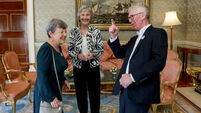
Blair’s man hails peacemaker Bertie, but not some of his ‘green’ advisers
Across the water, almost all the attention was devoted to a couple of throwaway lines in the final pages of Great Hatred, Little Room about the need to keep lines of communication open between governments and terrorist groups.
If Powell had confined himself simply to Spanish, Palestinian and even Afghan examples, the British Establishment would have nodded sagely. The inclusion of Osama bin Laden’s outfit in the list of organisations that must be met with a political — as well as military — response caused all hell to break loose.
“It is inconceivable that Her Majesty’s Government would ever seek to reach a mutually acceptable accommodation with a terrorist organisation like al-Qaida,” one official source was quoted as saying, a mite snootily. Such protestations should probably be taken with a big pinch of salt given Britain’s record of saying one thing and doing another in these situations.
In Belfast, Powell has elicited predictably parochial commentaries having succeeded in annoying both Sinn Féin and the DUP. The former have got into a lather about Powell relating a private conversation with Martin McGuinness in which he queried why Whitehall had acceded to a vastly expensive Bloody Sunday public inquiry when a simple apology would have satisfied the republican base.
Perhaps Sinn Féin are playing a sophisticated game. Any republican worth his salt would be more concerned about Powell’s recollections of the first meeting with the Provisionals in 10 Downing Street when Tony Blair apparently impressed on Adams and McGuinness that there was no possibility of a united Ireland. Strikingly, according to Powell’s account — and he was there at the meeting — Adams did not demur.
At the other end of the Northern spectrum, the Paisleyites (if we can still call them that) have been rumbled.
Powell makes several references to a DUP-Sinn Féin ‘back channel’ at a time when Paisley and Co were still claiming publicly that their only line of communications with ‘the Shinners’ was via the two sovereign governments.
RTÉ’s Tommie Gorman has refused to comment on speculation that he was the link man and it remains to be seen if much damage has been done to the DUP’s credibility. It’s probably safe to say that if more unionists read books, it would cause a greater stir. Perhaps because the Irish book market is so small, few Dublin politicians and senior officials put pen to paper as is the British habit. Consequently, remarkably little is known of the views towards the North inside the State apparatus and only when the official papers are released years from now will we know the full story — if then — but Powell gives a few intriguing clues.
Bertie Ahern, for one, can relax — or could if he didn’t have the Mahon Tribunal to worry about. The Taoiseach is lavished with praise: “There would have been no agreement in Northern Ireland if it had not been for his unadorned commonsense... He had no complex about the Brits, and never tried to see a conspiracy where there wasn’t one.” In Powell’s estimation, Bertie took risks and made considerable personal sacrifices for the sake of peace.
Occasionally, the Taoiseach became depressed about the Northern parties’ endless capacity to get bogged down in minor details and a day-long sulk with Tony Blair is recorded, but the strength of the Taoiseach’s personal and political relationship with the then British prime minister is referred to again and again.
On more than one occasion, Powell concedes Bertie’s judgment was superior to Blair’s, such as when he counselled against the two leaders descending on Belfast in late 2003 when the Taoiseach’s instinct was that the IRA would bowl short on decommissioning yet again.
The Taoiseach was also one of the first to realise that 9/11 had implications for our homegrown terrorist groups.
But if Tony and Bertie “hit it off immediately”, the same cannot be said of their respective kitchen cabinets. On the few occasions that I had dealings with Powell, I found him taciturn in the extreme, always unwilling to divulge new information. It’s the same in his book: he doesn’t do ‘kiss and tell’.
Nevertheless, the very occasional shaft of light is cast on Irish officialdom. Paddy Teahon, head of the Taoiseach’s office until 2000, was “peppery” and “aggressive”.
In the final week of the Stormont negotiations leading up to the agreement, the Taoiseach was prepared to work from a UUP proposal for the North-South bodies rather than allow the talks to collapse, despite “pressure from his own delegation”.
Later that week, Teahon and Dermot Gallagher, who was to succeed him, were still “unhappy” according to Powell and tried to unpick the deal. “Tony completely flipped. He shouted at all of us and was mildly impolite to the Irish.”
The Taoiseach saved the day at the price of a meeting with a furious David Trimble in which the latter was “appallingly rude”, almost causing the Taoiseach to hit him.
A pattern emerges from Powell’s book of the politicians in Dublin having to “override” the system to rein in their supposedly scrupulously neutral civil servants. A good example was in February 1998 when the IRA had killed a number of people, but officials “gave us (the British) the run-around” and tried to block Sinn Féin’s expulsion. The Taoiseach was firmer: they had to go. On another occasion, Teahon went to London with a particularly “preposterous proposal from the IRA” because, Powell supposed, he wanted a success before his impending retirement.
POWELL provides compelling evidence that Irish officials sometimes underestimated, for whatever reason, the terrorist threats from PIRA and RIRA. The Taoiseach was being told one thing, but the reality was sometimes quite different. For instance, Dublin officials regarded as “waffle” British intelligence reports that the IRA was still engaged in violence and criminality in 2002. That was before the Northern Bank raid and the murder of Robert McCartney.
The Taoiseach was not always right: Powell claims he was extremely doubtful that the DUP would ever share power. Yet the overwhelming sense is of politicians doing their best, seeking pragmatic solutions rather than holding to traditionalist stances and calling a spade a spade when necessary. Their servants, with honourable exceptions, were a different matter, if Powell is to be believed.
Powell never accuses anyone directly of having deep green tendencies, although some queried why Blair, once elected, sought to give unionism stray guarantees on constitutional matters despite this being the keystone of the agreement.
The implication is, however, very clear: at times the peace process could have come unstuck because one or two characters in the Taoiseach’s department and the Department of Foreign Affairs were desperate to get one over ‘the Brits’ if at all possible.
In fairness, some Irish officials could doubtless tell horror stories about British ‘securocrats’ and would plead they were merely trying to keep Sinn Féin on board.
CONNECT WITH US TODAY



Be the first to know the latest news and updates