Clodagh Finn: How a green suitcase found under a bed returned the ‘Irish Chekhov’ to the world
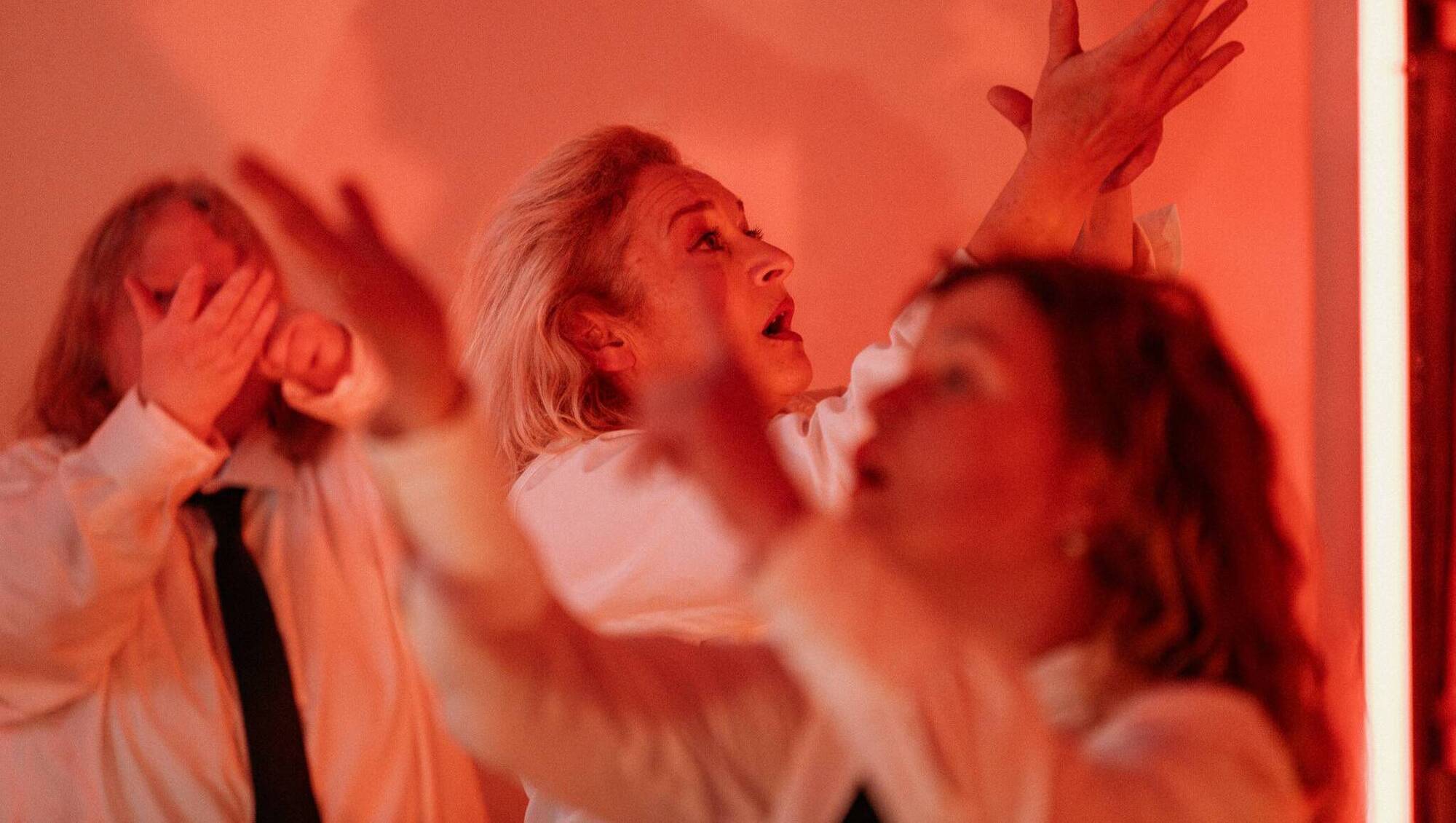
'Dignity', written by deaf playwright Teresa Deevy, performed at Cork Midsummer Festival this year. Picture: Jed Niezgoda

Many adjectives have been used to describe the deaf playwright Teresa Deevy: ‘The Irish Chekhov’, ‘epoch-making’, ‘acclaimed’, and, in more recent years, ‘lost to history’ and ‘forgotten’.
Happily, we can scratch the last two from the list because this once widely celebrated Waterford woman — “Miss Deevy may be a genius,” the Observer critic wrote in 1936 — is now firmly back in the public consciousness.
It is unlikely that she would ever have been entirely forgotten, but the retrieval of a green suitcase full of scripts kept under the bed in the spare room of her home in Waterford has helped to reintroduce an important Irish playwright to an international audience.
It was quite something, for instance, to see her work produced and feted by the famous Mint Theatre of New York in 2010. At the time, the hailed her as one of the “most prolific and acclaimed female playwrights in the world”.
Closer to home, she is very much in the ether too.
Read More
Just last week, audiences at Dublin Theatre Festival were invited to venture into a world entirely beyond the reach of sound, in a thought-provoking and deeply moving reimagining of , one of Deevy’s best-known radio plays.
The story is told through Irish Sign Language (ISL), which is a joyful about-turn given that the playwright herself wrote to RTÉ in 1939 to ask if she could watch the actors perform it in studio, as she wouldn’t be able to hear it when broadcast.
She “listened” to other radio plays by watching the reactions of those who could hear them.
All of the senses, for hearing members of the audience at least, were engaged in this latest iteration of , an extraordinary piece of theatre presented by artist and performer Amanda Coogan, created with Lianne Quigley, Alvean Jones, and Dublin Theatre of the Deaf.
In June, the same trio collaborated with the Cork Deaf Community Choir at the Cork Midsummer Festival.
It is not often that an audience is invited to imagine what it is like to live without sound.
If it is disorienting and challenging, it is also eye-opening and uplifting to witness the “rich choreography” of ISL, as the promo rightly describes it, fill the radio studio/auditory centre set which is fashioned out of cardboard and rope.
Could I make sense of it all?
Only partially, helped in no small measure by the notes that are passed back and forth to the audience describing the plot of Deevy’s original play. Central character Mary Hally persuades her reluctant lodger to listen to the account she gave a newspaper man of a violent encounter with the Black and Tans and her first love.
“Leave your mind free to follow my words,” she says, an ever-pertinent line, given that we rarely do either.
Whatever part of the narrative is lost in this telling is gained 100-fold in the emotional impact of witnessing it through a very different perspective.
In one haunting scene, we are shown the unimaginable difficulties faced by deaf people learning how to speak in an auditory centre.
The scene is a deviation from Deevy’s script, but not from the spirit of her work, which focuses on the experience of women on the margins fighting against social conventions.
This adaptation, as Amanda Coogan put it, “aims to investigate themes of exclusion, identity, power, and self-worth through the lens of deaf experience”.
Add to that, struggle. ISL was not legalised until 2017 after a hard-fought campaign by some of the people in front of us on the stage.
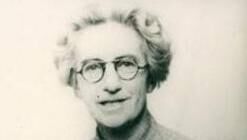
Deevy did not sign, but she did learn to lip-read after she was deafened by Meniere’s disease while studying for an arts degree at University College Dublin. She left college in 1913, but didn’t give up.
She moved to London and spent hours in the theatre. She read the scripts beforehand and then watched carefully as actors performed her favourite playwrights: Chekhov, Ibsen, and Shaw.
She resolved to write plays herself and did so, at first, under the penname DV Goode.
“I had this great impulse to write, to communicate what I was seeing and what I was thinking. I read people through my eyes, not my ears,” she wrote.
This column has already celebrated her later success at the Abbey Theatre in the 1930s. The national theatre produced six of her plays, in consecutive years from 1930 to 1936, and then the commissions abruptly stopped.
That is when she turned to radio, a medium completely inaccessible to her. And yet, she wrote plays for Raidió Éireann and BBC Northern Ireland — as well as reviews, articles, and short stories for a variety of publications.
At this time, she lived with her sister Nell in a flat on Waterloo Rd in Dublin. She led an active and full life, cycling around the city and travelling alone to Europe, at a time when most Irish people didn’t have a passport.
When at home, she and her sister played host to a variety of writers and artists.
Waterford playwright and writer James Cheasty offered this insight: “Although completely deaf [Teresa] was a great conversationalist. My replies were transmitted to her by Nell whom she was able to lip-read.
"Nell was really Teresa’s ears and when Nell died a few months later [in 1954], it was the greatest blow dealt to Teresa in her life-time. But she bore it with characteristic heroism.”
She continued on, but this time from her native Waterford. She moved in with another sister, Frances, who was also deaf, and continued her involvement with local drama until shortly before she died in 1963.
Then somehow, the memory of her heroism and her singular writing talent faded.
If the business of forgetting is difficult to pin down, thankfully, we have very many signposts on how the life and work of Teresa Deevy were retrieved from oblivion.
There was the green suitcase’s rich contents. A grand-niece, Jacqui Deevy, then generously donated them to Maynooth University. You can access that collection online, as I did, and read a draft of the original .
In 1995, Judy Friel directed a production of Deevy’s in the Peacock in Dublin; and five years later, Jonathan Bank of the Mint Theatre rediscovered and produced the very play that the Abbey had turned down in 1936, .
Around 2013, Lianne Quigley, artistic director of the Dublin Theatre of the Deaf and co-creator of , heard Chris Morash of Trinity College Dublin, and Jonathan Bank from the Mint Theatre, talk of their re-discovery.
She was buoyed up by the rarest of finds — an Irish deaf artist — and that was the starting point for a series of inspiring collaborations that draw on the deep well of Deevy’s work.
There is also a free-to-access book of essays: , edited by Úna Kealy and Kate McCarthy.
In the introduction, Majorie Brennan, a journalist of this parish, said the erasure of Deevy from history smarted in a personal way because they were both from the same city, Waterford.
She wrote: “Not only should Deevy’s work have been taught in our school, she should have been held up as an example of what a woman could achieve in a society, at best, indifferent and, at worst, hostile to their creative efforts.
"And what, too, could we have learned from her as an example of resilience and determination in the face of adversity?”
The good news is that Teresa Deevy is now finally back on the second-level curriculum alongside Sean O’Casey, WB Yeats, and JM Synge.
Leave your mind free to follow her words.
CONNECT WITH US TODAY



Be the first to know the latest news and updates