Gareth O'Callaghan: During his visit to Ireland Donald Trump revealed a surprisingly softer side
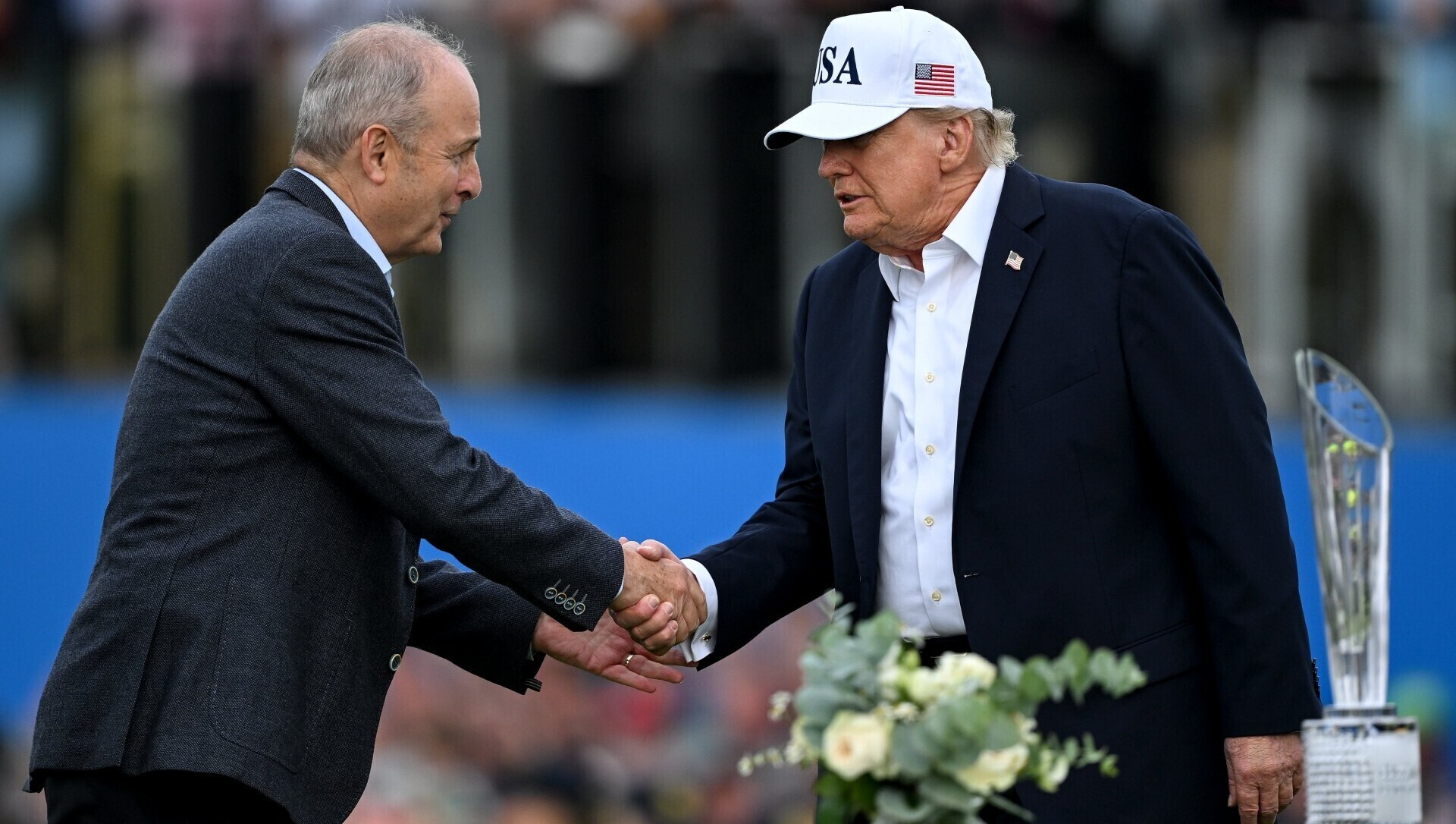
Taoiseach Micheál Martin and US president Donald Trump shake hands during day four of the Amgen Irish Open Golf Championship 2026 at Trump International Golf Links in Doonbeg, Co Clare. Picture: Ramsey Cardy/Sportsfile

A bad attitude is worse than a bad swing.
Those words by legendary golfer Payne Stewart, who won 11 PGA Tours during his short lifetime, crossed my mind last weekend as Donald Trump revealed a softer side no one envisaged while visiting his beloved golf resort.
I don't play golf. To the best of my knowledge, nor does Micheál Martin.
Much like the afterglow of a single Midleton malt, this was the mellow golfer Trump; Grandad Trump who stepped cautiously down the steps of his $400m personal transporter — a gift from his friends in the Qatari government — followed by his grandkids; as distinct from “a whole civilisation will die tonight” Trump.
Maybe it was the bloodline-in-tow, or the salt sea air in the heavenly scenery, or the “couldn't really give a toss if he’s here” attitude of many of the spectators who gathered in Doonbeg to watch Lowry win like a Goliath among his peers.
In stark contrast, Micheál Martin had a gentle calculated-yet-detached way about him, which is something Trump is not familiar with in his style of doing business. It felt like chalk and cheese watching them sitting side by side in Farmleigh.
Martin exudes this almost pained expression as though he’s expecting bad news while his hand tends to claw at his right knee whenever he sits next to Trump. It’s a classic primeval response to an inner sense of deep discomfort and uncertainty. Call it a tentative fear of what could happen at any moment (but hopefully won’t).
Read More
That said, this was Citizen Trump, as distinct from President Trump; the only business that pressured him last weekend was the promise of basking in his favourite pastime. Nothing else really mattered – much to the chagrin of the world media who were hoping for a clanger or a cliffhanger. For the catastrophist, it was an anti-climax.
Martin’s presence as he hovered close to Trump across the weekend was like a classic study in subconscious pacifism. Call him the lion tamer. This lion loves to be teased on his terms, but everything that moves and mutters around him is in danger of being devoured. It can all go horribly wrong in that split second.
Few words as possible is the pacifier’s greatest gift. Give Trump the floor. Call him out abruptly when he’s in mid-flight and you pay a high price. Let him share his mercurial views on a united Ireland. He’s on vacation, not a state visit.
He might be the most unpredictable and shameful bigot on the planet right now, but when you can’t see the hand he’s playing it’s best to veer on the side of caution. Become his confidante and you’ll be welcomed back. Animosity becomes his gunpowder.
In Trump’s ever-shifting manifesto of strategies, confrontation is met with retaliation. And tariffs, more tariffs, and taxes. Trump is a walking Monopoly board.
That Zelenskyy moment now determines the sparring rules when it comes to the art of walking a thin line between gentle platitudes and trading insults. Ten fiery minutes of global humiliation resulted in Trump taking to social media. “Come back when you’re ready for peace,” he wrote, before Zelenskyy’s car had a chance to pull away from the White House.
Weighing up what the lion had for breakfast is crucial before stepping into the cage. Sometimes it’s best not to cut to the heart of what your critics are urging you to say; mostly they’re thinking of the next day’s headlines, not your global reputation. It’s called avoiding the madman theory.
Donald Trump is a Holmesian bad man, to use a term coined by US Supreme Court judge Oliver Wendell Holmes. “If you want to know the law, you must look at it as a bad man does, who cares only for the material consequences,” he famously said.
“Not as a good one, who finds his reasons for conduct, whether inside the law or outside of it, in the vaguer sanctions of conscience.”
Whether Trump has a conscience or not wasn’t for public speculation on this visit. He gets to talk about anything he wants. That’s the deal and he makes the rules. The man who randomly starts a war on a whim was in town to watch golf. Ireland was placed on notice.
Last weekend was one of those extremely rare occasions where he appeared to humble himself out of respect — but for what? Nothing constrains him.
Even his armed detail, wearing their Peter Miller golf attire, seamlessly fitted into the backdrop. There seemed no need to make an effort, and we almost felt comfortable enough to fall in line and bear witness.
Then the Holmesian bad man rewarded us all on Sunday for not pissing him off, like schoolchildren who are told they have no homework for the weekend. As though he had just tossed a coin, he was going to take the tariffs off Irish whiskey.
The US is Ireland’s biggest export of Irish whiskey, accounting for one-third of global sales. Was that the ghost of John Jameson reminding us to "live a bit more and fear a bit less"? No. It’s just Trump’s game of performative authoritarianism as he plays cat and mouse with his tariffs. It’s all part of the madman theory. Let’s go back in time.
In , published in 2000, Irish author and BBC journalist Anthony Summers digs deep into the clandestine world of another Holmesian bad man — namely Richard Nixon, addicted to power and intrigue, whose era was characterised by a “rogue state”. Criminal behaviour is his legacy. Trump makes no secret of his admiration for Nixon, and has no issue with his leaving office in total disgrace.
Nixon came up with the madman theory in 1968 while chatting to his future White House chief of staff Bob Haldeman. He desperately wanted Ho Chi Minh to beg for peace as part of Nixon’s efforts to end the war. If his enemy started to believe he was “somewhat crazy” and “capable of the bloodiest brutality”, then North Vietnam would have no choice but to cave in to his demands.
When the odds are stacked against your best efforts in a time of war and then your adversaries find out that your mental instability could mean your hand is sitting on the nuclear button, then such inventive exaggeration should pay off in your favour. It didn’t, as history recalls.
But was his plan for how the enemy might perceive his feigning insanity simply a game, or was he really deranged? His psychiatrist of more than 40 years even admitted “he might not be the right man to have his finger on the nuclear trigger”.
Adopting Nixon’s madman theory by posturing the impression of insanity to an enemy, like Iran who Trump randomly chose to bomb and whose civilisation he threatened to “erase”, can buy you time; or worse if the country you’ve gone to war with has also adopted the madman theory. Who’s to say what will happen? All that is clear right now are shades of Nixon and North Vietnam in 1972.
Talking to an American tourist in Dublin last weekend, whose only gripe was that Trump was also here, his overall impression of us is how we gently disarm and integrate visitors with our charm.
“America has changed horribly,” he said to me. “Ireland hasn’t; it’s still a welcoming place, and I hope it stays like that.”
Maybe Trump sensed that — when a Holmesian bad man met a political pacifist — and for a short time a game of golf eclipsed the inanity of war. Kudos to Micheál Martin.
CONNECT WITH US TODAY



Be the first to know the latest news and updates