Gareth O’Callaghan: Would there have been a Good Friday Agreement without the 1981 hunger strike?
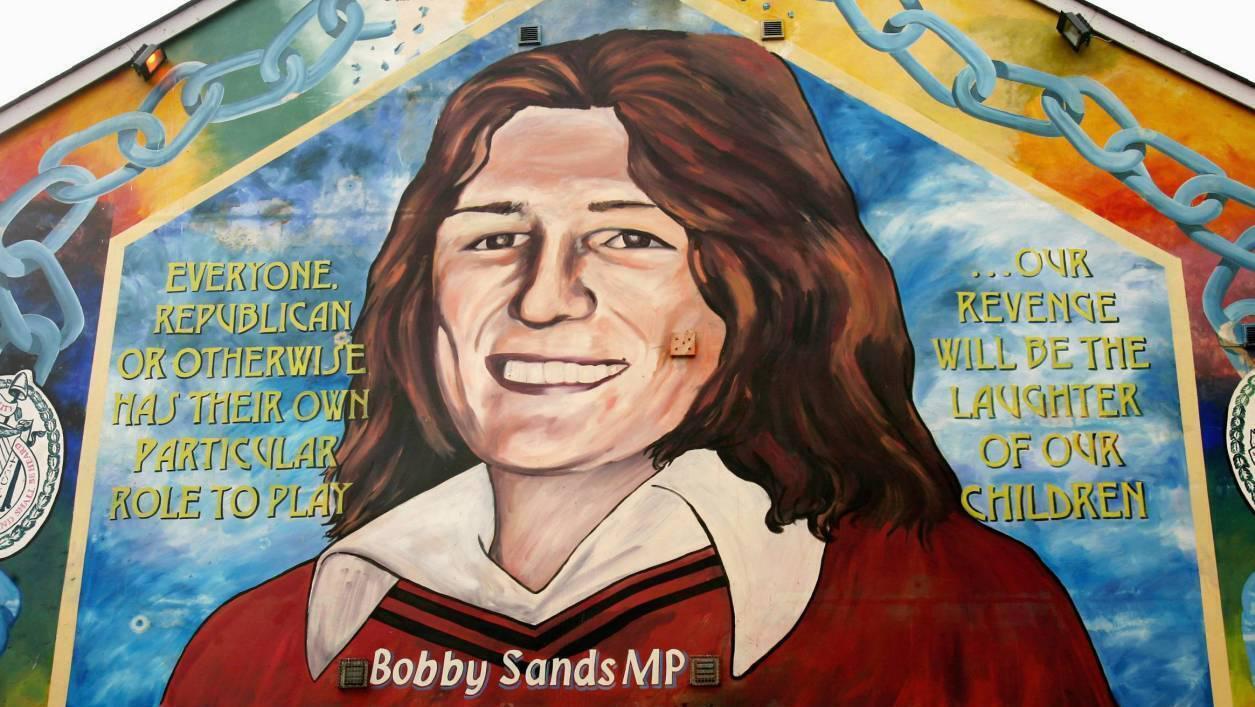
The Bobby Sands mural on the Falls Road in Belfast. Picture: Jeff J Mitchell/Getty Images

Martin Luther King Jr once famously said we are not makers of history, we are made by history. I doubt if he realised he would eventually become one of the greatest makers of history.
Recently, during our sweltering summer, I spent a few days in Belfast. Like hundreds of other visitors every week, I stood below the most photographed mural on this island on the corner of the Falls Road and Sevastopol Street, just like I did 25 years ago when the current portrait was unveiled by artists Danny Devenney and Mark Ervine.
Just below the painting of a smiling Bobby Sands is a lark breaking free from its chains. The renowned songbird is one of the great symbols of freedom and happiness. Above Sands is the mythical phoenix, symbolising rebirth and renewal as it rises up from its ashes.
Standing there looking up at Sands, I couldn’t help feeling as though this painting represents one of the great fulcrums in the history of the renewal of Northern Ireland through its long saga of war and killings.
This year marks the 45th anniversary of the 1981 hunger strike by republican prisoners at Long Kesh, which resulted in the deaths of 10 men, including Sands, and a consequent reformation in politics.
Perhaps, in hindsight, reformation is an understatement. This protest-onto-death was possibly the greatest paradigm shift in terms of the political polarisation it caused between this island and the UK.
Depending on your political leanings, we have always had an uneasy collective conscience here in the south of the country when it comes to the Troubles.
Read More
That was never more obvious than during the 1981 hunger strike. Belfast might as well have been a five-hour plane journey from Dublin. In truth it was barely two hours by road.
I turned 20 just days after Bobby Sands started his hunger strike in March 1981. He died 66 days later. By the time the strike ended at 3.15pm on October 3, nine more men had perished. Death by starvation is excruciating.
The chips these men were playing with were their own mortal lives. It was an adversarial gamble with shocking humanitarian consequences. The audacity of starving their bodies to death was met by a level of callous indifference by British prime minister Margaret Thatcher that shocked the world as one by one they slowly and painfully died in the most grotesque way.
Like many others at the time, I couldn’t help thinking it was a shocking waste of life. How could these men — all of whom were in their 20s, many with young families — surrender their lives for the sake of five demands they were insisting on to reestablish the political status they believed they were entitled to as prisoners of war?
The right not to wear a prison uniform; the right not to do prison work; the right of free association with other prisoners and to be able to organise their own educational and recreational pursuits; the right to one visit, one letter, and one parcel per week; and full restoration of remission lost through the protest. These were their demands.
In the aftermath of their deaths, the demands seemed so menial when I see them written down here, almost trivial; but they were far from menial or trivial.
While Thatcher refused to grant “political status” or concessions, by the end of that year the political landscape both North and South was shifting so fast it was impossible to predict where and when it might all end.
Her intransigence made her a universal hate figure. Sinn Féin’s Danny Morrison famously called her “the biggest bastard we have ever known” at the party’s 1982 ard fheis.
In the in 2013 following her death, Morrison wrote: “Thatcher put my community through hell and her policies unnecessarily protracted the conflict.
When it came to a political agreement on Good Friday 1998, the prisoners in the H-Blocks were given early release (an “amnesty”) which was recognition the British knew they were political prisoners all along.
In truth, I was naive all those years ago and too young to make much sense of the reality of what was taking place when you consider how rarified the news services were compared to now. It would take me another decade for a clearer realisation to sink in of how the 1981 hunger strike impacted an entire generation of Irish men and women all over the world, and still does.
Forty five years on, there are still many people who refuse to believe anything other than the 1981 hunger strike belongs in the annals of paramilitary terrorism. To believe that is a blinkered attempt to thwart history. It’s simply not true. Too many have used the hunger strike to simply attack a particular political situation.
So let’s just for a moment imagine the 1981 hunger strike had not taken place, that the five demands were already a part of these republican prisoners' terms and conditions. I often try to imagine how our political landscape might look if Bobby Sands had decided instead to take his breakfast on that March 1 morning.
He would never have been elected to the UK parliament the following month, and likewise the political ripple effect of that success for Sinn Féin would have remained as mythical as the phoenix on his mural.
In the absence of the hunger strike, it’s impossible to see how Martin McGuinness could have been elected to the Northern Ireland Assembly in 1982 (and later, as deputy first minister, sharing power with his one-time arch enemy Ian Paisley); or how Gerry Adams could have been elected to Westminster in 1983.
Sinn Féin would most likely have remained a relatively small ineffective splinter group in Ireland’s political system, whereas they now claim the lion’s share of the vote in the North, and continue to be the largest opposition party in the Dáil.
Would there have been a Good Friday Agreement without the 1981 hunger strike and the consequent deaths of 10 republicans? Most definitely not, because the political rebirth in the aftermath of the hunger strike wouldn’t have happened in the way it did.
It’s likely the collusion between British security forces and loyalist paramilitary groups which resulted in the deaths of hundreds of innocent people would have remained an unspoken secret. Now, hundreds of classified files point to the fact the British government was in bed with some very dangerous loyalists.
The lawyer Pat Finucane was shot dead in front of his wife and children at his Belfast home in 1989 by a UDA hit squad which included British police and military agents.
In 1975, Harold Wilson was made aware the Ulster Defence Regiment (UDR) was “heavily infiltrated” by loyalist paramilitaries. His government’s response was not to shut down the UDR but to mobilise it along the border and increase its intelligence-gathering role against nationalists.
Without the seeds of change sown during the 1981 hunger strike, would we have learned the truth about Robin Jackson, a police agent and former member of the UDR who it's believed was behind over 50 murders between 1973 and 1998 when he died — including three members of the Miami Showband in 1975?
It’s widely believed he also carried out the Dublin and Monaghan bombings in May 1974. It’s unlikely any of this would have come to light, or that the political landscape would have changed as much as it has without the events that led to the deaths of 10 men in 1981.
Margaret Thatcher wouldn’t agree, but it’s not difficult to see how her bullying intransigence in the face of human suffering was the catalyst for a group of young men who became makers of history. Their ultimate sacrifice, in the years that followed, created a safer society for the next generation.

CONNECT WITH US TODAY



Be the first to know the latest news and updates