Jennifer Horgan: We've lost the language of death by turning away from religion and poetry
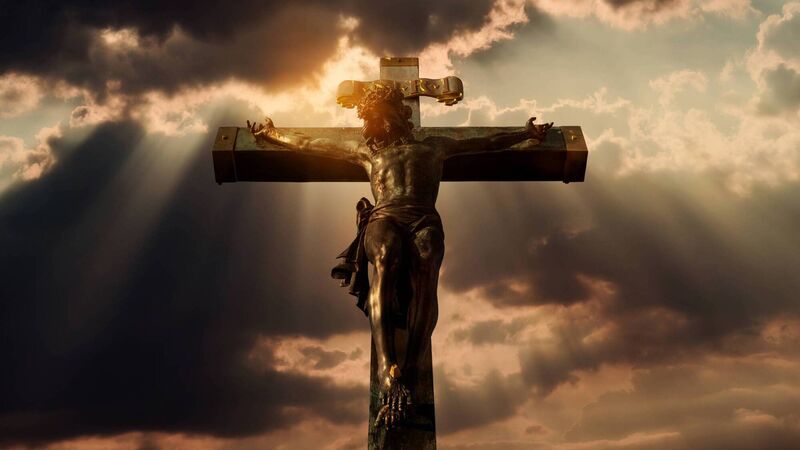
The story of the crucifixion allows us to practice living through suffering, and alongside death. File picture

I write a Friday column. It would have made perfect sense to write about Good Friday last week, but it hasn’t been a part of my life for a very long time.
I left Catholicism with good reason, but it was a hasty departure. Thirty years on, I acknowledge the treasures I’ve lost. One cultural heirloom I failed to salvage, let turn to ash, were the Christian stories, and perhaps most significantly, the Easter story.
Can I claim the story back for myself now, I wonder? A story doesn’t belong to any building or institution, surely. I think, possibly, that I can and I must.
I notice that I need stories more than ever before. I am reading far more books, watching far more films, far more TV. It’s an escape from my own story, I think.
My story, like any, has a beginning, a middle, and, most crucially, an end. Immersion in someone else’s story, fictional or not, offers relief. Every story I encounter and discuss is an experience of survival. The story ends; I do not.
But engagement with a story is only partly this. Stories also let us practice living through suffering, and alongside death. This is especially true of the story of the crucifixion. The impact that story had on me as a child was huge. In no other context would my parents have shared one so brutal, so violent.
I vividly remember sitting in the pew below the cross, taking in the blood on Jesus’s palms and feet, the agony across his features, thorns against his skin. His body was almost hyper-physical. I remember the stations, a fittingly drawn-out ceremony drenched with suffering. Did it always rain on Good Friday in the 80s? In my memory it did.
But the crucifixion was also the perfect story for grasping the deep pain in the world. It acted as a mirror for me, and as a shield. I want to reclaim it now because I still need it. It is still so relevant.
The Israeli government is doing to Palestinians exactly what the Romans did to Jesus. His crucifixion is grotesquely similar to their recent introduction of the death penalty for Palestinians, but it has the potential to act as a container for all human suffering.
I’m taking the symbol back because it stands for something so very real, beyond religion.
It offers personal comfort too. I am going to die. I need help with that. Gerald Manley Hopkins saw in the crucifixion an “enormous dark”, a “pity and indignation”. But only with an acceptance of death can we truly live and be resurrected, in a spiritual sense.
I don’t need to interpret that as literal rebirth. Resurrection, Easter Sunday, is the “trumpet crash” as Hopkins puts it. We go from being a “Jack, joke, poor potsherd” to an “immortal diamond”. Immortality comes from an understanding that we are part of a great tradition, even when humanity seems to ebb towards an abyss.
Alas, who reads Hopkins anymore? I can’t find statistics on Ireland but the latest research in America suggests approximately 9% of the population reads poetry. This is yet another loss when it comes to dealing with living alongside death and suffering.
We are lucky to have access to so much information, but that access has coincided with a fading away of these very human coping mechanisms — religion, poetry.
We are bombarded with news of death and destruction via images and reels — this is especially true for young people. Since 2015, research by Reuters suggests twice as many 18- to 24-year-olds turn to apps like TikTok for their news. Death is now presented, not via the human voice or body, but through images resembling a game online.
On top of that, we have no spiritual space in which to reflect and pray. It is too much, unbearable really. There are no symbols, no containers, and certainly no hopes for resurrection.
Whether we’re religious or not, the Easter story still holds a hugely important message — that we must consider death deeply, even the worst kind of death, in order to live fully. It’s reflective of our time that we by-pass the crucifixion, launching ourselves straight into a day of celebration and chocolate.
We have culled the sadness and I’m convinced we’re psychologically poorer for it. So, in my own heart and head, I’m bringing it back. Beyond myself, it is arguably even more important to talk about death now, to socialise it, because we’ve lost these stories.
This was the message on an RTÉ radio programme I discovered last weekend called . I was invited to contribute a short essay, and so I was listening for the first time, although the voice of Áine Lawlor was deeply familiar.
What is it to have a good death, one segment asked, followed by a wonderful conversation between chair of the Irish Hospice Foundation Jean Callanan, psychologist Ursula Bates, and head gardener in Our Lady’s Hospice Eileen Nolan. Posting the episode online, Jean Callanan wrote: “We don’t hear good discussions about death and dying often enough In the media.”
How right she has it. On air she told us that a hundred people in Ireland die every day and what many people want is pain relief. As I listened, I pictured Jesus again, experiencing the worst kind of death. I re-entered the story.
Jean Callanan also mentioned how dying people want to be in a place where death is talked about and acknowledged. Asking us to discard the narrative of a battle, Ursula Bates said: “We need to move away from the dialogue about fighting to keep well, fighting your illness, fighting death, to a sense of where we are now, being open to the person raising the conversation.”
The panel mentioned what a struggle it is to have these conversations about death without the language.
Considering the language losses we’ve suffered by turning away from the Church, turning away from poetry also, I think we should make this a cultural project of sorts — to open up these conversations in everyday life. We need to work on our vocabulary, on strengthening those containers that carry our heaviest things — the weight of loss, of grief.
Head gardener Eileen Nolan added that nature offers us imagery to grapple with death too. A leaf falling from a tree is consolation through symbolism. Nature is therefore an obvious substitute for religion, winter being a time of death and suffering, spring bringing resurrection, rebirth.
April is not just host to Easter this year, it is also poetry month. I won’t go to mass again, but I will happily position my faith between the lines of a beloved poem. Poetry still opens me up to that search for universal truths, for stories bigger than my own.
As it so happens, Cork has an international festival of poetry in just a few weeks time. Come along. Pick up a pew. Just like the story of the crucifixion, it’s for everyone.
Find out more about the Cork Poetry Fest here.
CONNECT WITH US TODAY



Be the first to know the latest news and updates