Michael Moynihan: Luas routes need common sense and proper future-proofing
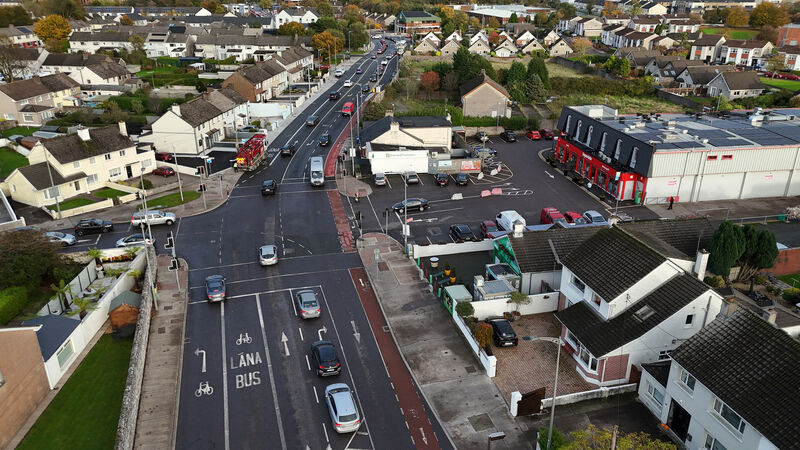
The emerging preferred route options for Luas Cork. The junction between Skehard Road and Church Road. Businesses including a pharmacy, hairdresser, barbershop and a beauty salon expressed concern about disruption and potential displacement. Picture: Larry Cummins

Last week, I mentioned the Cork City Futures Group, which aims to unlock the city’s potential (and is not, repeat not, a taskforce because taskforces are negative, ok?). Of course, within 24 hours, in-trays began to ping with the arrival of something to occupy minds in that group and far beyond.
I refer to Donal O’Keeffe’s piece last week here on the Cluas, or Cleeas, or Leeas, or whatever it is you want to call the light rail system planned for Cork. Donal reported on a possible change to the planned route which is likely to cause a good deal of chat, if by chat you mean spittle-flecked outrage.
“Under the revised proposals, the preferred route would have the light rail turning sharply left immediately before and west of CUH [Cork University Hospital], heading north and east along the hospital’s western and northern borders, and cutting through several housing estates,” he wrote.
“This area is heavily developed and populated, and would likely require a swathe of compulsory purchases. The grounds of Bishopstown GAA Club and Highfield Rugby Club could also be affected.”
Seriously.
This is a significant change to the original route, which would have taken the rail line past the hospital to turn left, or north, at the Wilton Roundabout. Apparently, misgivings were voiced about having a rail system on such a busy stretch of road when that route was announced.
However, ‘misgivings’ is likely to be a considerable understatement if this new route is adopted. The housing estates surrounding CUH are mature, long-established residential areas, while Bishopstown and Highfield are clubs central to their community: I doubt anyone involved with those clubs or living in the path of the new rail system will be too happy with the prospect of having their garden, kitchen, or dressing-rooms bulldozed.
This change would produce a raft of injunctions and legal challenges, not traditionally the accompaniment to a smoothly-run billion-euro construction project: those organisations surely are not serious about just announcing a huge change like this?
Well, readers may remember what happened last year when we learned of the plan for the rail line to go through Ballintemple — and demolish The Venue bar. Unfortunately, this was news to Con Dennehy, owner of The Venue, who only learned of the plan when it was posted online.
“I think the way they went about this was shoddy and unprofessional,” said Mr Dennehy.
“Those plans have been rattling around in somebody’s office for months — they should have brought us aside and given us a heads up. They’re launching this with great fanfare, but they’re now after blowing the value of the building out of the water — who’s going to buy it?”
On that evidence, the prospect of a sharp left turn at CUH is suddenly more credible.
(Notes from a non-engineer: just on that stretch going from Páirc Uí Chaoimh, up past The Venue and on to the Boreenmanna Road. Isn’t that very . . . steep for a light rail system? Not sure I’ve ever been on anything like that anywhere in the world. Am sure TII knows best, though.)
In Cork’s case, transport infrastructure is needed urgently. The news of this route change coincided almost exactly with another story about Cork transport: namely, the report from Paul Hosford and Amy Campbell that there were more than 2,700 complaints in just 12 months about bus services in Cork.
BusConnects, which aims to improve that situation, is another story altogether, but light rail is a key part of the proposed remedy for our transport chaos: is the inconvenience and disruption that the Bishopstown alteration will bring a price worth paying for better connectivity?
One more element worth considering, particularly for Bishopstown GAA and Highfield Rugby Club. When the Dublin MetroLink threatened to carve its way through the grounds of Dublin GAA club Na Fianna, its members were outraged, and eventually the route was moved away from the GAA club’s grounds.
However, Na Fianna were also proactive: it and the Dublin County Board commissioned a report measuring social return on investment, and that report found Na Fianna was worth about €50m for the local economy each year: for every euro equivalent invested into the club, about €15 of social value was created for the local community.
(For the benefit of Bishopstown and Highfield members: that study was carried out by Sandra Velthuis of Whitebarn Consulting, who may soon be getting a phone call from a number with an 021 prefix.)
It’ll be interesting to see other changes when the new route is published this month. Donal O’Keeffe suggested that in addition to the new route through Bishopstown, there may be a 2km extension at the western end of the system, as well as “minor” adjustments in Ballinlough.
The concerns raised about the Wilton Road, which led to that Bishopstown change, were mirrored by similar misgivings about traffic pinch points at places like MacCurtain Street, Skehard Road, and Churchyard Lane.
I presume it’s too much to hope for a significant change at MacCurtain Street, which might send a line out through Blackpool. Such a line might link up with the station on the main Cork-Dublin line at Kilbarry whenever that is built (probably to coincide with the opening of the event centre.)
Similarly, we may see the planners using common sense to link Cork Airport to the light rail system, but I doubt it. Omitting the airport from this plan now is a colossal and costly error because eventually it will have to be connected, and there are cautionary tales about that if you look north.
Last year, Department of Public Expenditure and Reform research suggested the cost of building the MetroLink to Dublin Airport had risen from a 2021 estimate of €7.1-€12.2bn to a possible €23bn.
Deferring a link between Cork City and its airport will only hike costs, but that depends on whether the system is ever built in the first place. For this columnist, that’s the biggest imponderable: whether any Government trying to find €23bn for a rail line in Dublin will have much cash left for a rail line in Cork.
- X: /mikemoynihanex
- Instagram: /mikemoynihanex
- TikTok: /mikemoynihanex
CONNECT WITH US TODAY



Be the first to know the latest news and updates