Sarah Harte: Jessie Buckley shows what's possible if we face our fears
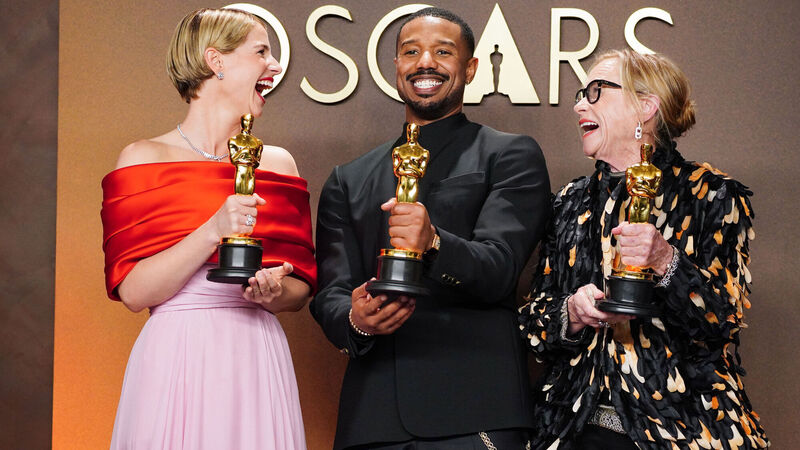
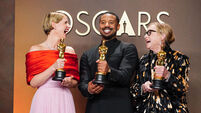
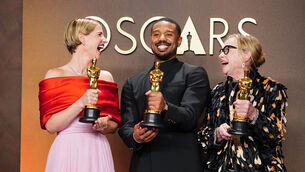
(Left to right) Jessie Buckley, Michael B. Jordan and Amy Madigan at the Oscars with their trophies on Sunday. Photo: Jordan Strauss/Invision/AP

So, Jessie Buckley won her Oscar. Hurrah!
Chloe Zhao, the ‘Hamnet director’, spoke in the run-up to the awards about Buckley’s authenticity as an actor. "Actors, their greatest blessing they can give to the world is their authenticity and their humanness."
Ralph Waldo Emerson, the mid-19th-century poet and essayist, wrote a famous essay called ‘Self-Reliance’, which argues that we often live in quiet fear of failure, rejection, or judgment. These fears prevent us from living authentically.
He wrote: "Always do what you are afraid to do." Jessie Buckley agrees. "It’s crazy how fear can just come over you. I always get afraid before I do a job, I’m panicking…..
"Sometimes, you need to step into environments that are gonna just destroy you from the side, and you’ve got no other option but to rebuild yourself, and to find a way to come out on top."
Apparently, it’s notoriously nerve-wracking to give an Oscar acceptance speech, with even famous actors sometimes suffering from glossophobia, which is the fear of public speaking. That particular phobia is remarkably common.
One statistic from a survey commissioned by the Broadcast Institute at the end of last year indicated that 30% of Irish people fear public speaking as much as death, with the figure rising to 50% amongst younger people. Another statistic suggests that three in four people have some degree of fear of opening their mouths in public.
I can sympathise. Last week, I interviewed Susan McKay, the Press Ombudsperson, and I found myself feeling nervous. McKay’s job is to hold the press accountable in a non-legal context. She is also an author, journalist and activist.
I sensed interviewing her would be interesting (it was), but my sudden nerves raised the spectre of my former glossophobia. I never opened my mouth in public until I was 40, which limited me, personally and professionally. Never uttering a word professionally, took some ducking and diving.
I casually asked a family member who is a psychiatrist why I had this phobia.
I should imagine the worst that could happen, for instance, falling on stage and consider if I could cope with that. Honestly, that idea horrified me, so I continued to shut my mouth.
Last week, I stumbled at the beginning when reading McKay’s bio aloud, and for a moment, I thought, "Oh, don’t let me go to that place where I fall apart."
It’s only happened once. Three years ago, I gave a car crash reading at a literary festival. A wave of heat came over my body, my voice trembled, my mouth went dry, and my leg started to shake. The more I read, the worse it was.
I read far too quickly, with the words rattling out of me in a machine gun burst, because suddenly I wanted the experience to end. The audience looked startled as I hurled words at them. It was like being caught in the spin cycle of a wash load.
Afterwards, in my hotel room, I stared at the wall. I was embarrassed and upset. Eventually, I figured out that nobody had died. It didn’t matter. I did my best, and so what?
People go to great lengths to overcome their fear of public speaking. One pal of mine forces herself to go to Toastmasters to keep her fear of public speaking in abeyance. She says that anxiety decreases through repetition. Her job requires her to speak in public, so she has no choice.
A relative who had a fear of public speaking and sometimes has to do it for her job read the best-selling book called by psychologist Susan Jeffers. Jeffers' core idea is that confidence is the result of action.
This bizarrely led my relative to tap-dance at the Cork Opera House in a top hat and tails. She went the wrong way to the troupe, which gave us a great laugh, but she overcame her fear of performing in public.
Research supports the idea that the most effective way to banish fear is to force yourself to face what you’re afraid of. Aristotle said, we develop courage by performing courageous acts.
Many of the Stoics, including Seneca, wrote about how fear often exists more vividly in our imagination than in reality. There’s definitely something in it.
I mentioned before how Terry Prone, the communications consultant and an columnist, helped me speak in public.
Who knows? Even if we have inherited a script, we have to create our own.
To that we must look to our role models and both Terry Prone and Susan McKay are good examples of that. Although they operate in different worlds, Prone, like Susan McKay, shattered glass ceilings when it was infinitely more difficult for women to be taken seriously. They were not flash-in-the-pan. They stayed the course.
Both are still impacting the body politic and life. I look at them and think there is a path forward to age and remain relevant. Yet their fears (maybe they have some privately) are not evident.
If we are not careful with our fears, we can live out our days in a lesser life than the one we were meant to live.
Henry James, in the short story , relates how a man loses out on life and love contemplating a beast in the jungle lying in wait for him.
He is obsessed with the notion of this imagined foe or catastrophe, which prevents him from having experiences that might transform his life. In the end, he realises that the catastrophe he imagined has happened. He lived a lesser life because of this irrational fear.
Fear can stop us from doing things. Avoiding fear means avoiding growth. It took me a long time to equate those two things. Soren Kierkegaard, the Danish philosopher, had an intriguing way of considering fear. He argued that we are not most afraid of danger but rather of possibility.
Regardless of how you view it, we have to widen the aperture that lets the world in, or that lets us go out into the world.
There is something noble about our ability to go on in the face of our worst sadnesses, humiliations and yes, fears. As human beings, we are perennially burdened with figuring out who we are and what our next step should be.
We can step outside our comfort zones into the unknown on our own personal odysseys, come what may, and expose ourselves to failure, criticism, and maybe even modest triumph.
It’s worth a try because our identities are not static. Until we draw our last breath, we can create new stories for ourselves.
By the way, well done, Jessie Buckley. You will have inspired lots of younger people to reach for the stars.


CONNECT WITH US TODAY



Be the first to know the latest news and updates