Sarah Harte: What makes a criminal, and can it ever be 'one of us'?
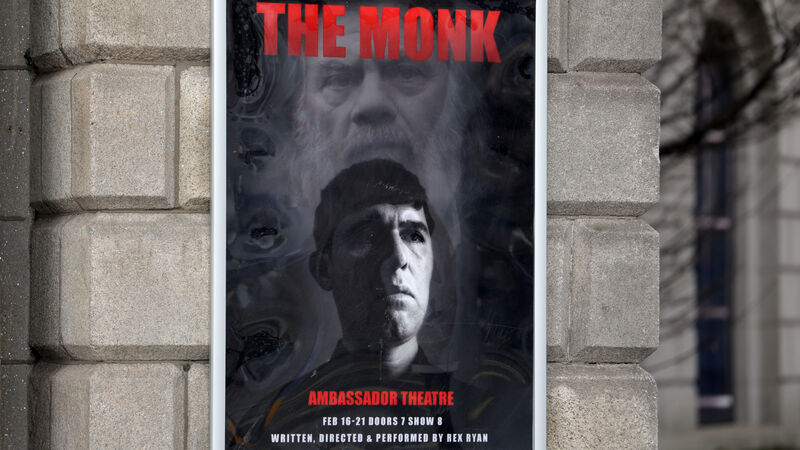
A poster for the play 'The Monk' about Gerry Hutch last month. Rex Ryan’s play about the Monk garnered positive reviews, and younger people in particular seem fascinated with the main character. Picture: Leah Farrell/© RollingNews.ie

Gerry ‘The Monk’ Hutch certainly livened up the last general election.
His inability to get transfers allowed Labour’s Marie Sherlock to scrape past the line in Dublin Central. The media had a blast chasing him. An array of political figures came forward to be "outraged in Dublin".
Last week, the Irish Examiner reported: "Simon Harris has said rules should be considered to stop people with criminal records from becoming TDs after Gerry "The Monk" Hutch… urged people to register to vote for him".
The Tánaiste is concerned that people are treating Hutch like a celebrity. He’s right. Rex Ryan’s play about the Monk garnered positive reviews, and younger people in particular seem fascinated with the main character.
Hutch is not the benign Robin Hood he depicts himself to be. Too often, victims are overlooked when criminals are glamourised. But is Simon Harris right about changing the rules?
Trump has a criminal conviction for fraud over hush-money payments to a porn star. Yet the US constitution doesn’t block presidential candidates with criminal records.
It’s odd that American law is harder on voters than on presidential candidates, because in many states like Tennessee, voters with criminal convictions cannot vote.
It’s striking, though, how we define crime or even who is a criminal. We’re not good at curbing the criminal tendencies and dubious business dealings of the elite in this country.
We prefer putting blue-collar criminals behind bars. It seems the more money you make, the safer you are with a ‘too big to jail’ psychology in play.
If executives and financiers get caught with their hands in the till, they get a slap on the wrist for things like ‘conflicts of interest’ in a civil context. The company or firm might have to pay a fine, which is absorbed as the cost of business.
If you’ve really done the dog on it, the Central Bank might insist that senior management be replaced, but they never find criminal intent.
This is how the system protects itself. No real deterrence exists for corporate crime. And why would you comply with rules and regulations that are not enforced?
Accurate statistics are hard to find because so much white-collar crime goes undetected, unreported and unprosecuted, but an often-cited statistic is that white-collar crime costs the Irish economy at least €2 billion a year.
So not a victimless crime, although white-collar crime can feel more abstract than street crime and therefore trigger a weaker emotional response.
Provisional Garda statistics released last week show reductions in most major crime types throughout 2025, but an increase in most fraud-related crimes.
Six years ago, the Government published a suite of corporate governance and law enforcement measures called the ‘White-collar crime’ Package. A Review Group headed up by former DPP James Hamilton clarified that we lacked the capacity to deal with fraud and corruption.
Ireland's first-ever insider trading case, Fyffes Plc v DCC Plc, a major business scandal, was interesting for several reasons. I covered the case as a journalist when it was in the High Court.
The State did not bring a criminal case. Insider trading cases are financially complex, and prosecutors and investigators are under-resourced in this country. My boss, veteran journalist Vincent Browne, was cynical about this decision.
In the High Court, in the Fyffes case, Justice Mary Laffoy found no evidence of criminal intent. However, the Supreme Court reversed her judgment on appeal, finding that there was insider trading.
Supreme Court judge Niall Fennelly had this to say: “It used not to be considered any sort of sin to profit financially from the use of secret, private or privileged information. That was how fortunes were made. Now things are different.
"The insider who exploits his access to the special knowledge he enjoys for the purposes of the company in his capacity as executive or director of a company commits a crime. He may be made, additionally, to answer for the profits he has made.”
DCC paid Fyffes €41 million in a settlement for having sold a 10% stake in Fyffes while in possession of price-sensitive information. In the end, the case amounted to a hill of beans. Nothing much happened.
One point Browne made was that Fyffes was also an unsympathetic plaintiff because of incongruities in its behaviour, including its statements to the market. It’s fair to say the case left many questions unanswered on both the plaintiff's and the defendant’s side.
At the time, I disagreed with Browne’s analysis of the case. After a row, I demanded that my byline be removed. On mature reflection, I was wrong. Why? I was biased because I was friends with one of the protagonists on the Fyffes' side.
This cosy culture in a small country, and the reluctance to go after people like us, are part of the problem. Whistleblowers are in short supply. It’s in everyone’s financial, career, and social interests to shut it down.
This class loyalty results in a lack of accountability and turning a blind eye. But it’s true that decision-makers likely identify more with corporate lawbreakers, extending to them an empathy they don’t show blue-collar criminals.
They identify corporate crime as mistakes rather than moral wrongdoing. That’s not just an Irish phenomenon. There are many interesting academic studies on systemic leniency extended towards white-collar criminals.
Still, it can feel like we pick an expendable minnow and nail them to the wall. We go after garlic importers and credit union managers, not part of the tribe, rather than high-profile corporate types, because we value safe convictions over bold accountability.
Legal outcomes should reflect the nature of the crime rather than the perpetrator's privilege, and the law, in theory at least, should be applied evenly. Traditionally, in the USA, they prosecuted executives rather than just focusing on corporate penalties.
The culpable were taken out the front door in handcuffs. Never pleasant to see people fall from grace unless you have a taste for that kind of thing, but the ‘perp walk’ sent a strong message of accountability.
Obviously, under Trump, there has been a major pullback in white-collar and regulatory enforcement, with a hollowing out of the agencies tasked with going after white-collar criminals. There has also been an eyewatering raft of presidential pardons for a parade of gangsters.
Bertie Ahern refused to condemn Hutch during the election coverage. He said he had known Hutch for a long time and cited his loyalty to his community in Dublin Central.
It’s complicated because Hutch is a criminal, but he got almost 10% of the first preferences in the inner city community. While I see where Simon Harris is coming from, I also respect Ahern for saying what he did. Because it’s easier to go after somebody like Gerry Hutch than a CEO accused of fraud.
Cognitively and socially, it’s easier for us to accept that Hutch is a criminal rather than someone in a suit in a boardroom with educational credentials and status that signal legitimacy. Even when the opposite is true, and we should be asking hard questions of a member of ‘our tribe’.


CONNECT WITH US TODAY



Be the first to know the latest news and updates