Colin Sheridan: The FAI made a choice when agreeing to host Israel — cowardice
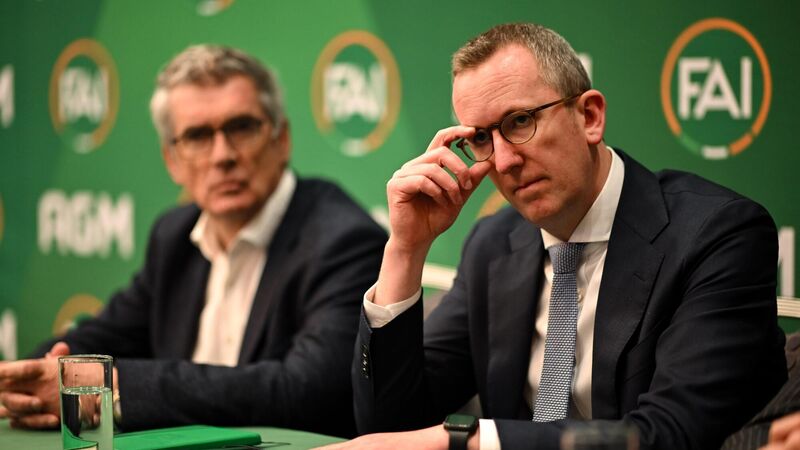
FAI chief executive officer David Courell (right) and FAI independent chairperson Tony Keohane (left). 'We, in reality, do not have a choice for a variety of reasons.' File photo: Stephen McCarthy/Sportsfile

Choice. The act of choosing between two or more possibilities. We make them every day — big ones, small ones, many of them without even realising we’re making them.
There are easy choices. The choice between two apples. Between multiple routes to work. Between a latte and a flat white. And there are difficult choices. To finally give up trying for a baby. To break up with somebody you love but choose to no longer be with. To stop chest compressions on a loved one you know isn’t coming back.
It can be heavy stuff, choosing. But choose we must. It’s part of the contract of living. Which brings us to the Football Association of Ireland, international football, and Israel.
This week the association’s chief executive, David Courell, told RTÉ Sport’s Tony O’Donoghue that the governing body had been presented with a difficult situation which only had “one viable option” in relation to fulfilling its fixture against Israel later this year.
Read More
“We, in reality, do not have a choice for a variety of reasons,” he said, before going on to explain — in a very FAI, word-salad sort of way — that the FAI did of course have a choice, and they are choosing to play Israel. And not just play them, but host them in Dublin.
There was no mention of a trip to the Guinness Storehouse or a photo-op in the Long Room at Trinners, but it’s the FAI, so give it time.
Back to choice.
Notwithstanding the fact our national football team has a rather tragic habit of sanctioning itself results wise, it’s important to get the boring legal bit out of the way: if the FAI were to choose (because, you know, they do have a choice) not to play Israel for all the flagrantly obvious reasons, the following are the potential repercussions.
In the case of a refusal to play, the dispute would be governed by the disciplinary system of UEFA rather than Irish law. UEFA would almost certainly award a 3–0 forfeit and could impose additional sanctions such as fines, loss of competition payments, or even disqualification from that edition of the tournament.
The FAI could appeal first to UEFA’s Appeals Body and then to the Court of Arbitration for Sport.
One argument — among many — might be that Israel itself has contravened UEFA’s ethical benchmarks and should be suspended. UEFA would be unlikely to overturn its own position, but CAS might at least consider the proportionality of any punishment.
In other words: there is a process. There is a dispute mechanism. There are avenues to challenge the rules. All of which means there is, in fact, a choice.
But taking that stand, fighting that case — that would require something the FAI has historically struggled to locate: a modicum of balls.
And that is what makes the sudden sanctimony so funny. The FAI, that great bastion of obedience and righteousness, now presents itself as the helpless prisoner of rules.
This is the same organisation that spent the better part of two decades demonstrating a relationship with rules that could generously be described as interpretive dance.
Yet now, suddenly, the FAI has discovered the sacred inviolability of regulations. Now they are rule followers. Now they are powerless before the statutes of international football. You would almost admire the transformation if it wasn’t so transparently convenient.
And the government, standing behind them like an ambulance-chaser who has suddenly become a constitutional scholar, shrugs its shoulders and says: nothing we can do.
We have no choice.
Ireland, apparently, is now a nation that simply follows instructions. This would come as news to anyone who remembers the remarkable contortions of the Irish state in the long-running tax saga involving Apple and the European Commission.
In 2016, the European Commission ruled that Ireland had granted Apple illegal state aid and ordered the state to recover roughly €13bn in unpaid taxes. The decision was eventually upheld by the Court of Justice of the European Union.
And what did Ireland do? Did it gratefully collect the money? Did it shrug and say “rules are rules”?
Of course not. The Irish government spent years — and roughly €10m in legal fees and advisory costs — appealing the decision and fighting the case in court. It argued, with extraordinary determination, that it should not be forced to collect €13bn that the European Commission believed it was owed.
Think about that sentence for a moment.
A state fought tooth and nail against receiving €13bn from a behemoth multinational technology company.
Why? Because collecting the money might upset Apple. That was the national interest. That was the hill to die on. Suddenly Ireland had choices again. Suddenly there were legal arguments, appeals, principles worth defending.
But when it comes to refusing a football match — a gesture that would reflect the clear and overwhelming sentiment of the Irish public and much of the football community itself — we are told the machinery of rules is immovable.
Choice evaporates.
This is how bureaucracies work. They do not say “we are choosing the safer option”. They say “there is no alternative”. The language of inevitability is the favourite refuge of cowardice.
And beneath the legal choreography lies something deeper: a refusal to confront the moral significance of what is happening.
Sport has always been political, whether administrators admit it or not. It was political when apartheid South Africa was excluded from international competition. It was political when Russia was suspended from tournaments after its invasion of Ukraine.
To pretend otherwise now is not neutrality. It is selective blindness.
The integration of sport, national identity and military service within Israeli society — including the close association between elite athletes and the Israel Defence Forces — gives its international teams a symbolic role that is unusually close to the machinery of the state itself.
Which means that when those teams compete internationally, they do so as more than just athletes in green shirts or blue shirts. They carry the weight of the national project in a very literal sense.
That does not mean Israeli players are individually responsible for the policies of their government. But it does mean that pretending sport exists in a vacuum is particularly absurd in this case.
And so we return to choice.
Ireland’s Constitution — that dusty document politicians quote when it suits them — contains a curious line in Article 29 of Constitution of Ireland. It states that Ireland affirms its devotion to peace and co-operation among nations founded on international justice and morality.
International justice and morality.
Those are not the words of a constitution that imagines the country as a passive spectator to events in the world. They suggest a State that sees ethical judgment as part of its foreign policy.
Yet when the moment comes to make even the smallest symbolic stand, the language suddenly changes.
We have no choice. Choice, apparently, is something that only applies when €13bn is at stake or when multinational corporations might be upset.
But outside the boardrooms and press conferences, choice still exists.
Choice is a Palestinian mother deciding which child eats today and which child walks for hours to queue — at gunpoint — for a bag of flour.
That is choice.
Compared with that, refusing to play a football match is the opposite of an impossible dilemma.
It is simply a decision.
And the FAI, despite everything it says, is choosing cowardice.

CONNECT WITH US TODAY



Be the first to know the latest news and updates