Clodagh Finn: The dung queen of Ireland — and other Irish women alive in the time of Hamnet
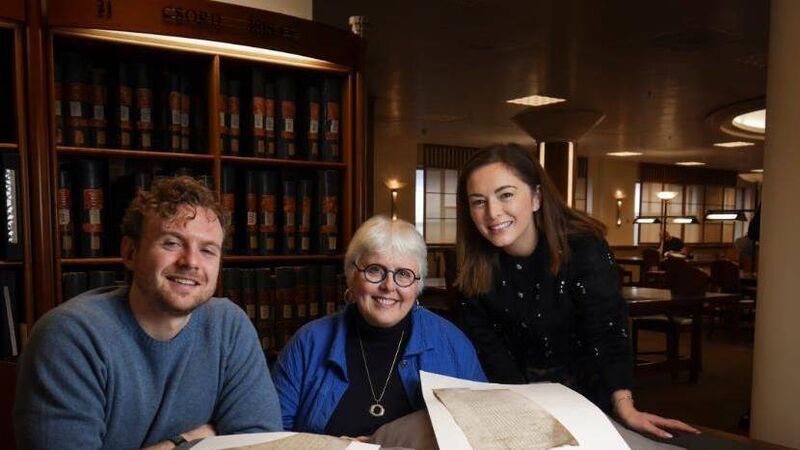
Dr Daniel Patterson, Prof Jane Ohlmeyer and Dr Bronagh McShane in the National Archives of Ireland viewing records from the Court of Chancery as part of the Voices project, which brings together historians and computer scientists to recover the lives of early modern women in Ireland.

Strong by name, formidable by nature. The business acumen, wiles and entrepreneurial genius of Catherine Strong, aka the dung queen of Ireland, seem very modern, but this woman who cleared animal and human waste off the streets of Dublin was working more than four centuries ago.
The capital’s “scavenger”, to use her official title, was at the height of her powers around the same time Agnes (or Anne) Hathaway and her husband Shakespeare were grieving the loss of their only son Hamnet, a personal tragedy returned so poignantly to the spotlight in Chloé Zhao’s Bafta-winning film.
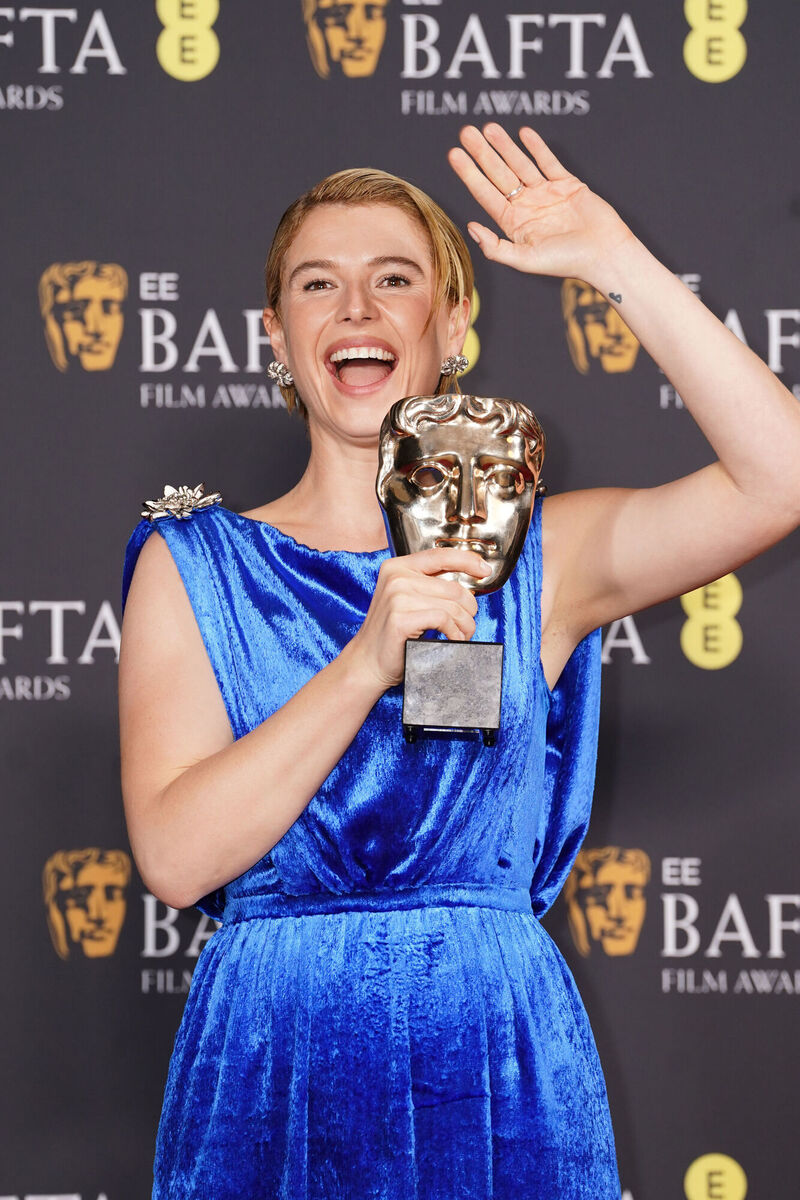
Perhaps more striking still is the way that film, and in particular Jessie Buckley’s Bafta-winning performance as Agnes, has put a rare focus on the lives of 17th-century women. It is an important act of storytelling and, as Buckley said at the Bafta awards ceremony on Sunday: “I believe in storytelling. I believe in women’s voices to tell those stories.”
And so say all of us.
HISTORY HUB
If you are interested in this article then no doubt you will enjoy exploring the various history collections and content in our history hub. Check it out HERE and happy reading
Her uplifting speech is not just a pipe-dream, though, because the voices of women from the very era she is portraying on screen are now being heard for the very first time.
Voices such as the (loud and boisterous, I imagine) one belonging to Catherine Strong whose remarkable turn at the head of the capital’s waste industry was uncovered by Jane Ohlmeyer, Erasmus Smith Professor of Modern History at TCD, as part of Voices, a five-year EU-funded project which is already rewriting the history of Ireland.
While we know what was said about Catherine Strong, rather than what she said herself, it’s clear from the record that this was a woman who lived by the phrase: “Where’s there’s muck, there’s brass.”
She was paid by shopkeepers and traders to shovel dung from the streets but, spotting an opportunity to make an extra buck, she reduced the number of carts used to do the job. The result? Uncollected dung in a city that stank to high heaven and, wonderful for us, angry complaints that were written down.
“This woman, who clearly is a phenomenal entrepreneur, was obviously cutting corners and turning trash into treasure. Fired by Dublin Corporation, she then became a money lender,” says Ohlmeyer, principal investigator of Voices.
She has a gift for working the scraps of information gleaned from disparate sources — documents nibbled by rodents, others charred in the Custom House fire of 1921 and those represented in a vast digital windfall now available — into an engaging picture of a real-life woman.
In essence, that is what Voices is trying to do. It is using AI and Knowledge Graph technologies to bring together myriad sources so that a team of historians and computer scientists can recover the lives of ordinary Irish early modern women who have, up to now, been hiding in plain sight.
It’s not that they weren’t there. It’s just that the elements of their lives were buried in documents held in a range of places, from the court of chancery documents in the National Archive to the funeral entries in the National Library, and nobody joined the dots before.
Now thanks to technology and €2.5m in funding from the European Research Council — “it’s like hitting the academic jackpot,” quips Ohlmeyer — the Voices team can take these very dry or very fragmentary sources and extract women’s voices from them.
And what stories they tell. The will of 13-year-old Magdalene Ringe, from the Virtual Record Treasury of Ireland, describes how this young Waterford girl was sick in body but not in mind and, in 1623, she bequeathed all that she had to her dear mother whom she said “had most need of it”.
The funeral entries in the National Library of Ireland — “the rip.ie of the 17th-century” — record the death of a Mrs Kinborow Valentine, at the age of 118, in May 1669. Even if her age was out by a decade or two, that is still a precious nugget of important.
To return to dung, a group of “viragos and matrons” fired lots of it at Dublin city officials, Protestant clergy and soldiers when they raided a Franciscan mass house in the centre of Dublin on St Stephen’s Day in 1629.
The leader of the pack was Elinor Nugent, a widow in her 50s, who started a riot by firing up the congregation with the “spirit of zeal and indignation”.
Here’s a description of that unlikely disturbance which sent the raiders packing: “They strike, they shoulder, they catch, they scratch, thump and tread underfoot whomsoever they lay hands upon; so that the mayor, bishop and soldiers were glad to hasten out of the doors; where they met, as they fled with a shower of stones.” And “dirt of the kennel”, or dung.
The women were arrested the next day but they were released soon afterwards.
Elinor Nugent was the head of her own household and she probably took over her merchant husband’s business when he died. She was also a freewoman of the city.
It’s not the image that comes to mind when we think of Irish women in the 1600s, but that is because we haven’t been paying attention.
Jane Ohlmeyer explains: “Whenever you read a historical record, it’ll give you the name of the husband, the age of the husband, the occupation of the husband. But very often the occupation of the husband is also the occupation of the wife, but of course they won’t tell you that.”
The woman is there alongside her husband, working in partnership in a range of professions; farming, printing, tanning, brewing — women are hugely important in the brewing industry — crafts and skills such as gold-smithing and jewellery making.
There are many female money lenders too, many of them based in Cork. At a time when there were no banks, no credit cards and a shortage of coins, ordinary women were the ones borrowing and lending money in their communities.
Women also become much more visible in times of war, as they step into the gap left by the men. And there was much violence and conflict in the early modern period.
“You see the way women carry war on their backs, and you see it across history, across time, and you see it very vividly here in Ireland in the 1640s. They’re the ones left to care for the old, for the young, the ones to run the estates, to try and make ends meet. But then, in that sense, they are also showing great agency,” says Ohlmeyer.
Women also become increasingly vulnerable, as the witness testimonies known as the 1641 Depositions attest. Sexual violence, then as now, was a weapon of war and many women spoke of the unimaginable horrors they endured as they fled rebellion in October 1641 during the coldest winter on record.
The depth of pain and grief endured by women on all sides of the conflict is too vast a subject to touch on here but at least their voices are now being heard.
And many more will emerge. When Voices began in 2023, there were only a handful of women. “Now,” says Ohleymer, “we are coming down with stories that will reshape the history of Ireland.”
It is also uplifting to see AI restore dignity to women at a time when Elon Musk’s Grok is digitally stripping it away, but that is not without its challenges.
AI-driven text recognition tools, such as Transkribus, can save hours of transcribing, but generative AI should come with a health warning. Project researchers have found that it hallucinates and invents data. It also reinforces the very biases — race, gender and class — that this project is trying to correct.
At least, that is clearer now. If you can see a bias, you can do something about it.
The best piece of technology will come last; a searchable public database known as the Knowledge Graph will allow all of us to get to know Irish women, their networks and experiences between 1550 and 1700.
Here’s to time-travelling when that comes online; an initial release is planned for this July. Keep an eye on voicesproject.ie for details.

CONNECT WITH US TODAY



Be the first to know the latest news and updates