Gareth O'Callaghan: The depression express and the small Irish habit of laughing through pain
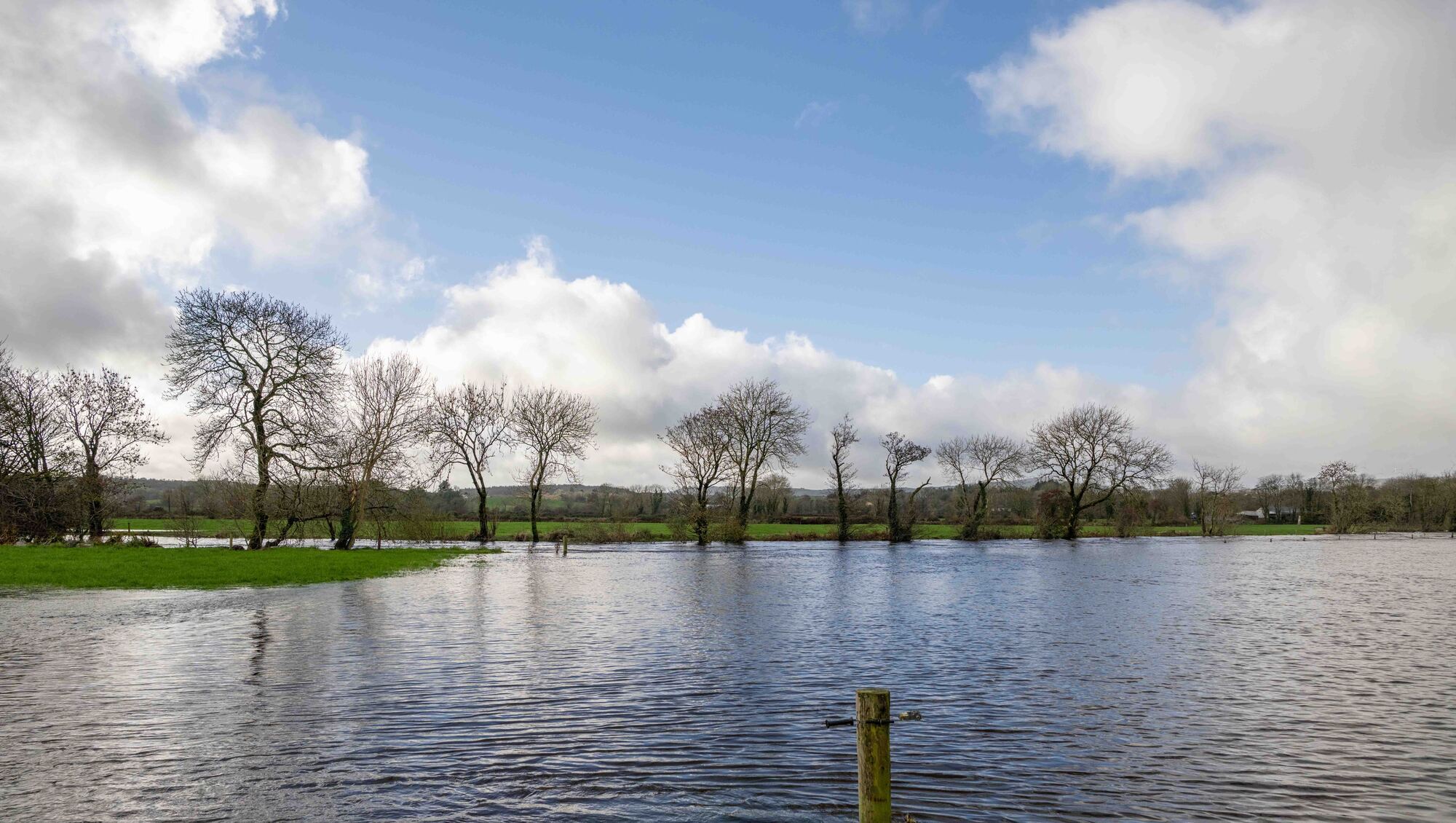
'Today the plains are flooded, the fields are lakes, the sky is grey, and a clouded mist sticks to you like depression.' Picture: Andy Gibson

“When will it ever stop raining?” the woman sitting opposite me asked. It wasn’t so much a question as an aphorism, one of those remarks Irish people come out with so naturally. Her name was Teresa. She was just back from Tenerife, where her sister lives. Denis, sitting next to her, was returning from a funeral in Thurles.
I’m on the train back home, hurtling downhill through the green fields of North Cork, through the townland of Ráth Luirc, curling around the town of Charleville and on towards Mallow; except there’s not much greenery to see. Today the plains are flooded, the fields are lakes, the sky is grey, and a clouded mist sticks to you like depression.
All the landmarks that are part of my weekly journey have vanished. The train is busy, but the mood is flat. It feels like I’m on the depression express.
Irish people love talking about the weather, so within minutes all of us in the four-seater are sharing experiences of the recent monsoon. Charlie, sitting next to me, is a farmer. He’s meeting a man in Mallow who’s lending him a boat. It’s the only way he can reach five cows that are stranded on a hillock at the high end of a flooded field.
“Will they all fit into the boat with you?” Teresa asks innocently. We all laugh out loud. A perfect icebreaker on a miserable afternoon.
Charlie shakes his head. “The plan is to take some hay up there to them.”
She stares out the window. “This weather isn’t good for my depression,” she says.
“Nor mine,” I hear myself saying out of the blue.
“I got tablets from the doctor yesterday for depression,” Charlie says quietly.
“Are they for the stranded cattle?" Denis asks. More laughter.
“Aren’t we a right little comedy troupe?” Charlie replies.
Where else would you find four people joking about depression, except in Ireland? Then the conversation fell silent, as though the cat had been let out of the bag. Each of us knows it. Soon after the seats around me empty. Just like that, we had all gone back to our separate lives.
The rain is pouring outside as I write, and I’m still struck by that conversation. For the briefest spell, we were all in the same boat, disguising painful experiences of something no one can adequately describe with humour. When we don’t want to cry, we make ourselves laugh. Only in Ireland.
I’m just back from the funeral of a young man who took his own life. His memorial pic shows an attractive lad with an infectious smile. He’ll never smile again. In years to come when his parents are old and his siblings have their own children, the life he cut short will still be breaking their hearts over and over.
I call suicide the revolt of the self. You can’t submit to its senseless charm. I’ve stood on that cliff, and it wouldn’t take much for a sudden breeze to blow you over the edge. There’s no coming back.
I’ve read many books on the subject. Perhaps the finest is , by Andrew Solomon. “When you’re so far down that love seems almost meaningless, vanity and a sense of obligation can save your life”.
I’ve always been prone to depression, and I’m not ashamed to admit it. I wrote a book about my experience in 2003 called , which resonated widely. A comedian once called me Ireland’s most depressed man. Unknown to him, I was in the audience. That hurt.
I thought I had discovered a cure. I was wrong. Depression is a tough nut to crack. No one has succeeded in finding a way to eradicate it in the way that smallpox was. Nor will it ever come to that, because depression isn’t a disease.
It’s a uniquely personal mood disorder, hinged to our past experiences and how they have impacted our lives. A psychiatrist once told me it was a psychological abnormality. That makes me psychologically abnormal. What a load of bull.
Generations of our people have endured lifetimes of “suffering with their nerves”, and who can blame them? Over the decades, we were the best Catholics in the world, but the most repressed people I have ever come across. Repressed emotions — fear, shame, guilt, regret — resurface as depression.
It’s not so long ago that sexuality was a curse, not a gift. Sex was the work of the devil, while abuse belonged in the land of the silent and the ignorant. For years in holy Catholic Ireland, the blind eye was the wisest. Is it any wonder depression filled the mental hospitals while our abusers handed out plenary indulgences?
Those unfortunate enough to suffer from severe depressive episodes found themselves prisoners, often for life, in the asylums dotted around the countryside, such as the ‘Harry Potteresque’ St Mary’s Mental Asylum, which still towers above the Lee in Cork city on its 53-acre site.
I hear people describe it as a fine period building, an architectural masterpiece. It will always be a hellhole for what it once was. You wouldn’t treat a dog the way some of its inpatients were forced to live out their broken lives.
We might have been a country of great Catholic reverence once upon a time, but at what cost? We deserted the most vulnerable and left them to die in those squalid institutions. It’s not a million miles from today, and the urgent cries of loved ones whose mental health needs support, but still only get the crumbs from the budget table.
I’ve known depression since I was a boy — that sense of detachment from what those around me called reality. I turned up, but most of the time I wasn’t present. While friends listened to glam rock, I was drawn to songs like and .
I escaped into my head where I felt safe, where I built a parallel universe that came from reading books.
My radio show became a lifebuoy that pulled me back out of that same head when it wasn’t a safe place. I spent most of my career sitting in a room on my own, talking to an invisible audience whom I entertained. How did that happen?
Over the years I’ve tried to shake it off and leave it behind; but, just like a stray dog that sits on your doormat, it refuses to leave. I’ve been to counsellors, gyms, and retreats. I’ve waded through medication, meditation, relaxation, shamanism, and hypnosis — each of them serving a purpose, but mostly realising nothing. So what was I hoping to achieve?
Was I trying to defeat an invisible enemy? If it ever felt like that, then I remind myself now that depression comes from a place in my unconscious mind that has the mental proclivity of a five-year-old. Living with it requires what I call reinstatement — getting to know yourself thoroughly and accepting it. For me, there’s no Plan B. Does it get easier as I get older? Unfortunately not.
As you grow older, you realise that most of your relationships over the years were held together by requirement and function, not actual connection. Most of the people I spent my adult life with have quietly vanished from it.
We’re slowly waking up to the importance of talking about feelings. It’s what saves lives, and it’s the only way we will ever feel better about ourselves. As the actor and writer Stephen Fry says: “Depression isn’t a straightforward response to a bad situation; depression just , like the weather”.
If only more of us would just talk openly to each other, then we might find ourselves in a bigger boat, and we might just care less about the rain.
CONNECT WITH US TODAY



Be the first to know the latest news and updates