Sarah Harte: Dear gentle reader, is Bridgerton's colourblind casting really harmful?
Films and TV have long been criticised as an all-white affair. But is 'colourblind casting' in period dramas like 'Bridgerton' or 'Amadeus' really the answer? And does it risk glossing over hard realities minorities faced in the past?
Sarah Harte: Dear gentle reader, is Bridgerton's colourblind casting really harmful?

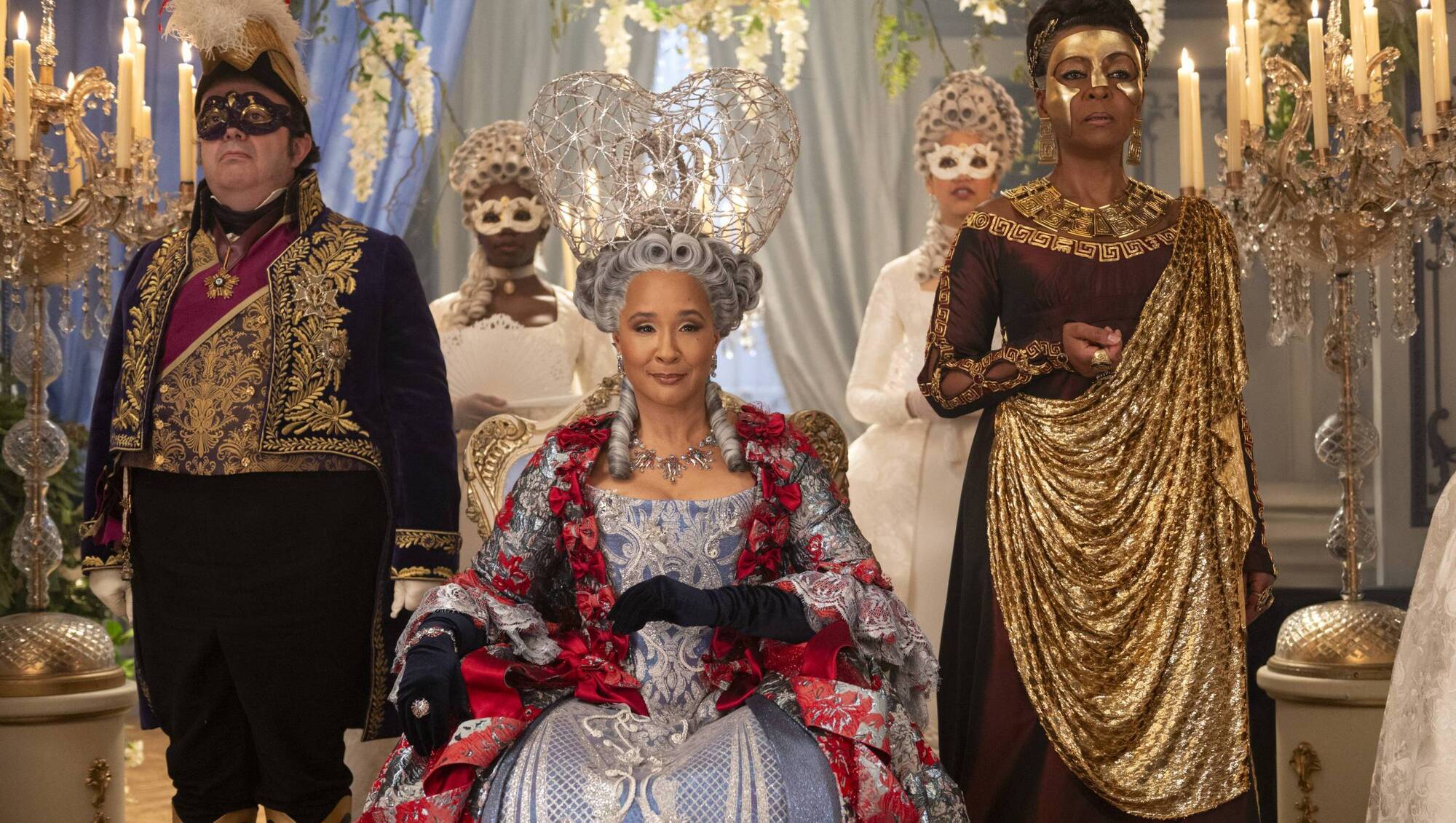
‘Colourblind casting' in shows such as ‘Bridgerton’, with Golda Rosheuvel as Queen Charlotte and Adjoa Andoh as Lady Danbury, risks obscuring the racism of the past, says Sarah Harte.  Picture: Liam Daniel/Netflix

Elon Musk has kicked off a row on Twitter (nothing new there) by claiming that the filmmaker Christopher Nolan has lost his integrity by casting the Oscar-winning black actress Lupita Nyong'o as Helen of Troy in his upcoming film, The Odyssey.

Nyong’o’s casting has not yet been confirmed, but the maddening crowd on X seem divided. Some argue that one of the most famous figures in Greek mythology was described in the Iliad and the Odyssey as ‘white-armed’ with ‘lovely hair’ and therefore Nyong’o is miscast. 

In contrast, others reasonably argue that these mythological characters didn’t in fact exist, so the actors who portray them can be any colour.

For the record, anyone who suggests that Nyong’o isn’t beautiful, as some have implied on X, badly needs to go to Specsavers.

Lupita Nyong'o with Schnitzel promoting 'A Quiet Place: Day One'. Nyong'o starred in the movie as Samira with Schnitzel as her cat, Frodo. Picture: Paige Young

It’s not the first time, however, that casting actors of colour, particularly in period dramas, has produced differing reviews. Last week, a BBC-commissioned review recommended that the BBC stop ‘box-ticking’ in casting its dramas to ensure diversity. 

Naturally, this warmed the cockles of the right-leaning press, with The Telegraph, The Spectator, and the Daily Mail gleefully reporting the news.

The review assessed “how accurately and authentically the BBC portrays and represents different groups and communities across the UK”. ]

Some participants in the review objected to colour-blind casting or what critics term ‘blackwashing’, while others felt more diversity was needed. 

Reportedly, a significant proportion of the viewing public thought that the BBC overdo it on the diversity front, but that doesn’t mean they are right.

'Colourblind casting could breed complacency'

The BBC review counsels against giving the viewer an inauthentic experience, highlighting the dangers of seeming to lecture or make a point ‘heavy-handedly’.

Then it gets to a controversial point.

“In depicting an anachronistic historical world in which people of colour can rise to the top of society as scientists, artists, courtiers, and Lords of the Realm, there may be the unintended consequence of erasing the past exclusion and oppression of ethnic minorities and breeding complacency about their former opportunities.”

Now, some creators will likely disagree. The hugely talented screenwriter and television producer powerhouse Shonda Rhimes, who created Bridgerton for Netflix, is the CEO of the juggernaut media company Shondaland. 

Season four of has just dropped on Netflix, with further series five and six commissioned, which is good news for mega fans, of whom there are many. It is one of Netflix’s top 10 most popular shows of all time.

Producers Shonda Rhimes and Betsy Beers with Netflix chief content officer Bela Bajaria at the world premiere in Paris last month of season four of the Netflix costume drama Bridgerton. Picture: Ian West/PA

Rhimes, who has repeatedly broken fresh dramatic ground, adamantly rejects the constraints of strict historical accuracy: “If a black woman in the 21st century can see herself in Regency England, it’s a good story.”

She dislikes the term “diversity” and considers herself to be normalising television to reflect society. Just depicting people as ‘people’ rather than centring a character’s race.

Many actors of colour portray people in Bridgerton, although it purports to be set in early 19th-century Britain. 

At that time, somewhere between 10,000 and 20,000 black people lived in Britain, depending on the source of your figures, as censuses did not record ethnicity. What is certain, though, is that very few of these people were rich and powerful.

Not everyone endorses this dramatic historical revisionism.

Glossing over slavery 

Black British historian Steven I Martin specialises in black British history and literature, working with museums and archives to bring diverse histories to broader audiences. In his own words, he firmly believes in the power of archives as an agent of positive change.

However, he considers Bridgerton’s take on racism to be a fantasy because the reality was that Britain then was the largest trader in human lives on the planet. He says: 

Slavery was central to the British economy.

He adds that he show entirely overlooked “the realities of that period”, which made him very uncomfortable.

Yale professor Marlene L Daut also raised concerns about Bridgerton, calling it a ‘multicultural Mecca’ showing black faces but glossing over slavery.

She argued that if “people want to see black aristocracy on screen, then why not just put them in 19th century Haiti where they really lived” rather than offer colour-blind inclusion unrooted in historical reality.

Work — and representation 

The practical advantages of historical reworkings are that actors of colour get jobs that would otherwise be lost to them. They are no longer confined to playing the baddie, an enslaved character, or a character with a traumatic backstory.

Then there’s the power and value of representation, which is obvious or should be.

To any criticism of blackwashing, it’s easy to counter with the industrial-scale historical whitewashing that has long taken place, so you could strongly argue that it’s simply a question of rebalancing the scales.

But you could also argue that, in certain contexts, both whitewashing and blackwashing, pursued for different reasons, end with the same result. A suppression of truth, which is presumably what the BBC is driving at.

Denying hard facts

It’s a valid question. Is something lost by soft-soaping hard facts? Can you tackle the racism hard-baked into society if we, with one sweep of a script, deny those facts?

In Florida (and in many other states in the US), in a major act of whitewashing, the Stop WOKE Act effectively denies children an honest education, preventing students from learning about brutal racism, minimising white supremacy, in case it causes white children distress.

If we accept that enslavement was profoundly degrading and dehumanising, can it be right to relegate it to a minor subplot?

Let's say a child is learning about history and watching a documentary with reconstructions of the period.

Would it be desirable for them to picture former presidents Éamon de Valera or Mary Robinson as black? Would that not suggest that Ireland was a racially diverse society where people of colour rose to the top when the very opposite was true?

Casual racism 

I told white Irish teenagers about the casual racism in Irish schoolyards in the 1970s and ’80s, and their mouths literally dropped open. They could not get their heads around the fact that their parents had sung these rhymes and that teachers and parents were OK with that.

They were literally like: “Are you serious?”; “My God, that’s shocking.”

Should I have told them that or occluded that reality? Who is cast in a big blockbuster movie such as The Odyssey as the mythological Helen of Troy doesn’t ultimately matter.

Tell it like it is (and was) 

But I can’t help but think we need to teach children how the world was, rather than what it ought to have been. Otherwise, we risk giving ourselves a big old pass on racism while sanitising historical realities and pushing a myth of progress that is not rooted in fact.

More in this section

Revoiced

Newsletter

Sign up to the best reads of the week from irishexaminer.com selected just for you.

Cookie Policy Privacy Policy Brand Safety FAQ Help Contact Us Terms and Conditions

© Examiner Echo Group Limited