Paul Hosford: Trump’s imperialist instincts run counter to Ireland’s foreign policy heritage

In a week of tumult and turbulence, it was perhaps the Canadian prime minister Mark Carney who exposed just how much Donald Trump’s bizarre pursuit of Greenland had crystalised matters for world leaders
Paul Hosford: Trump’s imperialist instincts run counter to Ireland’s foreign policy heritage

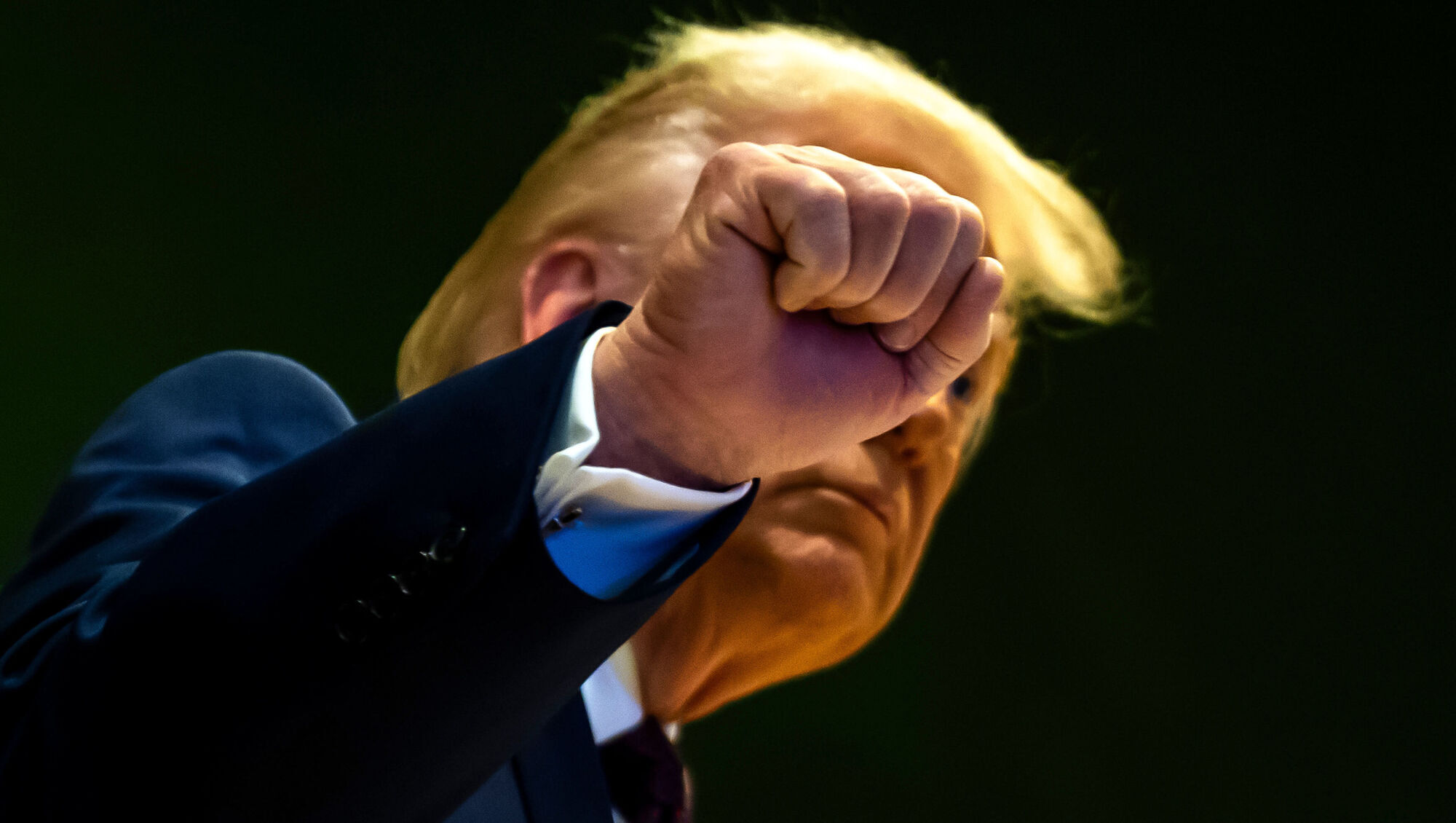
US president Donald Trump at the World Economic Forum in Davos, Switzerland. Trump had spent much of the preceding week ratcheting up his insistence that his country ‘needs’ Greenland. Picture: Laurent Gillieron/Keystone via AP

There were words.

Hundreds of them, many incomprehensible, but the sentiment was undeniable; the world you knew is over and one of the West’s most enduring establishments was under threat.

But enough about the Beckhams, there’s geopolitics happening.

In a week of tumult and turbulence, it was perhaps the Canadian prime minister Mark Carney who exposed just how much Donald Trump’s bizarre pursuit of Greenland had crystalised matters for world leaders.

“We are in the midst of a rupture, not a transition,” Carney said.

He noted that Canada had benefited from the old “rules-based international order”, including from “American hegemony” that “helped provide public goods: Open sea lanes, a stable financial system, collective security, and support for frameworks for resolving disputes.”

But that old order is gone and is not coming back, he said.

“Call it what it is: A system of intensifying great power rivalry where the most powerful pursue their interests using economic integration as coercion.”

Making himself one of the few world leaders to expressly warn against bending the knee to superpowers, Carney warned that “compliance will buy safety”.

“It won’t,” he said.

“The question for middle powers, like Canada, is not whether to adapt to this new reality. We must. The question is whether we adapt by simply building higher walls — or whether we can do something more ambitious.”

Canadian prime minister Mark Carney delivers a speech at the World Economic Forum in Davos, Switzerland. Picture: Sean Kilpatrick/The Canadian Press via AP

“Middle powers must act together, because if we’re not at the table, we’re on the menu,” Carney said.

That the former Irish citizen’s comments come in the days after his visit to China, it is clear that the US’s neighbour to the north has come to a conclusion that is creeping across the world: America is no longer a basket in which to put one’s eggs.

With the world’s leaders descending on Davos in Switzerland for the World Economic Forum’s yearly summit, Trump had spent much of the preceding week ratcheting up his insistence that his country “needs” Greenland, an Arctic island which is both a crossroads for ships from the US, China, Europe, and Russia, but most crucially, part of Denmark.

While 150 American troops are stationed on the island at Pituffik Space Base, the US has over time drastically reduced its presence in Greenland, which had been agreed under a 1951 treaty. But while the US has history on the island, Trump’s reasoning has seemed more personal than historical.

In a New York Times interview published earlier this month, he was asked why he was focused on owning the island and not just triggering a clause in the treaty that would allow the US open military bases in Greenland and his answer was instructive.

“Because that’s what I feel is psychologically needed for success. I think that ownership gives you a thing that you can’t do, whether you’re talking about a lease or a treaty. Ownership gives you things and elements that you can’t get from just signing a document.”

These words do not indicate a world leader who knows how or why to get what he wants, just that he wants it.

Much of the coverage and analysis here in Ireland of Trump’s ramblings — which included a 30-second segue about how he wouldn’t have shown pain had a binder clip cut his finger off — focused on Ireland’s position as betwixt and between. 

On the one-hand, our long-standing cultural ties and economic dependence on the US. 

On the other, our EU neighbours and allies. 

The same EU which had been lauded for its protection of the Irish island in the last decade as another unpredictable neighbour tore up the neighbourhood.

Somehow, this was presented as an equal consideration. That Ireland’s allies were merely having a disagreement, and not that one had openly spoken about annexing another’s territories while not ruling out use of force to do so. 

Of course, Ireland is exposed to the whims of the US president, but at what point does one ask the glaring question; is an ally that you have to allow do whatever they want for fear of retribution an ally at all?

Ireland’s long-standing economic and diplomatic alignment with the US has delivered undeniable benefits, from foreign direct investment to cultural and political support — Ireland’s peace has US fingerprints all over it and our culture is threaded through with American media, sports, and language.

However, the wild unpredictability of the Trump administration in both policy goals and rhetoric has sharpened the case for Ireland to strategically decouple — at least in part — from excessive dependence on the US. 

You can see this in the Taoiseach’s early January visit to China while he mentioned India at a Davos roundtable as another place where trade will be sought.

He and Carney met in Ottawa in September and are expected to meet again this year as Canada seeks its own decoupling.

None of this is an argument for hostility or isolation, but for autonomy, resilience, and the protection of Irish and European interests in an increasingly volatile world.

Of course the Taoiseach should still travel to the White House, Irish people can still enjoy Hollywood’s output, and I will be watching the Superbowl and the New York Yankees opening day in the coming weeks.

But Trump’s political project is rooted in transactional nationalism. 

His “America First” agenda openly rejects multilateralism, undermines international institutions, and treats allies as expendable if they no longer serve immediate US interests. For a small, open economy like Ireland, this approach is more dangerous than attempting to strike out without them. 

Trump has already repeatedly threatened punitive tariffs, corporate tax retaliation, and the reshoring of US multinational activity, much of which underpins Irish employment and tax revenue. 

An Irish economic model so heavily exposed to the whims of one US administration is not structurally sound.

Beyond this, Trump’s imperialist instincts and his visible disdain for international law and his willingness to use economic coercion run counter to Ireland’s foreign policy heritage, which has historically championed neutrality, diplomacy, and the rules-based international order. 

Continued alignment with a US leadership that dismisses these principles risks eroding Ireland’s credibility on the world stage.

There is also a European dimension. Ireland’s future lies in deeper integration with the EU, not in acting as a quasi-outpost of US corporate and strategic interests. 

Overreliance on US multinationals distorts the domestic economy, inflates housing costs, and narrows policy space. 

A Trump administration hostile to the EU could pressure Ireland to act as a wedge within Europe, forcing an artificial choice between Brussels and Washington. 

Strategic decoupling would reduce Ireland’s exposure to such pressure and strengthen European solidarity.

Decoupling does not mean severing ties. It means diversifying trade, investing in indigenous enterprise, deepening links with Europe and the Global South, and asserting a more independent foreign policy.

The last week should highlight a simple truth: US interests are not Irish interests.

A mature, confident Ireland must recognise this reality and not be held hostage by the ambitions of any one foreign leader.

In a world of resurgent great-power politics, strategic independence is no longer a luxury — it is a necessity.

More in this section

Revoiced

Newsletter

Sign up to the best reads of the week from irishexaminer.com selected just for you.

Cookie Policy Privacy Policy Brand Safety FAQ Help Contact Us Terms and Conditions

© Examiner Echo Group Limited