Gareth O'Callaghan: As temperatures drop, Ireland’s homeless face a silent and deadly crisis
The spectre of homelessness haunts far more people than the figures indicate. Many are just a week’s pay away from it. Almost 270,000 Irish people live in a state of consistent poverty, while a further 630,000 are at real risk of poverty. File Picture: Leon Farrell/RollingNews.ie
“Nothing burns like the cold. But only for a while,” wrote George RR Martin in A Game of Thrones.
“Then it gets inside you and starts to fill you up and, after a while, you don’t have the strength to fight it.”
Freezing to death is one of the most frightening ways the body can silently die.
In those final moments, you experience a feeling of intense heat as though the heart is fighting its most ferocious battle. Unfortunately that’s not the case.
The body’s survival temperature at its core is about 37C. Once that drops below 35C, hypothermia sets in. Violent shivering is the brain’s attempt to produce heat, but this zaps the energy supply. As the core heat falls, the heart slows and blood pressure drops.
Around 32C, the brain mistakes the freezing sensation for intense heat. This causes victims of hypothermia to remove their clothing — a sensation known as paradoxical undressing.
Extreme cold is now crippling the brain’s electrical functions. The body can no longer shiver. Heat loss accelerates uncontrollably. Temperature starts to drop rapidly. Heart rhythm is now too slow. Breathing is suppressed and oxygen deprivation sets in.
As the core drops below 28C, death is moments away. Heartbeat and breathing cease. At that point, the victim is already unconscious. Our bodies are helpless in the face of extreme cold — like the type we felt last week.
Given the right conditions, anyone can die of hypothermia. I’m reminded of this whenever I come face to face with someone who is homeless, someone who asks me for the price of a cup of coffee.
It happened on a sunny afternoon last weekend when the mercury had dipped to -5C.
I asked him his name. Tom. He had one mother of a chest infection. Despite his shivering, he was polite and chatty. I could also see he was exhausted. Questions flash through my mind on these occasions. How did he end up here? Who are his family? Do they worry about him? Does he care about them?
Of course, it’s none of my business.
But then I pause for a moment and imagine we had swapped places, and I was the one asking the stranger for the price of a coffee.
Yes, it is my business. If it’s not, then it should be
Two weeks earlier, I was waiting for a bus close to Dublin city centre.
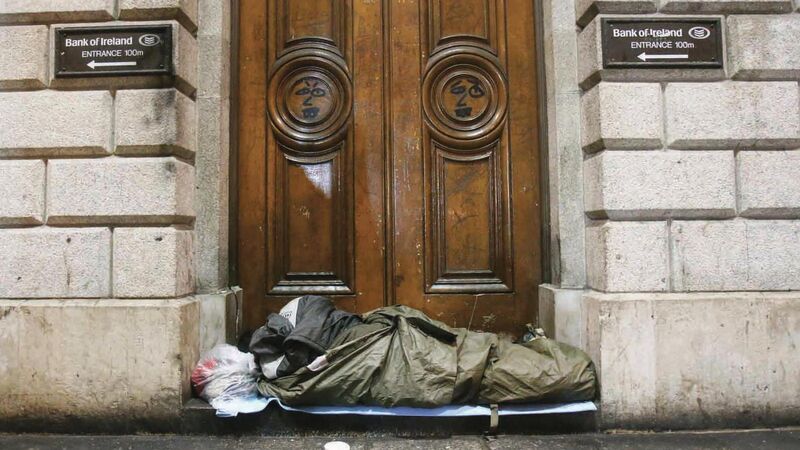
In the corner of a doorway behind me lay a body in a filthy wet sleeping bag. I call it a body because it wasn’t moving. Nobody else in the queue seemed bothered.
I knelt down and asked if whoever was inside was ok. A pale face with blotchy red eyes appeared. A young man with fair hair. He focused on me for a moment, then asked me to go away. He pulled the duvet back over his head.
For whatever reason — call it helplessness — I took a photo of the sleeping bag and posted it on Facebook later that evening. Perhaps my reason was because this was someone’s son.
Within hours, I had been contacted online by three different families, each asking me if I had a name or a description of the young man.
Their sons (or siblings) were missing, possibly out on the streets, hopefully alive.
'Lost boy'
Each of them explained how their own lives had been shattered — taken apart by their “lost boy out there somewhere on his own”, as one mother described it.
Why couldn’t I have just asked him his name? That question has haunted me ever since. I stood at the bus stop the next morning. The sleeping bag was gone.
This isn’t about the 16,000 people in State-funded emergency accommodation. It’s about those who vanish onto the streets and become ghosts in the shadows. Why are they society’s “forgotten”? Apart from the handful of services and individuals who give their time to reach out to those sleeping rough, does anyone really care?
Homelessness reflects not individual failings, but society’s unwillingness to care for its people. Nor is it a modern crisis
Cork Simon’s annual report for 1981 stated that its nightly soup run helped 97 people sleeping rough in 1979, 148 in 1980, and 106 in 1981. Of the 106, 10 were children, 23 women, and 73 men.
Two years later, four of them were dead. Simon described homelessness as “a situation of multiple deprivations”.
In 2023, there were 577 people sleeping rough in Cork City.
When Jonathan Corrie died in a doorway within walking distance of Dáil Éireann in 2014, public outrage was off the scale. Would it have been so vocal if he had died anywhere except in the shadow of Leinster House?
Corrie didn’t want emergency accommodation. Speaking to Dublin City FM reporter Hannah Parkes months before his death, he said every person should be “given a chance” to prove they could move out of being homeless.
Apollo House proved that in December 2016 when the Nama-owned, derelict Dublin city centre nine-storey building was taken over by activists who offered it as accommodation to the homeless.
Home Sweet Home
During an appearance that week on The Late Late Show, activist and singer Glen Hansard told Ryan Tubridy that the group behind the takeover, known as Home Sweet Home, was involved in “an act of civil disobedience”.
Two years after Corrie’s death, Apollo House focused more attention on the plight of the homeless than any other campaign in history.
Some 205 homeless men and women spent time there. The towering eyesore on the city’s skyline became an unlikely symbol of hope for 27 days. Hundreds of tradesmen offered their services free of charge.
Volunteers queued to offer support. It took just three days to convert two floors of the building into a safe and comfortable hostel.
Even Mr Justice Paul Gilligan told the activists in the High Court that he admired their campaign, but that the court had to address the matter of trespassing on private property.
Within weeks, many of those temporarily housed — despite being offered alternative accommodation — were again back on the streets.
But why did it take an act of civil disobedience to fuel such huge public interest in homelessness? Was it a tipping point or a kickback against the government’s ineptitude and lack of vision during that brief period between a gruelling recession and an overwhelming housing crisis?
If this Government can’t resolve the current housing crisis for all the people on the housing list, then there isn’t a hope of any political interest in the plight of those who do live on the streets.
The spectre of homelessness haunts far more people than the figures indicate. Many are just a week’s pay away from it. Almost 270,000 Irish people live in a state of consistent poverty, while a further 630,000 are at real risk of poverty.
Ten years ago, a group of volunteers with big hearts, who thought outside the box, made a difference in the lives of hundreds of rough sleepers for the few weeks they were tolerated by the authorities.
Imagine if each of us honoured a personal commitment to the homeless on the streets. Those who live on our streets are asking for our support, gently disguised as the price of a coffee. Surely we can do more.
Jonathan Corrie talked about “a huge amount of buildings that could be converted”. He never lived to see the conversion of Apollo House. All he wanted was a bedsit to call his own. His forever home.
CONNECT WITH US TODAY
Be the first to know the latest news and updates
More in this section