Paul Hosford: Government's failure to improve people's lives risks a disconnected electorate vulnerable to populism
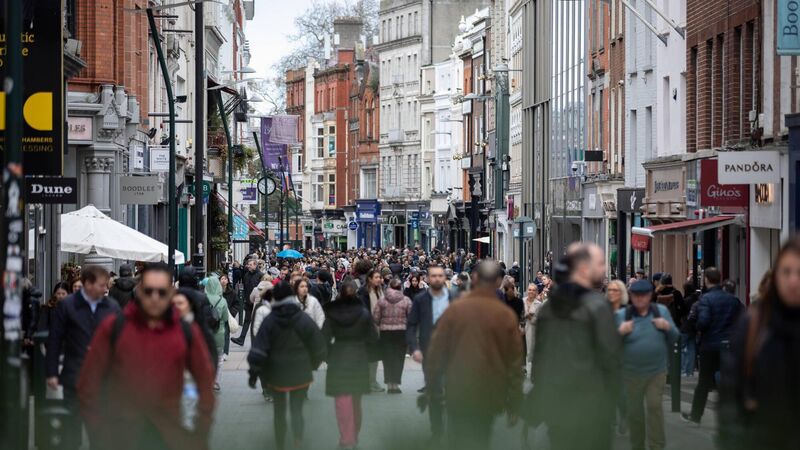
The last 18 months or so of Irish political life have seen little in the way of tangible improvements in day-to-day life for most. Picture: Patrick Bolger/Bloomberg
What is the measuring stick for a government's utility?
A year into this Coalition's time, it's reasonable to ask just what, exactly, a government is for. Is it legislation? Plans? Leadership? Regulations?
If you believe it is legislation, then this Coalition is certainly something of a laggard. Including two bills enacted this week, the Coalition is up to 14 for the year of 2025. There will be another five or six, but the first year of this Government will likely be way off the 32 pieces of legislation passed in the first year of the last government, 2020.Â
It is a legislative output which has been rounded on by the opposition, most of which has used some version of the term "do-nothing Government".
In November, Sinn FĂ©in leader Mary Lou McDonald said this iteration of Government "may well be the worst government in the history of the State — because no government has presided over such a combination of record crises, hollow promises, and stubborn inaction".Â
McDonald, never slow to give her unvarnished opinion of her Dáil counterparts, told the Dáil: "This Government came into being on the back of a grubby deal with Michael Lowry and his associates, and it certainly shows. An arrangement that allowed them to attempt to play both Government and opposition at the same time. A deal born of desperation for office, not dedication to the Irish people. And from its first moments in office was the moment the rot set in."
Government members will argue that 2020 saw a chunk of six or seven bills passed to deal with immediate and existential crises like Brexit or covid, and that 2020's 32 bills was not realistically sustainable.

Besides, they will add, the speaking row which saw the Government formed, as referenced by McDonald, had a knock-on effect. With no agreement on speaking time came no committees. No committees meant the passage of legislation was stymied. All things considered, senior members of the Government will argue privately, the level of output is fine.Â
Besides, they will say, the Government's role goes beyond simply passing bills. There have been marquee announcements of plans in housing, in infrastructure, this week in childcare. The argument is that the Government may not be passing laws, but it's planning to address systemic issues.
In parallel, several long-standing issues — especially in housing and healthcare — have either progressed slowly or failed to produce tangible improvements felt by the public. This feeds a sense of inertia in the political and public system and drives an apathy from the public as problems become endemic or acute and accepted as par for the course.Â
Take housing, for example. In a country where homeless has increased 10-fold in just over a decade, there have been few national mobilisations around the issue. Indeed, the last subject which saw any real public protest was water charges in the early stages of the last decade.
This sense of inertia is reinforced by lived experience. Rents remain high, home ownership is increasingly out of reach for younger people, hospital waiting lists persist, and pressures on household finances continue despite strong headline economic figures.Â
As a result, describing the Government as having “done nothing” functions less as a literal claim and more as an expression of political disillusionment.
But this political disillusionment infects all levels of the political system and public life. In the face of a Government which feels in a holding pattern, the opposition has failed to make a meaningful dent.Â
In her contribution on former finance minister Paschal Donohoe's departure, McDonald referred to the Dáil bike shed scandal. While the €330,000 spend on the shelter undoubtedly cut through and captured the public imagination, it was last year.
The problem the opposition has run into is that if they attempt to make everything seem like a scandal, nothing seems important to the public. If somebody is always giving out, what's one more day of it?

It is a strange paradox — a Government which doesn't seem to have much in the way of broad strokes ambition and trundles along in an incrementalist dander, and an opposition which is somehow struggling to make the public care too much about it.Â
Irish people, it feels, have either become broadly OK with the way the country is going or don't see how it can change.
All of this contributes to a general populace that is becoming less engaged in politics and cannot see where the intersection of politics and policy is, that the realities of our day to day are the result of years of policy decisions which compound.
The media, too, plays its part in this. Some, not all but too many, attempt to make politics little more than a sideshow, a strand of entertainment. In a world where eyeballs are being dragged everywhere, the demand for entertainment value is at an all-time high.Â
In other countries, we see that this has led to politicians who think little of saying and doing things which we would, thankfully, consider beyond the pale. But nuance as a virtue has all but been dispensed with, as simple lines are drawn. But the public isn't stupid, it will accept thoughtful answers — just look at Catherine Connolly's presidential campaign.
The notion that the Government is "doing nothing" is obviously facetious. There are good and talented people at every level of the Government parties, and the hours and pressures of modern politicians are gruelling, truly.Â
But the last 18 months or so of Irish political life have seen little in the way of tangible improvements in day-to-day life for most, as decades-old structural deficits come home to bite.
The danger from failing to address those issues, through legislation or the actual implementation of those glossy plans, goes far deeper than just not making childcare cheaper or housing more available.Â
It risks an electorate which is disconnected, apathetic and vulnerable to populist charlatans. That would be a failure by any measuring stick.