Clodagh Finn: Remembering the artist who illustrated Joyce’s Finnegans Wake
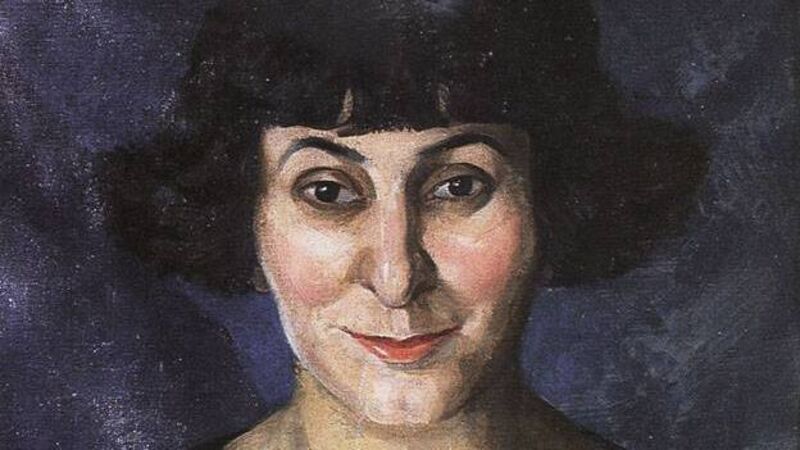
Stella Steyn had an exceptional career as an artist.
If there is one potentially unifying thing that has emerged from the controversy over the denaming (or not) of Herzog Park, it is the unexpected but happy return of artist Estella Solomons to the spotlight.
Her name has been mentioned several times in recent days in a pretty uncomfortable discussion about who in the Irish Jewish community deserves to be remembered or not.
It was a real balm, though, to leave all of that aside and venture down the digital rabbit hole to marvel again at her wonderful portraits, landscapes and etchings so recently celebrated at the National Gallery in , an exhibition of her work in 2022.
At the time, the gallery described her as “a rebel woman”, an acknowledgement of the fact that Estella Solomons joined the Ranelagh branch of Cumann na mBan in 1917. She once hid ammunition for Sinn Féin volunteers under lettuces that she had planted in her parent’s garden on Waterloo Rd in Dublin.
Her studio on Great Brunswick St (which, pertinent for our times, was renamed Pearse St in 1924) was also used as a ‘safe house’ for those on the run. She painted many of those revolutionaries, but had to destroy some of the portraits as they would have identified the sitters.
HISTORY HUB
If you are interested in this article then no doubt you will enjoy exploring the various history collections and content in our history hub. Check it out HERE and happy reading

As for Estella Solomons herself; she was a woman whose artistic talent was already evident at the age of 16 when she enrolled at the Dublin Metropolitan School of Art in 1898. Look up the details of her life because in it, you’ll see how many other female artists were in her circle — Mary Swanzy and Eva Hamilton, for example — and how many of them were overlooked later.
Having said that, it was also really encouraging to see just how celebrated she was in her day.
In December 1936, the papers noted that at least 150 people were present at the opening of her exhibition at Daniel Egan’s Gallery, while the gave this wildly enthusiastic review of her portrait of poet and painter AE (George Russell): “This astonishing picture would stand out no matter where one came across it. Depicted seated, with a background of books, the dead writer is evidently in conversation and about to fill his pipe… There can be no doubt that where this portrait is, ‘AE’ lives.”

Estella Solomons was at the heart of Irish cultural life. She painted many of its prominent figures — Alice Milligan (writer and activist); Kathleen Goodfellow (poet and writer); Frank Aiken (later Tánaiste and foreign minister), and poets Padraic Colum and Austin Clarke to mention a few) — and she helped her poet-husband Seumas O’Sullivan edit the famous literary journal, the Dublin Magazine.
Yet, when she died in 1968, her death made just a few paragraphs in the evening newspapers.
She was not forgotten, though. When a history of her former school Alexandra College was published in 1984, Ulick O’Connor argued that its authors had not done enough to celebrate the achievements of some of its former pupils in the arts.
“It doesn’t seem enough to me,” he wrote, “to inform the reader that Estella Solomons and Mary Swanzy were among a group of ‘talented students in the artistic fields’. Mary Swanzy was to become a painter of near world renown and Estella Solomons is among our best portrait painters.”
That brings me to another high-achieving graduate of Alexandra College, the school founded in 1866 by Anne Jellicoe which would go on to revolutionise education for women in Ireland.
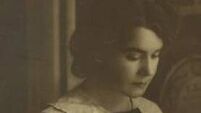
If you look up Stella Steyn, born in Dublin in 1907 to Jewish parents William Steyn and Bertha Jaffe, you might find her life reduced to a line such as this, as I did: “Notable work: Illustrations for James Joyce’s ."
And that is indeed notable, as is her description of being asked to do so when she was visiting her friend, Lucia, Joyce’s daughter in Paris in 1929. It is worth quoting in detail: “One late afternoon I had called for Lucia and was sitting waiting for her when he [Joyce] came into the room and, taking no notice of me, he went to the piano and with his head bowed over his hands, accompanying himself, he sang some melancholy Irish songs in a low, sad, voice. I said, ‘You must miss Ireland?’
He replied, ‘I do’.
I said, ‘Would you not like to go back?’
He replied, ‘No. They jeer too much.’
“I agreed to try some illustrations for him for . He read passages from the part he suggested to me. I think it was old Ondt’s funeral and the rivers of the world holding the train of Anna Livia (the Liffey). I am afraid I understood nothing. He said I had a smattering of a couple of languages and might get something from it, and drew my attention to the musical quality of the language. Today I would have said I understood him, but I am afraid at that age I didn’t lie, and so had to admit to him that I did not.”
While that is of note it is not, by any measure, the most important or interesting part of Stella Steyn’s shamefully still-overlooked artistic legacy.
Just months before that conversation with Joyce, Stella Steyn was hailed as one of the ‘Leading Figures in Modern Irish Art’ in , of March 1929, alongside Harry Clarke, Paul Henry and Seán Keating.
That fact was unknown to me until I read Chiara Harrison Lambe’s award-winning essay on Steyn which traces the path of the artist’s exceptional career.
Here is the briefest of outlines. After studying at the Dublin Metropolitan School of Art, supported by her family and tutor Patrick Tuohy, she honed her skills as a painter and illustrator in 1920s Paris, following in the footsteps of other female artists such as the much-better-known Mainie Jellett and Evie Hone.
In the early 1930s, though, Stella Steyn did something that no other Irish artist did — she enrolled at the Bauhaus in Germany, the famous school of design, architecture and applied arts. Her teachers included Wassily Kandinsky and Paul Klee.
By then, she was already well established, not just in Dublin but in London, Paris, and New York. Her paintings were exhibited at the Royal Hibernian Academy in Dublin; the first American exhibition of contemporary Irish art at the Helen Hackett Gallery in New York, and at St George’s Gallery in London. And that is not a complete list.
Why then, as Chiara Harrison Lambe asks, does her work so rarely appear in accounts of significant 20th-century Irish artists?
Her essay, which won the National Gallery’s inaugural Sarah Cecilia Harrison essay prize in 2022, was entitled: Stella Steyn (1907-1987): ‘A name to remember.’
Seek it out and read it; it is a masterful study of the power of art at this disturbing time when there is so much talk of names and which ones we should remember.