Sarah Harte: Anti-hate laws not about being woke, we need clear and legal parameters
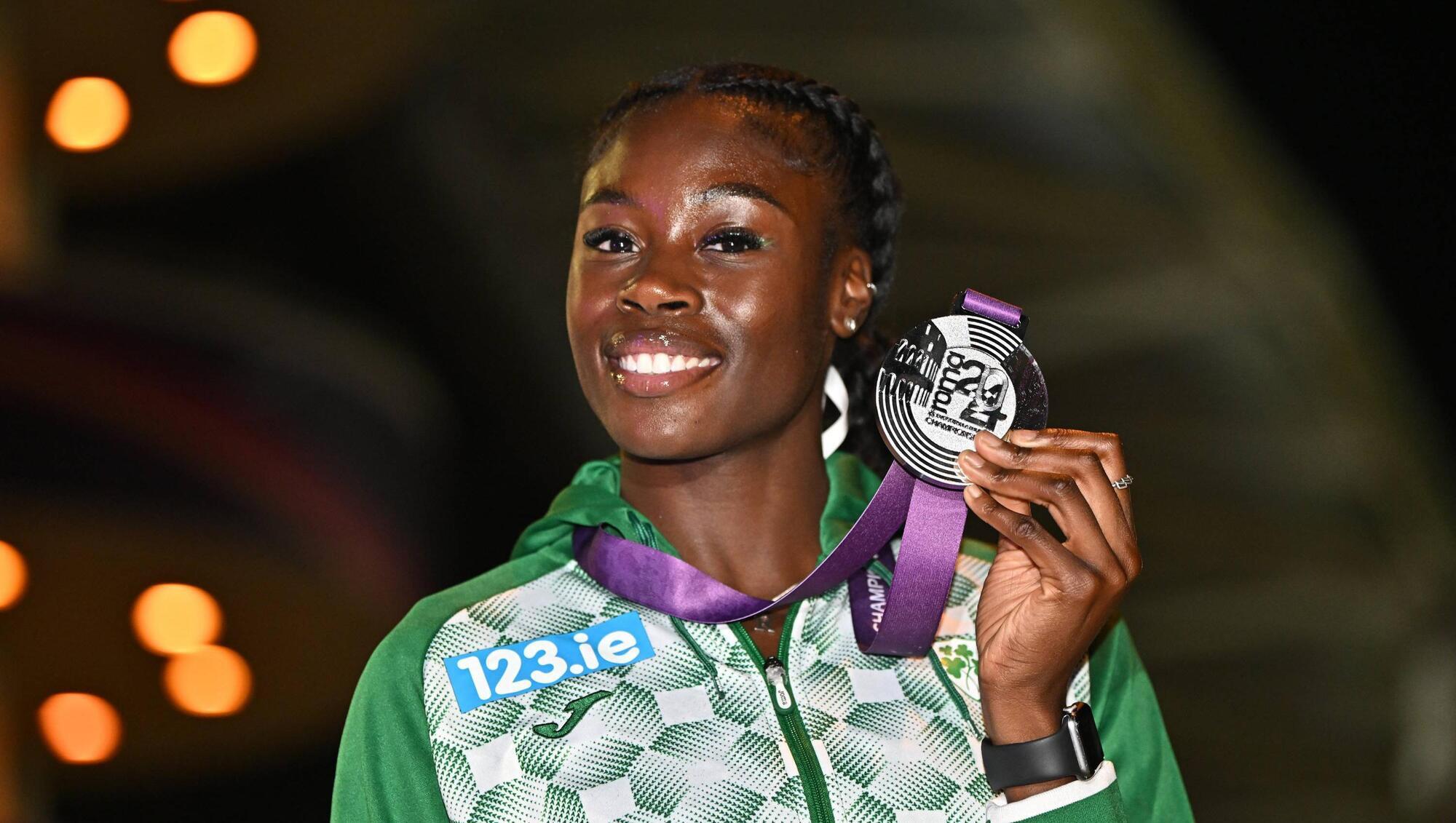
Women's 400m silver medallist Rhasidat Adeleke of Ireland poses with her medal at the 2024 European Athletics Championships at the Stadio Olimpico in Rome, Italy. Picture: Sam Barnes/Sportsfile
Wasn’t the European Athletics Championships amazing?
It’s been a long time sporting-wise since we felt that collective buzz.
The 400m mixed relay race wasn’t shown on RTÉ, so I watched it with a family member, craning over his shoulder to watch it on his phone.
Afterwards, we flew to his computer and watched the after-commentary on a chest-thumping race.
Then my phone started buzzing, and friends got in contact, including one man who pulled on the green jersey for Ireland many times.
I went to bed misty-eyed.
It was our first such gold medal since 1998.
It was my second favourite sporting event ever.
Why? Because the Irish team marked an astonishing championship record of 3 minutes and 9.92 seconds.
Listening to them afterwards was heart-lifting.
Chris O’Donnell who ran a great race, was so self-effacing, speaking about how he hadn’t imagined it in his wildest dreams.

Thomas Barr, who for a long time has been a great performer for his country and ran his fastest relay split ever, acknowledged his triumph with his trademark West Waterford Deise graciousness.
Sharlene Maudsley, who flew past Femke Bol, gave her big smile and spoke about looking forward to hearing the national anthem on the podium.
Then Rhasidat Adeleke, a super-speedy Irish girl, also said, with her winning smile, that before the race, she felt they could pull it off.
Rhasidat and Sharlene are doubtless to a generation of girls what Sonia O’Sullivan was to me and others in the 90s, a new face of Ireland.
To go back for a second to my favourite sporting memory.
It was watching Sonia O’Sullivan in the heat of the 3000m in the Barcelona Olympic games.
I was a young waitress wrapped in her apron in a working man’s pub in Cork City on a short break from a nearby café with a warning not to be long.
The bell dinged for the last lap, and rising star Sonia came from the back against the background of male cries in the pub of “Go on Sonia, girl!’ to power towards the finishing line.
It felt like a new departure.
It wasn’t simply about running, it veered into far deeper emotional waters because back then there was a marked lack of female role models both in sport and otherwise.
So, watching Rhadidat and Sharlene pound down the track, I was somehow brought back to that seminal moment.

At some comparable level, I felt it was a fresher, more expansive Ireland, another phase in our evolution.
So, what a crashing disappointment it was to read that Rhasidat, who collected three medals, one gold and two silvers, had been in what her coach described as a dark place because of online abuse and hate.
We went online in droves to praise her as Taoiseach Simon Harris did, but this won’t have helped her psychologically, in the split second she discovered that she had been targeted by faceless cowards.
She wants to move on and focus on the upcoming Olympics in Paris, and no surprise there because that is what champions are made of.
But it does leave us with a question mark over how we continue to live in a society where online hate is a fact of life for so many people.
Last month, An Garda Síochána reported a 12% increase in “hate-related incidents” in 2023.
That followed an even higher increase in 2022 of 22%.
These are just the reported incidents.
What can we do?
Legally, we can enact the Hate Crime Bill once we amend it, this incorporates online abuse.
Currently, in the Seanad, it needs a clear definition of what hatred is, as unclear law is always bad law.
Our 1989 act is ineffective, so we have no law to address anti-hate posting online.
It’s not ‘wokery’ having an anti-hate law as some politicians have suggested, that view is an on-trend simplification of the issue.
We simply need clear legal parameters.
On that subject, Elon Musk, who has suggested he will take legal action against the Government if we pass the law, needs to butt out.
Plenty of us support free speech, but not his brand.
Donald Trump Jr also needs to mind his own business, because nobody cares what he has to say, except maybe for dead elephants.
The same goes for Ohio Republican senator JD Vance, who in the context of the bill, has ludicrously compared us to China and Iran, neither known for their wokery.
Currently, social media accounts can be created and used anonymously or even with pseudonyms, which has to be a driver of some of the abuse.
Because of European privacy law and GDPR, we’re not in a position to force the tech and social media companies to remove anonymity from social media which would surely reduce online levels of abuse.
But privacy-friendly age verification system technology is on the way, which will allow this.
It’s a subject that needs further debate as there are potential downsides to removing anonymity.
Critics say it would curtail freedom of speech.
Other arguments against it include that users exploring their sexuality or gender identity would be exposed, as would whistleblowers or sources for journalists.
In short, vulnerable people who need anonymity would be impacted.
An additional argument is that social media companies would know even more about us, be able to link our real-world selves with our online activity, and mine that data.
What we should attempt to do at governmental level is force social media companies to manage the regulation of online abuse better.
They do zip to regulate online abuse, relative to the enthusiasm with how they mine our data.
On the public health front, social media companies have played a significant role in the degradation of public discourse, which results among other things in the spewing of hate.
They also have failed to deal with images of graphic content on their platforms.
Last month, our media regulator, Coimisiún na Meán, faced criticism when it published its draft online safety code, which omitted tackling algorithms or recommendation systems suggesting content to users, although they have said that they will address the problem through the EU Digital Services Act.
This needs to happen quickly.
Every week there are reams of stories about parents in particular, complaining about the damaging material recommended to their children’s social media feeds.
Even if the law moves at a crepuscular speed, change is on the way.
Although this is a subject for another column, mark my words, criminal law is going to change as the immersive tech market develops and virtual technology becomes more real, because the lines between digital and physical realities will continue to blur.
Naturally, there’s no magic wand to be waved here for regulating human behaviour.
Software and law don’t solve all of society’s ills.
There are always sexist, racist, angry people in the world with pitchforks.
But the Adeleke story is more proof, if any was needed, that we cannot manage the cyber world by consent alone.
This is a major public health issue of our time.
As a small island, we stood up as world leaders on the smoking issue, and we can do it again.