Maeve Higgins: Migration is a much messier story than Biden likes to portray

Earlier this year, the Biden administration ramped up efforts to stop migrants from crossing the US border
Maeve Higgins: Migration is a much messier story than Biden likes to portray
Asylum-seekers try to beat the deadline to cross the border at Roxham Road from New York into Canada, after Joe Biden and Justin Trudeau announced a plan to close a loophole to an immigration agreement that has allowed thousands of asylum-seeking immigrants to move between the two countries. Picture: Ryan Remiorz/The Canadian Press via AP

A morning spent walking on Keel Strand on Achill Island left me filled with longing. It’s beautiful there; gulls wheeling over soft white sand, bracing air gusting across glittering waves, the kind of magical light you only get in the West of Ireland. 

Why would anyone ever leave Mayo?

I know why, of course. As school children, we learned all about why people left throughout history. There was oppression; there was famine; there was war. In the past, emigration from Ireland was forced on people rather than chosen. The Irish word “deorai” means exile, and for those emigrants, it was an involuntary exile.

Emigration was loss; we saw that in the phenomenon of the “American wake,” where people fully understood and ritualised emigration as a kind of death. 

And it was — one characteristic of historic Irish emigration was that only a few emigrants ever returned to Ireland. Many hundreds of thousands vanished to America in the worst years of The Great Famine, never to be seen again.

But sometimes, hundreds of years later, their descendants return. President Joe Biden is one such person, his great-great-great-grandfather, Edward Blewitt, left Ballina in 1851.

Biden visited Mayo in 2016 when he was vice president. This week, for the first time during his presidency, he is set to return to Mayo. 

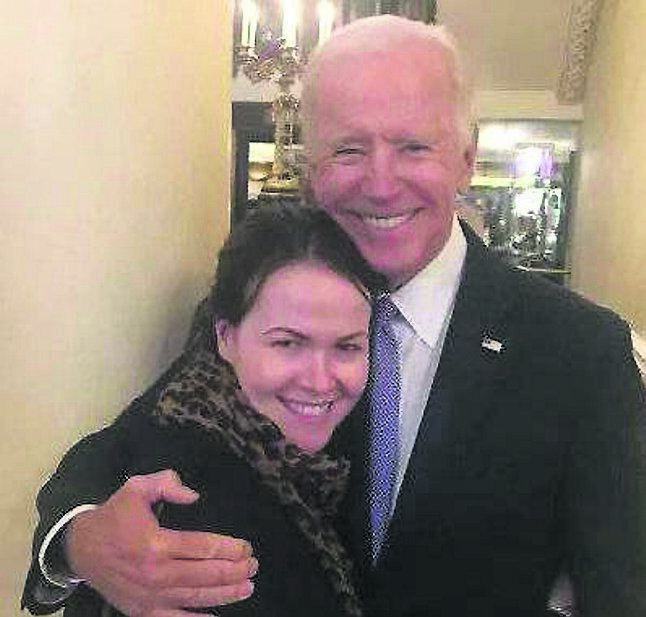
He still has distant relatives there and a fondness for the place captured in smiling photos of him on his last visit. He beams as he sits next to a woman playing the harp outside a Ballina pub, and proudly holds up a county jersey, surrounded by delighted local people.

President Joe Biden with Mayo relation Laurita Blewitt, a descendant of Edward Blewitt.

It’s impossible not to feel a sentimental pull towards the Blewitts and everyone like them, forced to leave. It’s equally inevitable that we feel a thrill at the triumphant return of one of them, in the form of one of the most powerful people in the world. 
With a story like this, it’s tempting to leave it there and to trot out the usual tropes; a local boy done good, a prodigal son returned, a circle closed at last.

That’s all too neat. It’s a narrative trap that you will see in a lot of the coverage of President Biden’s visit, and one he enjoys himself.

Migration is a much messier story, and it continues. By its nature, migration is movement, and people are still on the move.

Irish people today are, thankfully, much better off than our ancestors. Those of us who migrate are usually in control of that decision; we are not being forced out of the country to survive. 

Other countries are less fortunate. The UNHCR reports that 9.3m people worldwide were forcibly displaced at the end of 2021 by persecution, conflict, violence, or human rights violations.

This figure does not include the many millions of migrants who are forced to leave their homes because of a slower form of violence, the relentless pressure of capitalism and globalisation that decimates the land, empties the seas, and assigns worth to human life exclusively by calculating how much work they can produce.

The combined strain of climate chaos and economic displacement will continue to displace people inside their own countries and push them out to seek safety across borders. 

They are pushed into “deorai”, into involuntary exile from the countries they know and love.

I want to think about them, the present-day Edward Blewitts. Considering the date he left Ireland, Blewitt must have lived through occupation, civil strife, and famine, circumstances severe enough that he booked passage to a country thousands of miles away.

There is no Irish equivalent to him today; perhaps the closest comparison is a Syrian, unable to return for fear of persecution by a hostile government.

He could be any number of Central American people; in Honduras, El Salvador, and Guatemala, the people have suffered through intensely difficult socioeconomic and security conditions, exacerbated by climate and natural disasters, corruption, and poor governance. 

There are many present-day Edward Blewitts, and all have much in common with President Biden’s ancestor.

The difference is outside their respective circumstances. The difference, and it’s tragic in scale, is in their potential futures. 

Edward Blewitt made it to America. He was allowed to build a new life for himself there, which he did. Today, his Syrian, Honduran, and Guatemalan equivalents most likely will never have that opportunity.

Getting into the US today without a visa is a difficult, sometimes very dangerous, pursuit. Seeking asylum is a human right, one that is ignored or dodged by many wealthy industrialised countries, including the US.

Earlier this year, the Biden administration ramped up efforts to stop migrants from crossing the US border.

It’s not accurate or fair to blame all immigration issues on the sitting president. The immigration system has been failing migrants for decades now, and that is down to the House and the Senate, as well as the executive branch.

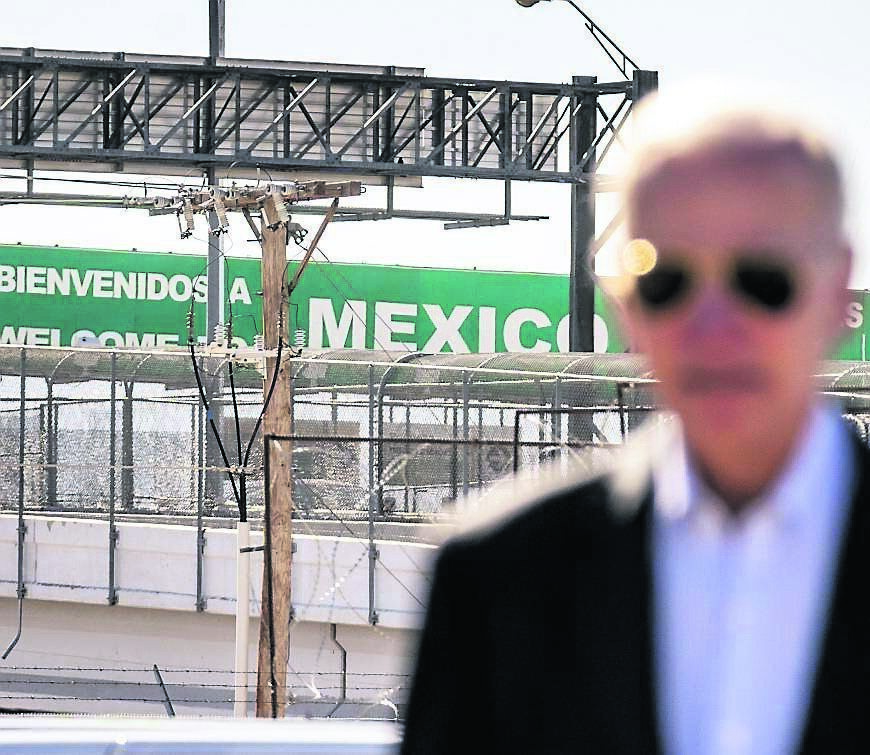
A large 'Welcome to Mexico' sign hung over the Bridge of the Americas is visible as President Joe Biden talks with US Customs and Border Protection officers as he tours the El Paso port of entry in January. Picture: AP Photo/Andrew Harnik

That said, in February, President Biden released a set of regulations that will essentially prohibit migrants who travelled through other countries on their way to the shared border with the US from applying for asylum in the US. 

These proposed regulations are likely to take effect in May, when a Trump-era pandemic border restriction, known as Title 42, is set to end.

On March 29, eight people, including two children, reported to be members of two families from Romania and India, drowned in the St Lawrence River, which forms part of the Canada-US border. They were trying to get to the US.

In Mexico that same week, a fire broke out at a migrant detention centre. 

Central American migrants were locked inside, rounded up on the streets of Ciudad Juarez as they waited to apply for asylum to the US. So far, the death toll from that fire has reached 38. At least one of the men trapped inside the burning detention centre had already been turned away by US border patrol.

I expect to hear President Biden wax lyrical about his ancestors who left a sorry place, needed a safe harbour, and found one. 

I want him to make that history relevant, to draw the line between the Edward Blewitt of 1850 and the Edward Blewitt of today. He won’t do that, because the Edward Blewitt of today is a person to whom Biden could offer safe harbour, but does not.

x

More in this section

Revoiced

Newsletter

Sign up to the best reads of the week from irishexaminer.com selected just for you.

Cookie Policy Privacy Policy Brand Safety FAQ Help Contact Us Terms and Conditions

© Examiner Echo Group Limited