Fergus Finlay: Davos is a talking shop that does nothing to help people in dire need
They arrive in private jets to bleat about climate change or 'co-operation' — then they go home and nothing changes
Fergus Finlay: Davos is a talking shop that does nothing to help people in dire need

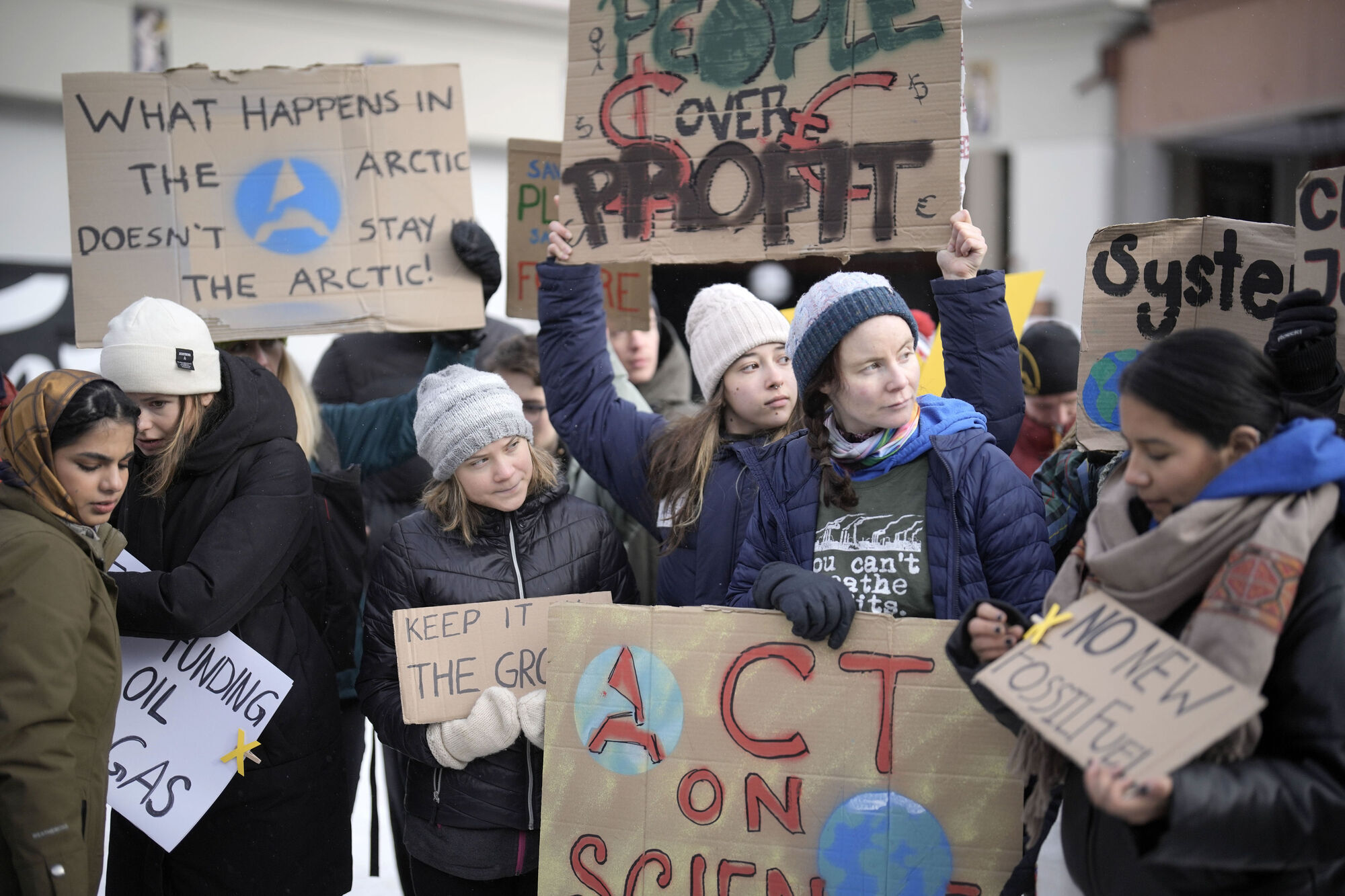
Climate activists Greta Thunberg of Sweden, Vanessa Nakate of Uganda, Helena Gualinga of Ecuador, and Luisa Neubauer of Germany demonstrate among others at a climate protest at the World Economic Forum in Davos.  Picture: Markus Schreiber/AP

It crops up once a year, that word. You don’t hear it the rest of the time, but suddenly it’s all over the news. It somehow, for no reason I can determine, seems really important. And it makes my gorge rise. It sends shivers down my spine. 

I don’t do hate often, but I hate that word, probably more than any other word I know. It is redolent with hypocrisy, complacency, all the cant in the world.

The word is Davos. It’s a place name. I see on the web that it’s a ski resort in Switzerland, with a year-round population of around 10,000. Most of them, apparently, work in the dozens of hotels you can find on websites like booking.com. 

In the off-season, when there isn’t snow and hundreds of the world’s rich and powerful aren’t lounging around with their minders, you can book a three-star hotel room for around €250 a night. Heaven only knows what rooms cost this past week, so great was the demand.

Because last week they were discussing — wait for it — “Co-operation in a fragmented world”. If you’re anyone who is anyone, how could you miss that? Especially the bit about how the climate crisis is spiralling out of control — and the effect that could have on economic growth — “particularly in emerging markets”.

Only in Davos, it seems, can they get the words climate, growth, and emerging markets into the same sentence. There isn’t room in that sentence — or any other sentence I could find on their website — for words like hunger and famine and death.

I will admit I found myself wondering about which “emerging markets” they had in mind. Hardly Afghanistan, I suppose, where oppression is growing every day. 

Surely not Pakistan, potentially a very large market of course, but whose growth may be hindered a tiny bit right now by climate catastrophes that have left millions of people homeless and at imminent risk of disease.

Maybe the emerging markets they were thinking of are in the horn of Africa. Oh no, hang on. Economic growth in that region has been, shall we say set back, by the fact that the crops and the animals are all gone and the people are dying of starvation.

Nobody came to Davos to rend their garments. Nobody came to renounce anything or admit guilt. Nobody came to give anything back, or “give up their old sins”. Few, if any, came to Davos by train. No, they came in their private jets to worry about climate and emerging markets, and to bleat about co-operation.

And then they went home. Nothing changed. Nothing will change.

In all probability, a few chats were had about new business between the hundreds of “business leaders” present, but the poor old “emerging markets” will continue to get the short shrift they always have. 

People will continue to die of hunger and malnutrition. The millions who were homeless before Davos will be homeless after it.

It’s a parallel world, Davos. If you don’t think so, look at one of the things that happened in the other world last week — the real world. The Oxfam Report.

It was published on the first day of Davos, and it’s called Survival of the Richest. Speaking for myself, I think it’s a mistake to publish it the day the Davos Conference starts. 

Even if the elites wanted to (and of course, they don’t) it’s too late for a report like that to really shape the Davos agenda. It would have been much better to have tried to build a global head of steam around the facts it contains and get at least a debate started about the solution it proposes.

Mind you, the Davos elites know these facts anyway. They are after all the prime beneficiaries of all the inequality in the world. But maybe some reminders wouldn’t go amiss.

Billionaire fortunes are increasing by nearly €3bn a day — not a year but a day. The richest 1% in the world have captured two thirds of all new wealth created in the last two years. Some of those ever-richer billionaires would have occupied some of the nicer suites in Davos.

How has that happened, in the face of the pandemic and the cost of living crisis? Simple really. Public spending right around the world had to be dramatically increased during the pandemic. One of the consequences of all that extra money was a huge increase in asset prices. Guess who benefitted most?

And since inflation began making food and utilities harder and harder for ordinary people to afford, the best possible place to own shares was in a petrol company or a food manufacturing company. The harder it became for the rest of us to get buy, the more their profits grew. Surprise, surprise.

Secretary-general of the United Nations Antonio Guterres speaks at the World Economic Forum in Davos, Switzerland, last week. Picture: AP Photo/Markus Schreiber

And surprise, surprise again. The world — the political world anyway — long ago bought into the notion that it was essential — in the very best interests of all of us — that wealth be protected. 

So there’s another phenomenon at work. The richer you are, sunshine, the less tax you can expect to pay. Because we need you. Because there’s a huge media industry built around the need to persuade us to be grateful to you.

So, right across the developed world, decade by decade, average tax rates on the incomes of the richest have fallen steadily — from nearly 60% in the 1980s to just about half that now. And taxes on overall wealth, as expressed for example by inheritance taxes, have begun to disappear entirely.

I’ll offer you just one direct quote from the report — “two thirds of countries do not have any form of inheritance tax on wealth and assets passed to direct descendants. Half of the world’s billionaires now live in countries with no such tax, meaning $5 trillion will be passed on tax-free to the next generation, a sum greater than the GDP of Africa!!” (I’ve added the two exclamation marks. They’re an expression of shock.)

There is, of course, a solution. It hasn’t reached Davos yet — and if the elites have anything to do with it it never will. The solution is taxation — and even bodies like the International Monetary Fund are now beginning to accept that it’s an unavoidable necessity.

One more fact from the Oxfam Report — and by the way, this is a really thoroughly researched report. Around 5% of the wealth of the world’s multi-millionaires and billionaires could raise $1.7trn a year, enough to lift 2bn people out of poverty, and fund a global plan to end hunger.

That’s an astonishing amount of money. And mind you, the rich would still remain very rich. But the balance would be shifted a tiny little bit.

Maybe someday the people who run the annual Davos bunfight — and what a comfortable group they are — will organise a few days in the Swiss mountains around the theme “How do we reverse the slide into gross and ugly income inequality — and how should the super-rich contribute?”. 

Maybe then I’ll apply for a seat in the hall and try to figure out how to afford a ticket. Until then, could we please give Davos the publicity it deserves. And that’s none.

x

CLIMATE & SUSTAINABILITY HUB

More in this section

Revoiced

Newsletter

Sign up to the best reads of the week from irishexaminer.com selected just for you.

Cookie Policy Privacy Policy Brand Safety FAQ Help Contact Us Terms and Conditions

© Examiner Echo Group Limited