Maeve Higgins: Learning moments from encounters with experts while writing my column
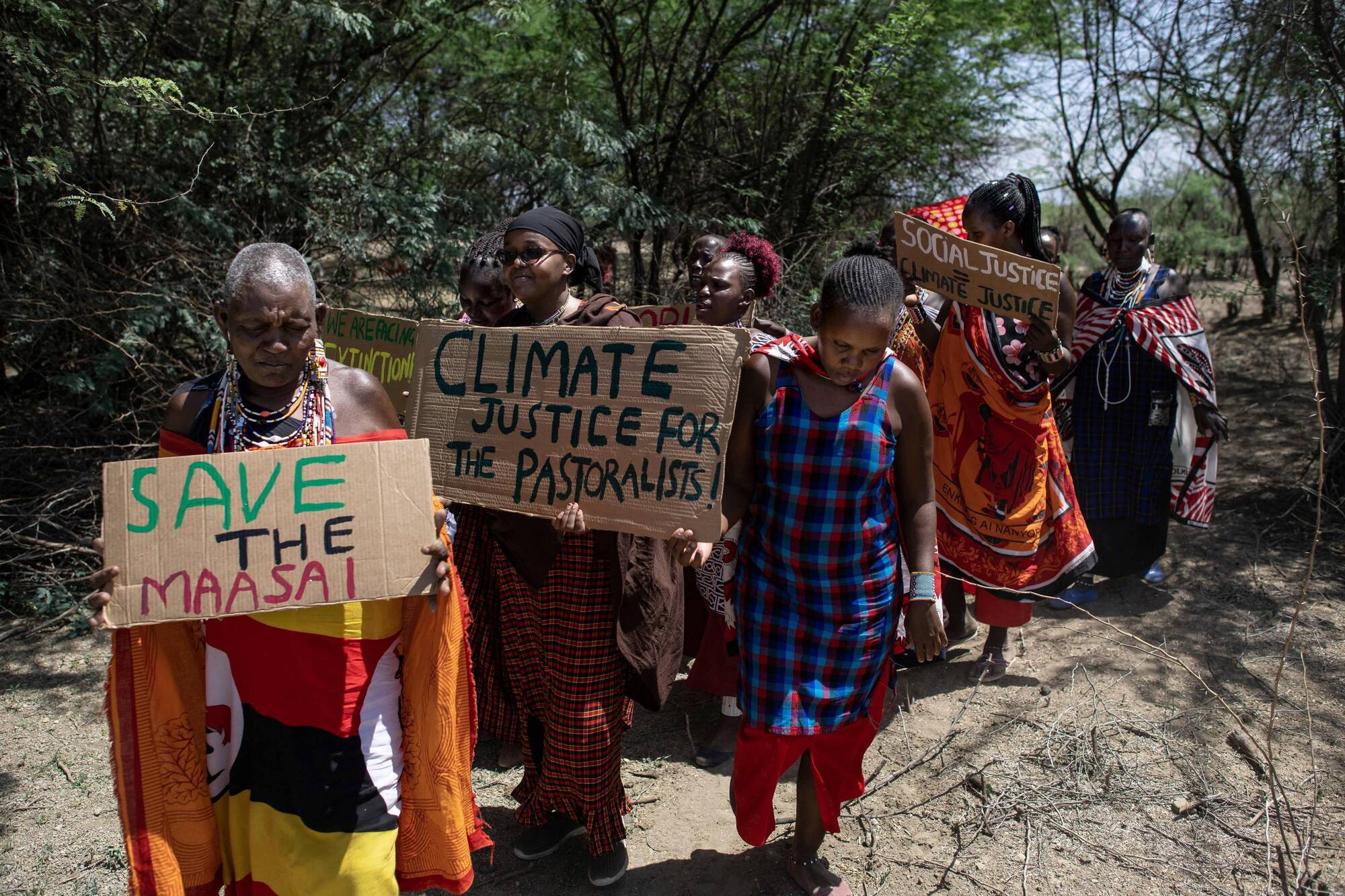
Women from the Masai community take part in a Global Climate Strike organised by Fridays For Future, to demand climate reparations and action from world leaders and take genuine climate action, at Magadi in Kajiado county in Kenya in March. Picture: Tony Karumba/AFP via Getty Images
EVERY time I write this column, I learn a ton of new stuff, and thatâs my favourite thing about being a writer. Writing is a way to ask questions, however basic or complex, to think things through and eventually form an opinion of your own.
This past year, Iâve written about dozens of subjects as varied as the lead-up to the war in Ukraine, the intricacies of growing hazelnuts in Wicklow, and the origins of public art in New Yorkâs subway system.Â
Iâm grateful for the researchers, journalists, historians, and other experts whose work helped my own, and also to the many regular people Iâve interviewed to understand better their lived experience and how that shapes or is shaped by our broader society. For my final column this year, Iâm reflecting on three learning moments I encountered while writing, moments that taught me something I didnât know before.Â
I hope my writing transmitted these moments into insights for you as the reader. In any case, Iâm grateful to you for reading!
I learned that colonisation came at a vast and terrible cost, not only to the people killed and displaced by the colonisers around the world but to the climate.
In April, the UNâs Intergovernmental Panel on Climate Change (IPCC) released its global report of climate change mitigation progress and pledges, one that also examines sources of global emissions.
That was when the word âcolonialismâ popped up in their lexicon for the first time â cited as helping to cause climate chaos historically, and today.
The report also named colonialism as a force that makes segments of the population vulnerable to the impact of climate chaos in the future.Â
The IPCCâs summary for policymakers states: âPresent development challenges causing high vulnerability are influenced by historical and ongoing patterns of inequity such as colonialism, especially for many Indigenous Peoples and local communities.â
Many climate scientists and activists, including indigenous people from colonised lands, have long known this but naming it was an important step. One form of climate justice demanded by a growing number of people is land back.
Indigenous power
I spoke to Jade Begay, climate justice director at NDN Collective, an indigenous-led organisation dedicated to building indigenous power. She explained: âItâs not just about getting what was stolen from us. For many indigenous peoples across the globe, when we say âland,â this is not just physical, you know, soil and dirt and flora; itâs so much more.
âOur languages are connected to the land, our philosophies, our creation stories, our mythologies, and our identity is really connected to the land and the water. So when we say land back, weâre talking about getting all of that back, including our inherent right to manage those lands, co-manage those lands, potentially with other tribes, and the people we used to be in relationship with,â Ms Begay said.
Another fact that blew me away but also made total sense was that medieval Ireland was far from utopian, but it was a place where, unlike today, reciprocity was a key concept.
The people stewarded the land in a far less destructive way than we do today. They understood that everything could only work within the web of relationships between land, wilderness, animals, and humans. I thought about what Jade Begay had told me about Indigenous people and what was taken from them by colonisers when I spoke to Dr Elva Johnston, an historian specialising in early medieval Ireland.
I first came across Dr Johnstonâs work when she presented a short and brilliant summary of how the early Irish stewarded the environment at the recent Citizens Assembly on Biodiversity Loss, which is available on YouTube.
Dr Johnston later told me that in the islandâs 8th and 9th century days:
The landscape and the people are completely intertwined and interconnected â you canât separate them out entirely.
She added that the people visualised the land as female â sort of a Mother Earth trope associated with fertility, saying âThatâs really pervasive, so when the king is chosen, he marries the land. So the people are linked to each other, and the prosperity of both are interconnected.â
The last thing she told me is poignant in how true it is, and how far weâve gotten from it; she said the medieval Irish knew that âthereâs no legitimacy without the legitimacy that comes from the land, but the land itself only exists because it has been named by people. It goes in a sort of a circleâ.
And finally, on a less harmonious note, 2022 was the year in writing when I learned that rats can absolutely climb through the pipes and end up gasping for air in your toilet bowl. Itâs not an urban legend; for Carl Arnheiter and his family last January, it was not a drill. When we spoke, he explained how he heard splashing from his bathroom and was horrified to see a distressed rat trying to clamber out of his toilet.Â
Mr Arnheiter used a long pair of kitchen tongs to grab the rat by the tail and deposit it into a five-gallon bucket. He said: âIt was pretty exhausted, and started squealing when I dropped it in the bucket. I didnât want to release it in the yard and didnât want to kill it. It had had a pretty rough afternoon, and I didnât want to add to that, so I drove it to a cornfield in the river bottoms and released it near a rock pile.âÂ
A happy ending for that rat, but not for long! In October, New York City Mayor Eric Adamsâ office posted a job notice looking for a âdirector of rodent mitigationâ or what they informally call a ârat tsarâ. Announcing the posting, NYC Sanitation Commissioner Jessica Tisch said: âThe rats are going to absolutely hate this announcement ... but the rats donât run this city. We do.â
Responsibilities include developing rat mitigation strategies, managing projects and policy initiatives across city agencies, and leading from the front with hands-on extermination techniques.
âThe ideal candidate is highly motivated and somewhat bloodthirsty,â the job notice reads, describing the role as âa 24/7 job requiring stamina and stagecraftâ open to someone with a âswashbuckling attitude, crafty humour and general aura of badassery.â
I checked with Mr Arnheiter, and unsurprisingly, he did not apply for the role.

Subscribe to access all of the Irish Examiner.
Try unlimited access from only âŹ1.50 a week
Already a subscriber? Sign in
CLIMATE & SUSTAINABILITY HUB
CONNECT WITH US TODAY
Be the first to know the latest news and updates