Terry Prone: Martin and Kenny are examples of honest and decent politicians
Irish people still respect dignity and restraint in their leaders
Terry Prone: Martin and Kenny are examples of honest and decent politicians

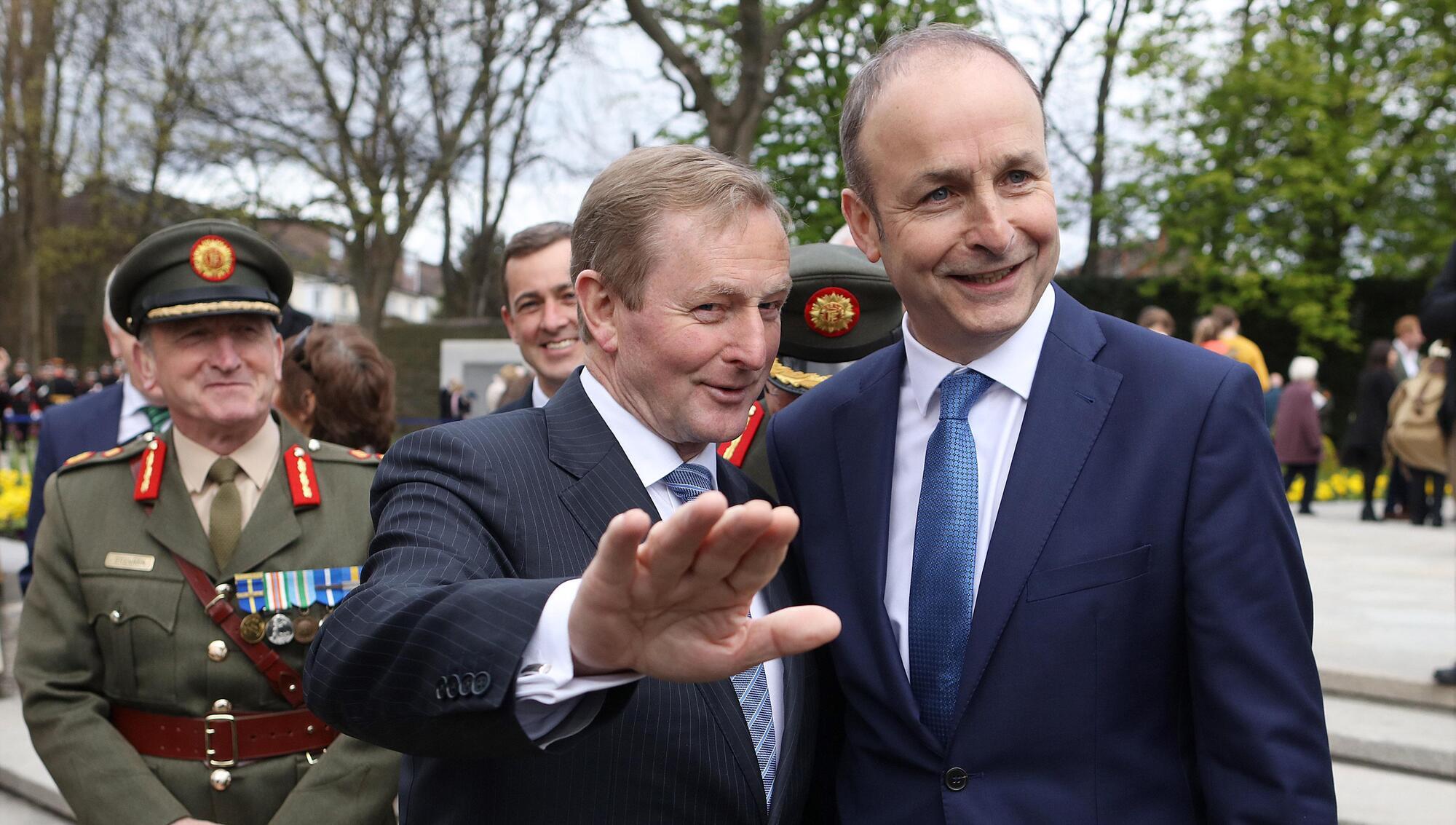
 Enda Kenny with Micheál Martin at Arbour Hill in Dublin. Commonsense and the capacity to find joy in every working day are the eternal verities of good politics.


Taking the train to Cork a few weeks ago, juggling ticket, briefcase, coffee and coat, I sent a prayer of gratitude up to nobody in particular when the ticket travelled through the machine in proper order and up went the barrier.

In normal circumstances, no more obstructions could be expected on the way to the platform where the train for Kent Station awaited. Normal circumstances, however, didn’t apply. Instead, a considerable traffic jam had built directly after the ticket checking area. Hundreds of people locked solid, nobody moving. Well, that’s not quite true. Up ahead in the crowd were phones being raised overhead to take pictures of people who were taking selfies of themselves with some celebrity or other. As the group around the celeb shifted, it was possible to see the back of his head. Blond hair and plenty of it, substantially greyed. Not saying I know the back of his head that well, but I was pretty sure it belonged to Enda Kenny, former Taoiseach, former leader of Fine Gael, former TD.

I skirted the outside of the crowd, figuring that he was likely to be headed for the Westport train, and got to the right platform for the south. Once I’d sorted my belongings and ingested half a beaker of coffee, I sent a mock-abusive text to Enda Kenny, accusing him of delaying every decent person in Heuston Station who wasn’t headed to the west.

I could imagine him receiving it, right down to the aged technology he would use. Enda Kenny has had the same semi-smart phone for about twenty years. Within minutes, back came the delighted answer, filled with descriptions of the people who had taken their pictures with him and the stories they had told him about themselves. Nothing like consistency.

Enda Kenny spent his political career recounting encounters he’d had that morning or the previous afternoon with a mother of six or a plumbing apprentice or a former sailor, each of whom had told him stuff with which he would then regale the Oireachtas or the broadcaster who was interviewing him. He was often mocked for it, mainly by people who didn’t believe he had so serendipitously met a person who’d shared with him such topically relevant thoughts.

He had, though. People always wanted to talk to Enda Kenny, have a skit with him, and tell him what they wanted him to know. They still do. That’s the kind of person he is.

What they tell him becomes part of his own internal commentary — and the Heuston Station incident demonstrates that the remembering and re-telling continues to happen long after it could have any political payoff for the man.

The remembering and re-telling provoked by the man’s self-evident curiosity and interest in others.

Park Enda Kenny on his train to the west for a few minutes and have a look at the man who up to the weekend was Taoiseach but who is now merely Tánaiste. Micheál Martin. This man who has spent the last three months being accosted by total strangers, by former opponents, and by people who could never stick him. They’ve been accosting him in public places, at events where he was a guest of honour or a keynote speaker, and they’ve been doing that clutch-and-pull thing you do when you want a handshake to bring the other person closer to you, so you don’t have to shout what you’re saying.

Each of these many people has been telling Micheál Martin the same thing, often in the same words: He’s been a great Taoiseach. No, a really, really good Taoiseach. Honestly, he’s made them proud to be Irish. He should be very happy with what he’s done with the role during a difficult time. They just had to tell him. In fairness.

Every time, the then-Taoiseach said almost the same thing back to them. He thanked them and told them that what they’ve said meant a great deal to him.

This appreciative self-deprecation sometimes provoked them to hammer home their message to him, lest he miss its importance. And he has nodded appreciation, smiled, and moved on. It’s been an unplanned victory tour.

A Coalition government wrote an end to Civil War politics, and a man grew into the role in a way that moved even the unwilling to praise him and let him know how good he personally has been in the top job. Some of what was left unsaid was deeply felt: the respect for a man surviving personal grief and successfully navigating the deadly line between playing to the emotional gallery and respecting the public’s right to understand. TV and social media love a good cry, but the Irish people still respect dignity and restraint in their leaders.

One of the most perceptive tributes was paid by Leo Varadkar, who talked of Martin’s “commonsense” and “decency” and said that he had noticed that when a public tragedy happened — like the explosion in Creeslough — Martin’s immediate instinct was always to scrap whatever was in the prime ministerial schedule and just go there.

Just go there to listen, to absorb the grief, to serve as the human face of the state. Varadkar simply said he would emulate that kind of behaviour. Varadkar is often described as a good communicator, but his comments went beyond a crisp sound bite. They were the insights of a man clever enough to watch a political opponent, observant enough to register an unusually pronounced characteristic, generous enough to adopt the position of a learner.

The Taoiseach has been joined in his praise of Micheál Martin by the majority of commentators these last few days. No doubt the recipient of the praise will be pleased. But not as pleased as he was by the job itself.

He did the solemnity and grativas required by the pandemic. He refused to take the fashionable description of today’s Ireland as a “failed state.” He got good and ratty with Sinn Féin at every opportunity. But the message that ran through him like the message in a stick of souvenir rock was one of delight.

He was happy out. Always. Right throughout his period in office, he enjoyed the gig. He laughed and made other people laugh.

This is a trait he shares with Enda Kenny, although neither is likely to be pleased by the statement. It’s true, though. They’re the rare politicians who are permanently chuffed by the quotidian. They enjoyed their period in the Taoiseach’s office not just when they were doing well, not just when they nailed an issue or made a commentator-acclaimed speech. They relish the boring stuff: for example, the two of them love the procedures and protocols of the Oireachtas. They cherish the very idea of public service and understand the sequences and the systems.

When we talk of legacies, we tend to become grandiose. But commonsense, decency, and the capacity to find joy in every working day are the eternal verities of good politics.

x

More in this section

Revoiced

Newsletter

Sign up to the best reads of the week from irishexaminer.com selected just for you.

Cookie Policy Privacy Policy Brand Safety FAQ Help Contact Us Terms and Conditions

© Examiner Echo Group Limited