Maeve Higgins: Farming can be the solution, not the problem it is usually seen as
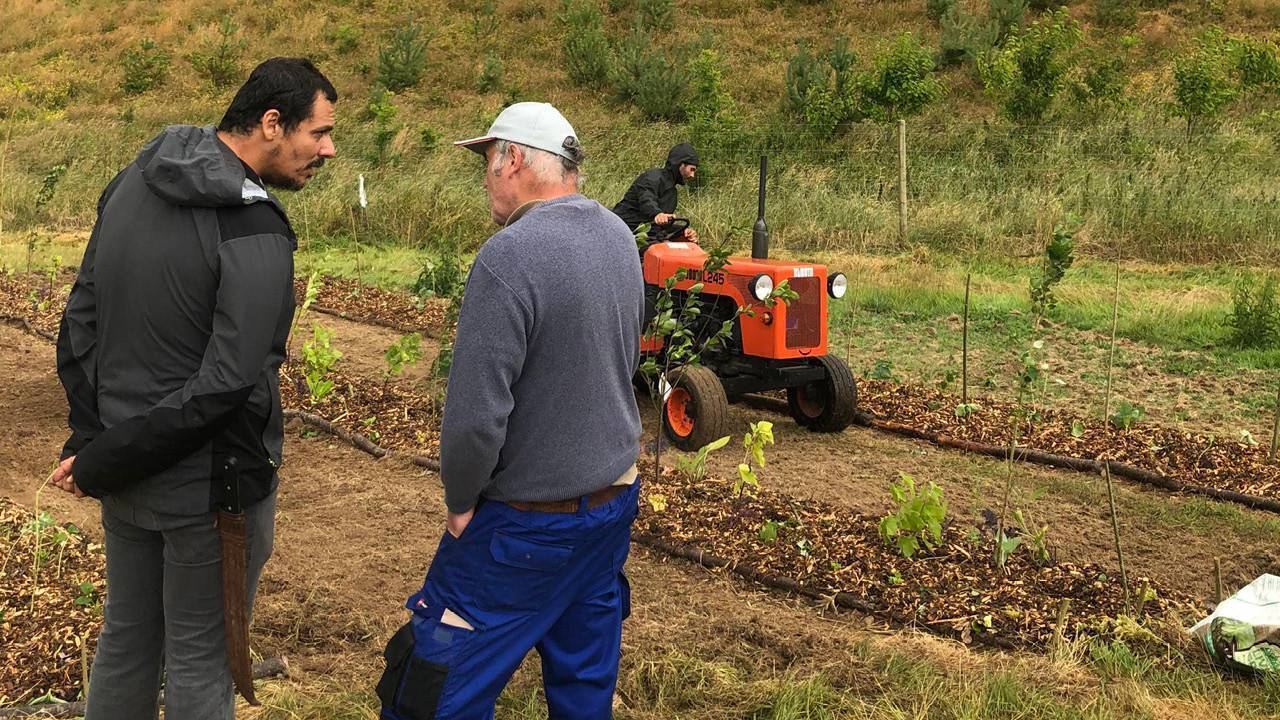
Brazilian farmer and consultant Felipe Amato (left) teaching a workshop on syntropic agroforestry at Hazel Nairn and Davi Leon's farm in Ashford, Co Wicklow.

There is a major fight going on between Irish farmers and the government. As the climate crisis engulfs the planet, the government has to reduce carbon emissions from every sector, and agriculture is a big one.
Many farmers feel they are being targeted unfairly. The fight seems inevitable and intractable, with big industry and lobbyists all vying for power.
Understanding the undeniable fact that something has to give, you would be forgiven for thinking that all farmers are stressed out and fighting for their livelihoods, but you’d be wrong.
There are farmers in Ireland today peaceably going about their daily business of stewarding the land and feeding the people, and enjoying themselves while they are at it.
They are not emitting greenhouse gases at a rate that will wreck our environment, so they don’t have to worry about meeting targets being fought over this week in Dublin.
In fact, their farms capture carbon dioxide from the atmosphere and store it in the land.
‘Hazel and Davi’s Wicklow Farm’ is run by Hazel Nairn and Davi Leon on part of the Nairn family’s 20-acre farm and woodlands in Ashford, Co Wicklow.
Their goal is to regenerate the landscape through farming, and they produce vegetable boxes through a Community Supported Agriculture (CSA) scheme.
In early 2020, they planted Ireland’s first syntropic agroforestry system; an apple, plum, hazelnut, and walnut forest.
Syntropic agroforestry is a system of farming that works with nature; syntropy means the accumulation of energy and life, and agroforestry means growing trees and shrubs amongst whatever you’re farming, be that animals or crops or both.
At the farm in Wicklow, they are pioneering trials for commercial syntropic agroforestry systems that will work with the Irish temperate climate and landscape. From what I saw, it’s going brilliantly.
I saw the trees, already fruiting but not ready to harvest. All around them grew various fruit and vegetables, including radishes, carrots, spinach, kale, onions, potatoes, broad beans, strawberries, raspberries, currants, and rhubarb.
Hazel and Davi had also planted ‘service species’ including alder, poplar, and willow trees, as well as shrubs called Tree Lupins.
Those species provide cover and, when pruned and chipped, make potent biomass to add to the soil.
This keeps the fertility cycle going, and indeed the abundance of berries, fruit, and vegetables in amongst the leafy trees on a July day was stunning.
I grew up in rural Cork, and generations of my family have farmed beef, dairy, and potatoes.
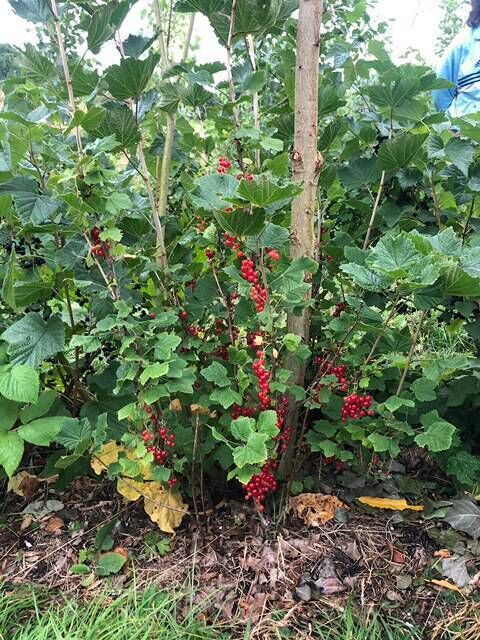
Hazel and Davi’s Wicklow Farm looks different from what I’m used to — there is no slurry tank, no tons of fertiliser in huge plastic bags, no massive and costly machinery.
While the fields were laid out in orderly rows, instead of one crop of a uniform height, the fields looked more like densely packed orchards.
Syntropic agroforestry is new to Ireland, but it is an ancient practice developed by early farmers in the Amazon.
Indigenous people grew their food in a clearing, sowing their annual plants and future tree crops together.
Those dynamics — a diverse landscape with many layers of plants all taking turns in harvesting the sunlight — inspired the system thriving today.
Farmers love this system because within a few years it is possible to make a closed loop of productivity, eventually not needing to add anything from the outside.
Ernst Götsch is a Swiss farmer who moved to Bahia, Brazil, in the early 1980s and developed syntropic agroforestry on 400 hectares of land there.
Götsch restored the composition of highly acidic soil (initially with a pH of 3) to one of the most productive cocoa farms in the country.
His farm is one of the most biodiverse stretches of Atlantic Forest, and he did this without using chemicals like fertilisers or pesticides.
He is recognised as a leader in the field (sorry!) by scientists, researchers, and farmers who have studied and implemented his techniques.
Syntropic agriculture systems can produce an estimated 60 to 80 tonnes of food per hectare.
Now, as you’d expect, these would be intensively managed systems, but isn’t that fantastic?
Not only could they achieve such high food production levels, but they would do it while sustaining biodiversity and sequestering carbon.
At a dark time for many farmers, with increasing pressure from all sides, syntropic agroforestry is a bright spot that offers a potential paradigm shift.
Researchers from the International Institute for Sustainability report: “Overall, it is widely recognised that agroforestry systems increase resource use efficiency, contribute to biodiversity conservation and enhance ecosystem services provision.”
That last part, about human wellbeing, is huge.
As the beef and dairy farmers duke it out with the government over emissions, it’s vital to remember that traditional farming is a tough job, often unpredictable, and lonely.
Dr David Christian Rose is an expert on mental health and wellbeing in agriculture who works at Reading University.
In May this year, he spoke at a conference organised by Teagasc, The Agriculture and Food Development Authority, noting:
“Farmers face a unique set of acute and chronic stressors including farm bureaucracy, climatic conditions, animal and crop disease outbreaks, time pressures, workplace hazards, rural crime, finance, isolation, machinery breakdowns, and media criticism.”
It’s just as vital to remember that farming does not need to stay this way.
A just transition from carbon-intensive farming to new systems is essential for the environment and also for farmers.
Here too, is where community-supported agriculture and syntropic agroforestry shine because this is not something you can do on your own.
The typical model of a lone farmer in a tractor for hours on end is not in play at Hazel and Davi’s farm.
The farm has a busy, sociable feel, with neighbours volunteering to help plant woodlands, and people dropping by to pick up food and see how the trees are coming along.
Having a more abundant landscape will depend on more people joining in, and not leaving it to a tiny percentage of the population to manage most of the land.
When I visited, Davi and Hazel were hosting a week-long syntropic agroforestry workshop with Brazilian farmer and consultant Felipe Amato.
There were around 15 people from all over Ireland, learning the principles of the system and practising it too, planting new rows of plum, apple, and pear trees alongside strawberries, potatoes, kale, and all the support species too.
The workshop was part-funded by National Organic Training Skillnet, and the participants were keen to implement the system on their own land, whether that was a garden in Cabra or a farm in Cavan.
As the fight about emissions continues, bear in mind that farming isn’t the problem when it’s done right.
And when farming is done really right? It can be the solution.

CONNECT WITH US TODAY



Be the first to know the latest news and updates