Kieran Shannon: Croker classic can't be allowed mask football's flaws
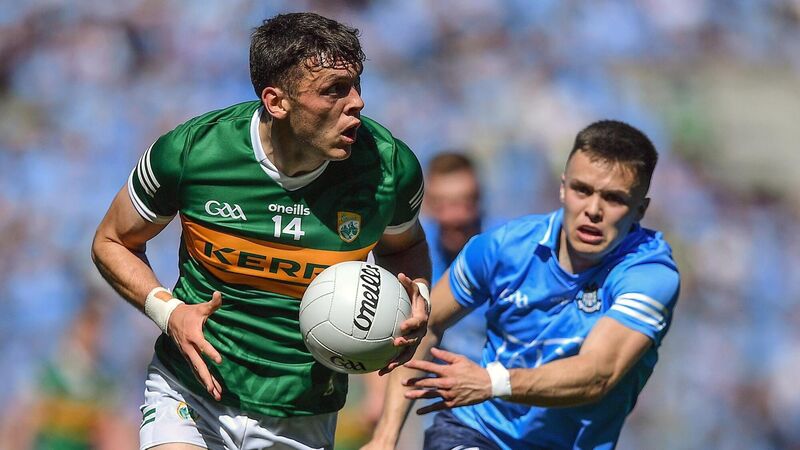
HEADS UP FOOTBALL: David Clifford of Kerry in action against Eoin Murchan of Dublin during the GAA Football All-Ireland Senior Championship Semi-Final match between Dublin and Kerry at Croke Park in Dublin. Pic: Piaras Ó Mídheach/Sportsfile
It never disappoints, though they play a sport that often does.
If there’s one football fixture that is almost guaranteed to entertain and enthrall, it’s an All-Ireland semi-final, especially one featuring Dublin, and all the more so again if the opposition is Kerry.
It’s 20 years this summer since the new Croke Park opened and thankfully for everyone it immediately had a Dublin team and an All-Ireland semi-final that could pack it out.
Stephen Cluxton and Alan Brogan were rookies, Tommy Lyons was their manager, but bad news for them, Joe Kernan had taken over the helm in Armagh and his team would edge them out by the same scoreline Jack O’Connor’s side would pip Dessie Farrell’s last Sunday: 1-14 to 1-13.
It was a marvellous occasion, both a delight and an assault on the senses. The sight of orange mixed with blue; the sound that resounded around the stadium as the teams marched behind the band; the surge on the Hill as Ciarán Whelan rifled a ball to the net right in front of it; the drama and disbelief as that game’s and summer’s leading scorer Ray Cosgrove had a free come back off the upright.
Right there was a template for the two decades to follow. Whenever the boys in blue were in the last four, you could automatically put up the Full House sign and brace yourself for the occasion and often the game of the year.
In 2006 you had the Mill by the Hill and Ciaran Mac’s fingerwave. In 2010 Bernard on fire but Donncha as cool as ice. In 2011 Bernard as cool as ice in the face of the heat and provocation Donegal brought that day. 2012 and his miss and David Clarke’s save. 2014 and Donegal’s display of shock and awe. 2015 and Mayo coming back from the dead the first day only for Kevin McManaman killing them off the second. 2019 and Con mortalising Lee Keegan. 2021 and Mayo showing the six-in-a-row team were human too.
Even the one-sided first-half demolition of Tyrone in 2017 was an I-Was-There moment for the audacity of Con’s early goal and the cold-blooded dismantling of the previously impenetrable Tyrone defensive system. About the only skip-forward affairs were the 2018 encounter against Galway when there were only 50,000 there and the 2020 Covid game against Cavan when there wasn’t even 50 people there.
Yet for all those epic games and moments in which the Hill either erupted or was silenced, Kerry-Dublin has either matched or eclipsed them all. The 2007 semi-final is now something of a lost classic, possibly because the failure of Pillar’s team to win or even reach an All-Ireland historically diminishes them and that game, but in essence, it was that year’s final. Then you had 2013 and 2016, one as great as another where Kerry scored a brace of first-half goals and still somehow ended up on the losing side.
Last Sunday’s game was in keeping with that tradition. It wasn’t quite the shootout of those previous semi-final encounters; its rhythm and nature more resembled the tension of the 2011 final between the counties, ever before it climaxed with another iconic injury-time winning free. But again it offered up the occasion and game of the year, as much as Armagh-Galway is a close second.
It was a privilege to be in Croke Park last Sunday. Sport, let alone this one, doesn’t get better. Some of the scoretaking and playmaking was among the best we’ve seen in the venue.
Some are patently obvious: O’Shea’s winning free, the string of points David Clifford kicked in the first half, Cormac Costello’s goal.
But some weren’t. Take for instance Brian Fenton’s foot pass in to Paddy Small that led to Dublin’s last score. If that pass is off, the game is over; the ball is turned over, Kerry come away with it and hold onto it until the whistle sounds. But Fenton nailed that pass for Small to win the ball and the free and for Dean Rock to point it.
When Kieran Donaghy brought out his book six years ago, Maurice Fitzgerald, another player with a history of producing big displays and big moments in Dublin-Kerry games, spoke at the launch. In his view one of Donaghy’s finest hours was one of his toughest — the display and levelling point he produced in the 2011 final against Dublin. Likewise with Fenton, James McCarthy, and Ciarán Kilkenny last Sunday: Like Donaghy in ’11 and Gooch in ’13, their legend is even the richer for a Dublin-Kerry game that they lost.
And yet as magical as last Sunday was, it brought home how football itself cannot be complacent.
In many ways it’s been a good football year. The provincial championships, in light of Derry’s breakthrough, were about as satisfying as you can expect in this day and age. The Tailteann Cup was a resounding success. In the qualifiers you had Clare’s run and dramatic late win over Roscommon. In the quarter-finals you had Armagh-Galway; in the semis Dublin-Kerry. The final itself is also an appetising prospect.
But just because it’s been a good footballing year doesn’t not necessarily mean football is in a good place.
Last week I interviewed Mike Frank Russell. He’s 44 now yet it’s hard to think there’s anyone alive who has a greater love of kicking a football than that former Kerry star. He still plays with his club, still goes out the back more evenings than not, and shoots away into the darkness.
But yet he admits he doesn’t necessarily love football itself at the moment, or at least watching it. Too often games drag because too often teams just hold onto the ball, going back and forth, back and forth, back and...
Russell, though now middle-aged, is hardly a dinosaur. The last time Kerry and Galway met in an All-Ireland final he was the finest forward in the country, a final played in this millennium; he was still only 22 then. When a man who loves a sport so much finds it often hard to watch, the problem is not with him, it’s with the sports — or rather those who are supposed to be its legislators, its guardians.
For years the late great Joe Lennon rightly argued that football at its heart was a ball-possession game, not a ball-propelling one; he had no issue with the handpass in itself. Even hurling, a predominantly ball-propelling game in the last century, has evolved into a primarily ball-possession game.
But never did a Lennon or anyone else ever envisage or design for football to be played as it is now: where even Kerry will hold onto the ball for three minutes before scoring their 12th point last Sunday.
I brought my 10-year-old son to the game last Sunday. For the last month we’ve effectively lived in Croke Park. He plays a range of sports but football by a distance is his favourite; like a young — and a not-so-young — Mike Frank, his favourite way of passing the time is to kick a ball over the posts he has in the back garden. But on our way up the last day he spoke about how too many games, like certain spells of a Clare-Meath qualifier we saw last month, are too pedestrian.
In three weeks' time the sport will go back exclusively to the clubs where teams will ape the possession-at-all-costs model we’ve seen in stadia throughout this summer. Worse, we’ll see it in underage games.
It is not the game Mike Frank Russell aspired to play or my son does or that we want to watch.
Interventions are necessary.
Basketball, the sport we constantly hear Dublin and others have learned so much from since Donegal’s 2014 semi-final ambush, reached a similar moment 60 years earlier. In the early 1950s the dominant NBA team of the time, the Minneapolis Lakers, starring the league’s first superstar George Mikan, encountered the Fort Wayne Pistons.
The Pistons won 19-18, the last quarter, 3-1. They weren’t going to allow Mikan on the ball, so they held on to it themselves for minutes at a time, taking only 13 shots all night. “The Pistons,” wrote the St Paul Dispatch, “gave pro basketball a great black eye.”
Four years later the owner of the Syracuse Nationals came up with an experiment during a practice game among his own players. Each team had just 24 seconds to shoot.
“I looked at the box scores from the games I enjoyed,” Danny Biasone later explained, “games where they didn’t screw around and stall. I noticed each team took about 60 shots. That means 120 shots per game. So I took 48 minutes and divided that by 120 shots. The result was 24 seconds per shot.”
A few months later Biasone had convinced the NBA to adopt the 24-second shot-clock for the following season. His Nationals would end up winning that NBA championship. More so he’d saved the NBA.
Football needs to find and assign a Biasone to have a vision of what represents a game we enjoy and to stop teams screwing around and stalling. Maybe it’s ensuring at least three men have to stay inside the opposing half of the field at all times. Bringing in a 90-second shot clock or a backcourt rule.
Whatever. The game needs to maximise its fantastic potential and optimise the chances of further games like last Sunday.