Christy O'Connor: GAA and Hawk-Eye need to keep eyes on the ball
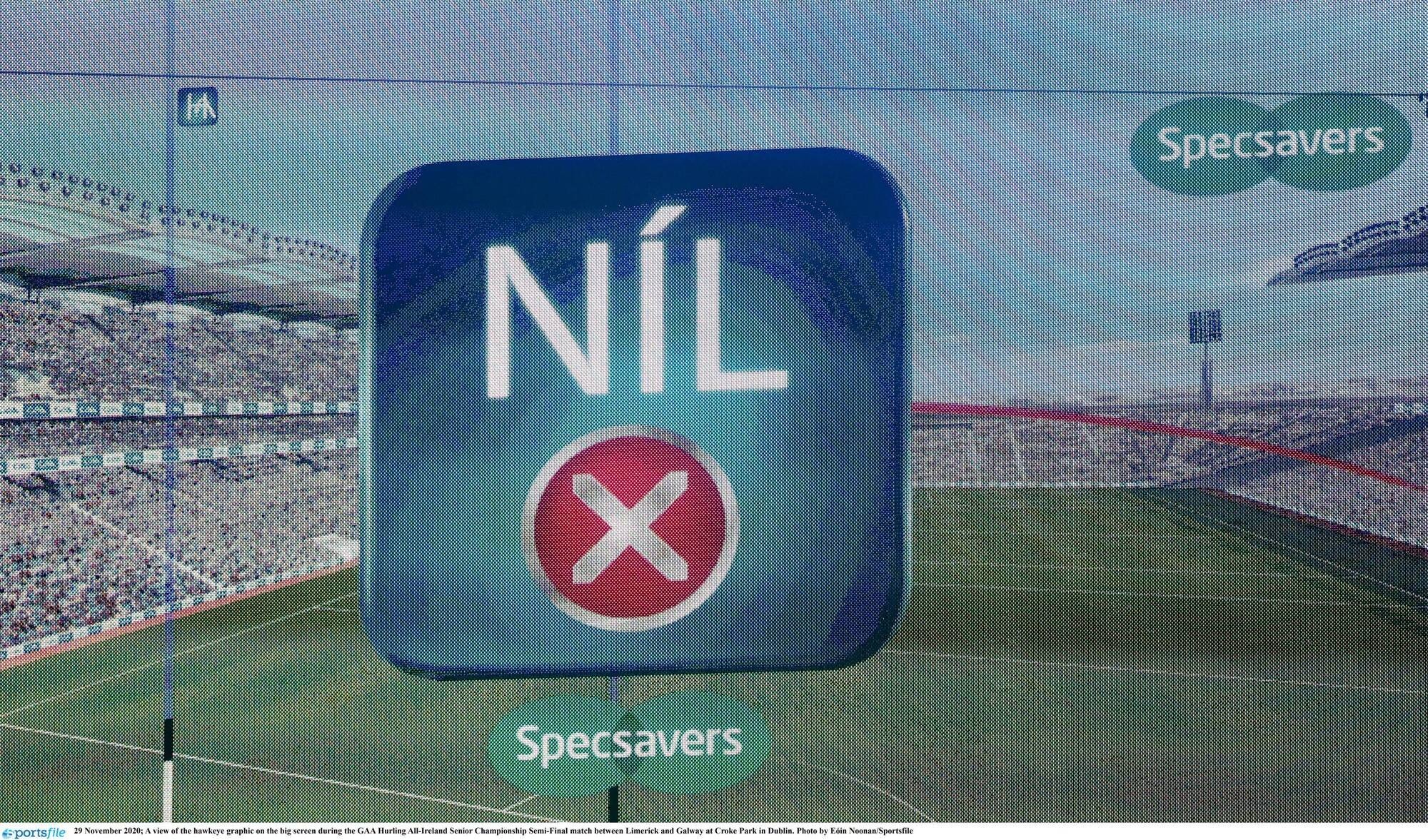
A view of the Hawk-Eye graphic on the big screen during a championship game at Croke Park. Photo by Eóin Noonan/Sportsfile
After TJ Reid’s effort from a long range free on Saturday evening was signalled by the umpire to be reviewed by Hawk-Eye, the referee James Owens immediately began communicating with the Hawk-Eye official.
As Owens continued to look at the big screens on the Hill 16 and Canal End, the level of communication was more intense than normal. It was obvious that there was some confusion around the decision.
One minute and 11 seconds after the ball cleared the posts, the decision – or lack of it – was shown on the big screens in Croke Park. ‘Hawk-Eye Data Unavailable’.
“The Hawk,” said Ger Canning in his TV commentary, “is not having a good night.”
Was the data unavailable because the ball was lost in the sun as it went through the scoring zone?
Or was it because of a technology issue? Nobody knows because the GAA offered no clarity on the matter.
That’s not good enough because a similar incident happened in Sunday’s Tipperary-Waterford camogie match, which preceded the Munster final. It appeared as if the white ball got lost in the clouds but the Hawk-Eye officials couldn’t tell if it was a score or not and the attempt was waved wide. The decision took an age, which was similar to a Tony Kelly free over an hour later, which was also eventually waved wide.
The Hawk hasn’t had a good couple of weeks. In the recent Kilkenny-Limerick All-Ireland U-20 final, Kilkenny were awarded a point in the first half when Limerick goalkeeper Conor Hanley Clarke stopped a ball going over the crossbar with his hurley. TV replays clearly showed that the ball had not crossed the bar.
The referee and umpire agreed that it was a score but, before that decision was made, Hawk-Eye couldn’t intervene because the ball was still in play. Yet once the decision was made, and Hawk-Eye had any doubt, the officials should have called the referee to review the matter.
Kilkenny won by one point but the most frustrating aspect of the whole Hawk-Eye debate is the inconsistency attached to it, especially between Croke Park and Thurles, the only two venues where the system is in place.
If the ball clears the crossbar in Croke Park, even by just one inch, the Hawk Eye system will deliver an automated signal for a point. There is, and can’t be, any grey area, but that technology isn’t in place in Thurles. Furthermore, the crossbar is higher in Croke Park than in most grounds. So, outside of Croke Park and Thurles, goalkeepers can try, and get away with, catching balls over the crossbar at every other venue.
The Tipperary goalkeeper Brian Hogan pulled balls back over the crossbar in the 2019 All-Ireland semi-final and final, and a point was awarded each time for Wexford and Kilkenny. After those incidents, umpires in Thurles and Croke Park were told not to make a decision on a Hogan-type play, and to let Hawk-Eye make the call. So, what do umpires do everywhere else? They won’t make that call when the margins are in inches.
Yet when an umpire did make the call in Thurles for the U20 final, which was wrong, Hawk-Eye didn’t do anything to correct it.
Trying to make big Hawk-Eye calls in Thurles anyway has always been an ordeal because it’s a review system, as opposed to the automated system in Croke Park, which is why the process is so painstakingly slow in Thurles.
The dull and wet weather on Sunday, especially with a white ball for the camogie match, makes that tracking process of the sliotar even slower and harder again.
The technology in Thurles is an issue but there is still grey everywhere. And how far does that grey area often extend? From the time Hogan caught a Lee Chin free in the 2019 All-Ireland semi-final until John McGrath scored a goal at the other end, 27 seconds had elapsed before the goal was subsequently disallowed, and Chin’s point was awarded.
Yet what happens if a player receives a red card, or a second yellow, during that time before Hawk-Eye alerts the referee? Does the red card stand? Yes.
In theory, it would be hard to over-turn a red card if the referee makes the correct decision in a potential ‘vacuum incident’. But, given how grey such a scenario would appear, it probably wouldn’t stop an appeal process.
There are a couple of key issues here. The pace of the game, especially hurling, and the speed and height the ball is travelling, makes it harder for any score detection system. On the otherhand, it doesn’t really make sense that Hawk-Eye is only in place in two grounds for different competitions played out at multiple venues.
Cost is the obvious factor. The Hawk-Eye nine camera-system in Croke Park is a lot more expensive but it’s easier for the GAA to justify given the volume and magnitude of the games played there. Yet there are ways around the cost issue, especially when the technology is so readily available.
The TV camera systems are so high-spec now that the GAA need to start asking if they can roll out their own version of Hawk-Eye. Could the GAA commission a company to devise a system, buy the product and then patent it as their own? Surely the GAA could even approach one of the third level institutions and see if a group of IT or engineering students could come up with something similar? It would certainly be worth the investment.
In the short term, a mobile solution should be the way to go. When the All-Ireland hurling quarter-finals were staged in Páirc Uí Chaoimh in 2017, the Hawk-Eye system was operated from a van, which was connected to the temporarily installed cameras around the ground.
The cameras used that that day were a different mobile camera system, which had a better frame rate than Hawk-Eye. Another company which provides CCTV systems in some GAA grounds has shown how they can get the same level of magnification on their cameras as the Hawk-Eye cameras do.
Mobile solutions are usually rented, but if the GAA could patent their own mobile system, it would be a lot easier to roll out on any given summer Sunday around the country.
Any such system may not be as high-spec or advanced as Hawk-Eye but the GAA are constantly progressing their technological infrastructure. Fibre platforms have been installed in stadiums around the country to improve ticket scanning, media facilities and connectivity. And that level of technology could provide the GAA with a platform to develop their own system.
Technology is constantly improving and evolving. The digital sliotar developed by Greenfields Digital Sports Technologies has a chip which can cater for goal-line technology. The digital sliotar can’t detect scores when the ball goes above the height of the post but any score-detection system should cover goals.
The GAA needs to address this issue and get it right because the last few weeks have left too many doubts around Hawk-Eye, particularly when there is so much at stake during the championship.
And especially when the technology is so readily available now.