Michael Moynihan: A pedestrian-friendly Cork would be in everyone's interests
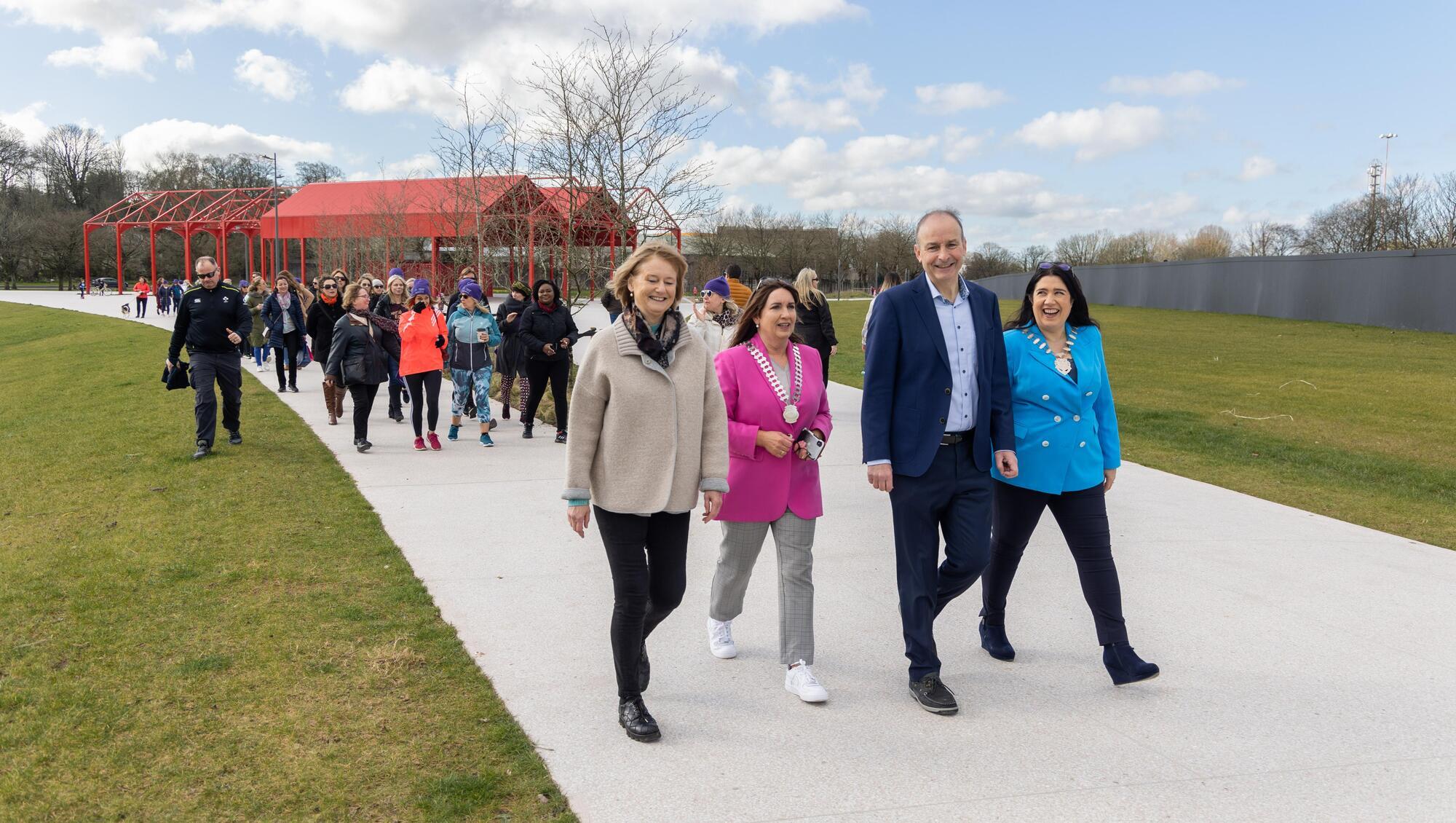
Taoiseach Micheál Martin walking in Marina Park in Cork City with members of Network Cork to celebrate International Women's Day. Picture: Darragh Kane
Mention the cyclists of Cork here and there’s sure to be a response. Same with any citation of those driving around the city. Every group, it seems, has vocal representation online and in real life, plenty of people to speak on their behalf.
Every group, that is, except the one everybody belongs to.
“All of us, at some point in the day, use our legs,” Marica Cassarino told me.
“We’re all pedestrians at some point. It might be difficult, then, to represent pedestrians as a group, but if you start thinking of urban spaces and whether those are designed for pedestrians, then you’re tapping into universal design.
Marica, a lecturer in applied psychology at UCC, is a member of Pedestrian Cork, the group that represents those vulnerable road users in Cork.
“I came to this when it was proposed by Orla Burke," she says. "She had started conversations with the Irish Pedestrian Network, and this group had come together and reached the conclusion that pedestrians are the most vulnerable road users, but you don’t hear much about them.
“Orla and others held a public meeting in October 2019 to try to stimulate a conversation about safety and accessibility, and Orla suggested that any concerned citizens, from any walk of life, could come together.
“That’s how we started, as a form of advocacy for the most vulnerable road users.”
The guide for the group early on was the Design Manual for Urban Roads & Streets (DMURS), which should be adhered to when designing roads and streets.
“Whether it is or not is another story,” said Marica.
“But the idea of the DMURS is that there’s a hierarchy on the streets involving pedestrians, particularly vulnerable pedestrians who might be wheeling or using a walking aid — and those should be prioritised.”
That’s the idea of the group: to represent the voice of the most vulnerable road users.
"I’m living in the suburbs, Orla is living in the city centre, we have people from the county, so the mix is good, people bringing their own experiences to the group.”
When they came together, one of the first things on the agenda was what data they were going to use in their advocacy. They realised that Cork was “quite poor” when it comes to data on the pedestrian experience, so Marica used her research skills, and the group ran a survey.
“We had over 1,200 responses and we used that information to inform all our submissions to public consultations in Cork," she says.
“Those have been our main activities, as well as other, smaller tasks. When the Marina was pedestrianised during the pandemic, we did a case study, for instance, to see how people felt about that, and we produced a report on that.”
Ah, the pandemic. When we were all pedestrians, if only for a short while.
“Pedestrianising roads and streets and allowing people to use those spaces, for instance, shouldn’t cost an awful lot of money.
“Just last week I was at a meeting of Get Ireland Walking, and there were multiple stakeholders present who are interested in that area, and one point which was raised there was the lack of data on the pedestrian experience. We did our survey as a group, and other organisations do their work, but we have very little open data to tell us there are ‘good spots’ in the city, or ‘bad spots’.
“And that shouldn’t cost too much, understanding what does and doesn’t work in the city — and making changes accordingly.
“I know that sounds easy, and I’m aware it’s more complicated than that — there are a lot of people and a lot of interests involved.”
True enough. But Marica added that there’s walking and there’s walking.
“The Marina is wonderful, of course it is," she says.

"But it’s worth pointing out that there’s leisure walking — going for a stroll, exercise, walking the dog, whatever — but from our perspective, it’s also important to encourage and promote utility walking.
"How do you get people — if they can — to choose to walk to work rather than driving? When walking becomes the default for day-to-day activities, such as walking to work, you become more aware of it and you want more of it.
“But when we did our survey, people told us they would change their walking route to work not to use the shortest path, but often to use the safest path, or the quieter path, or less polluted.
“So there was an appetite to make it the default activity, and that’s important. It’s good to create spaces, but look also at whether the facility is just going to be used for a Sunday afternoon walk as opposed to becoming the walking route to work for people.”
Marica’s name and accent gave away her Italian roots, and the temptation was to ask her which part of her homeland — or somewhere else in Europe — is a shining example of best practice for pedestrians (a temptation too great to resist, in fact).
It was refreshing to hear her say that from her perspective: “I’m not sure there’s any one place which is the ideal.
“What is noticeable is that in cities and countries which have invested heavily in active transport — not just walking but walking, cycling, and public transport — like the Netherlands, the experience is completely different when you’re there. The default position in going from A to B is one of those three options.

“And sometimes the infrastructure is changed to accommodate cycling, for instance, but when that happens there are benefits for pedestrians, because people are accommodated in walking to parking for bicycles or a bus stop as well.
“So there are good examples in places like the Netherlands and the Scandinavian countries, but as an Italian I also see huge investment in this area in places like Milan.
That kind of integrated transport approach is key, she adds, pointing out: “There are a lot of synergies and similarities when it comes to ideas for pedestrians and ideas for cyclists — that’s clear from the Cork Cycling Campaign and the Transport and Mobility Forum Cork. It’s all the same people.”
Without sounding too Pollyannaish, a realisation by all involved that roads can be made better for everyone would lead to real progress.
Not long ago, I pointed out here that a child-friendly Cork would be a Cork that’s accessible to all. A pedestrian-friendly Cork would be one everyone could call friendly.