Fergus Finlay: Extremists on the left and right bear an uncanny resemblance to each other
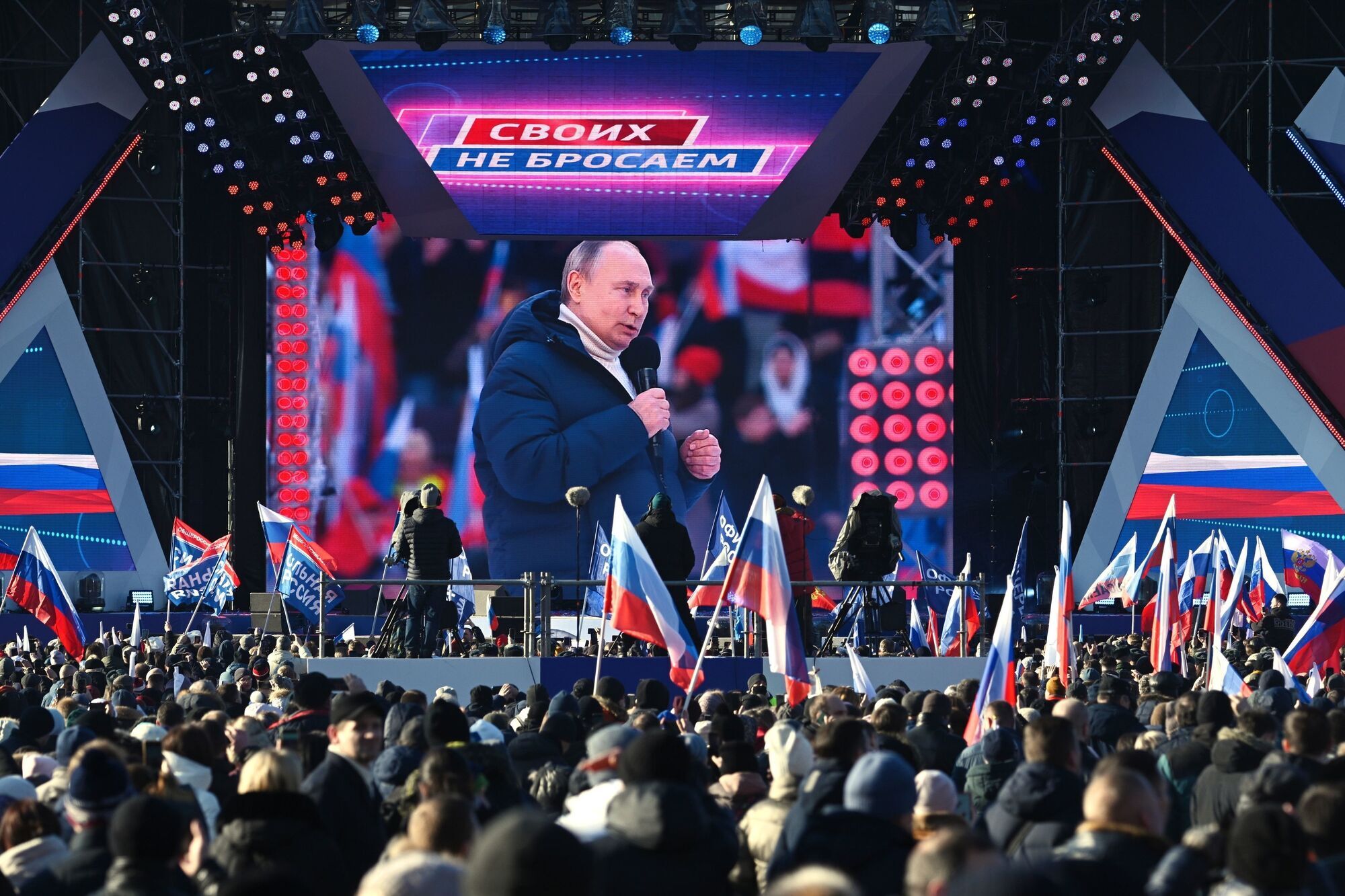
Russian President Vladimir Putin seen on the big screen as he delivers his speech at the concert marking the eighth anniversary of the referendum on the state status of Crimea and Sevastopol and its reunification with Russia. The banner reads "For Russia" projected in the backgroud. (Vladimir Astapkovich/Sputnik Pool Photo via AP)
THERE was a time when we all saw politics as a straight line, stretching from left to right. A spectrum, that’s what we called it. We understood what ‘left’ meant and what ‘right’ meant.
Sometimes it could get a bit confusing. New parties came and went — in Ireland, the Progressive Democrats, for instance. They were firmly on the right of the spectrum when it came to economics — and went even further right on one occasion on the issue of citizenship. But in broad terms, after an uncertain start, they could even be a bit left of centre on some of the social issues.
And of course, the issue was always a bit cloudier here because of the bulging mass at the centre of the spectrum. Throughout most of our political history, it was safe to describe Fine Gael as being to the right of Fianna Fáil, and Fianna Fáil as being to the right of everyone else.
But you could always be forgiven for being a bit confused — especially when you started trying to explain the political spectrum in Ireland to an outsider. And that was before anyone asked about left and right in Northern Ireland politics.
There is no political spectrum now — here or anywhere else. It’s a circle.
At the top of the circle is democracy, in all its brilliant and ugly forms. At the bottom is totalitarianism. And all the way around the circle, from left to right (or right to left), is a huge variety of shades of opinion. Not just opinion, but indifference and complacency, passion and joy, dedication and commitment, fear and loathing. From extreme left to extreme right, and vice versa.
Both extremes — top and bottom — are characterised by a set of values, but also by power. In a democracy, power has to be won — usually, though not always, by fair means. It also has to be lost — the transfer of power after an election is the very definition of democracy.
In totalitarian systems, power is held onto be any means. Cruelty, oppression, the denial of rights — all of those are justified by the totalitarian need to hold on to power at any cost.
In a totalitarian system, with few exceptions, power is only lost by violence and is usually replaced by more repression.
Place on the circle
One of the interesting things about the world we live in is the different attitudes to peace in democracies and totalitarian systems. I’m open to correction on this, but I don’t think there’s ever been an example in history of one democratic country declaring war on another.
But another interesting fact about the way in which the political spectrum has developed into a full circle is the place where the extreme left and the extreme right live.
In my innocence, I used to think that people on the extreme left were just more left-wing than me. Whatever I wanted by way of a rights-based society and a role for the state in wealth creation and distribution, they wanted more of it.
But actually, it’s both more complicated and more simple than any of that. What the hard left want most is to have enemies. That’s what the extreme right want too. And their real enemies are nearly always their own. The hard left hate the broad left and the liberals most, and the hard right hate mere conservatives with a passion.
They both hate the state. Both extremes are quick to embrace conspiracy theories — often the more outlandish the better. They both have complete fixations on the same things.
Even in America, the extreme right hates America, or at least any version of it that’s not their own. The hard left all over the world, of course, regards the US as the ultimate enemy, the power that can do no right.
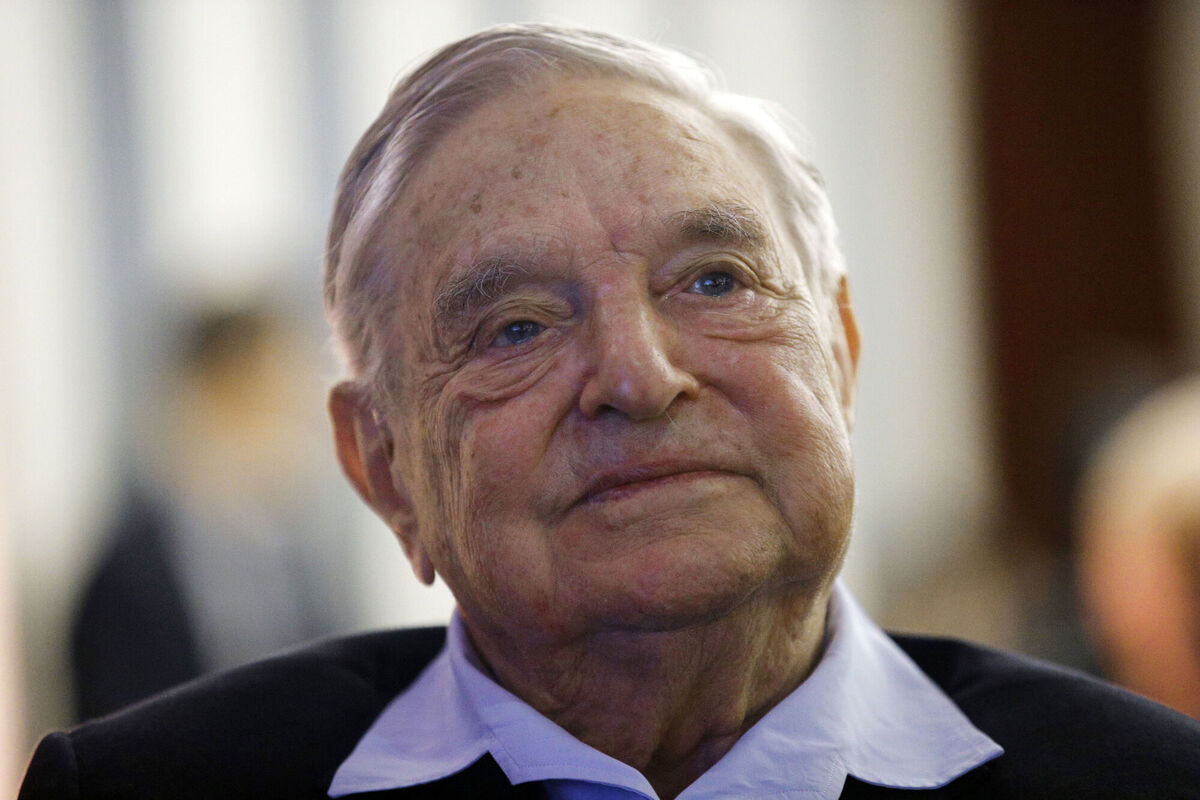
Both extremes of left and right hate concepts such as globalism and Zionism — their hatred of Zionism in particular often tips into antisemitism. Figures such as George Soros — and the nonsensical conspiracy theories that swirl around him — bring out the exact same response in hard left and hard right.

Whataboutery
I’ve always believed that it’s our duty, sort of, to challenge and question. There are aspects of American policy and practice with which I profoundly disagree, for example, and I have written here before about the oppression of the Palestinian people. But that wouldn’t qualify me, I’m afraid, for membership of the hard left. I just want to challenge, not to hate.
Here’s the funny thing. If you try, as honestly as you can, to allocate a place on the political circle to the extremes of left and right, you’ll find them right down on the bottom, close to where Vladimir Putin lives, and divided from him and each other only by a hair’s breadth.
Weird, isn’t it?
Throughout the pandemic, the hard left and the hard right found huge common ground in opposition to virtually everything proposed by public health. It was all a vicious conspiracy, anti-freedom, anti-personal liberty. Or it was an exercise in mind control, started by globalist forces like (you guessed it) Bill Gates and George Soros.
And when Putin started his vicious war against Ukraine, both hard left and hard right found themselves uniting again. We’ve all seen the absurd stuff from the US where Fox News hosts are turning themselves inside out to try to blame Joe Biden and absolve Vladimir Putin.
On this side of the Atlantic, it’s the hard left that can’t deal with what Putin has done.
Let me give you a small example. I recently replied to a Facebook post I didn’t understand. It was from someone on my ‘friends’ list, and it seemed to be saying that Putin, in the end, had no choice but to invade Ukraine, because Nato was encircling it and threatening Russia severely. One of my ‘friend’s’ friends described the invasion as a pre-emptive strike.
When I raised a couple of questions about this point of view — that’s what Facebook is for, isn’t it? — the abuse started. Not a lot, because there weren’t too many people involved, and most of them were just angry rather than abusive, though I did have to block one man whose choice of language was beyond disgusting. The abuse was accompanied by all the “what about” questions. What about Nato? Why isn’t Israel in front of a war crimes tribunal? What about the “biolabs”? What about the threat to Russia? What about Volodymyr Zelenskyy’s money or his spin doctors?
It was minor enough stuff, but I found myself intrigued by the fact that there are people in my immediate circle apparently unwilling to believe and to assert that Russia has invaded Ukraine at the behest of a totalitarian leader. On the contrary, these people all regard me as a stupid or corrupt tool of some establishment.
Of course, I don’t matter, and what they think of me doesn’t matter. But there are times when everyone has to come together in the face of evil, and this is simply one of them. Every now and again tortured expressions of ideology need to take second place to simple concepts, like right and wrong. Otherwise, totalitarianism wins.

Subscribe to access all of the Irish Examiner.
Try unlimited access from only €1.50 a week
Already a subscriber? Sign in
CONNECT WITH US TODAY
Be the first to know the latest news and updates
More in this section