Mick Clifford: Neutrality requires a debate, not a slagging match
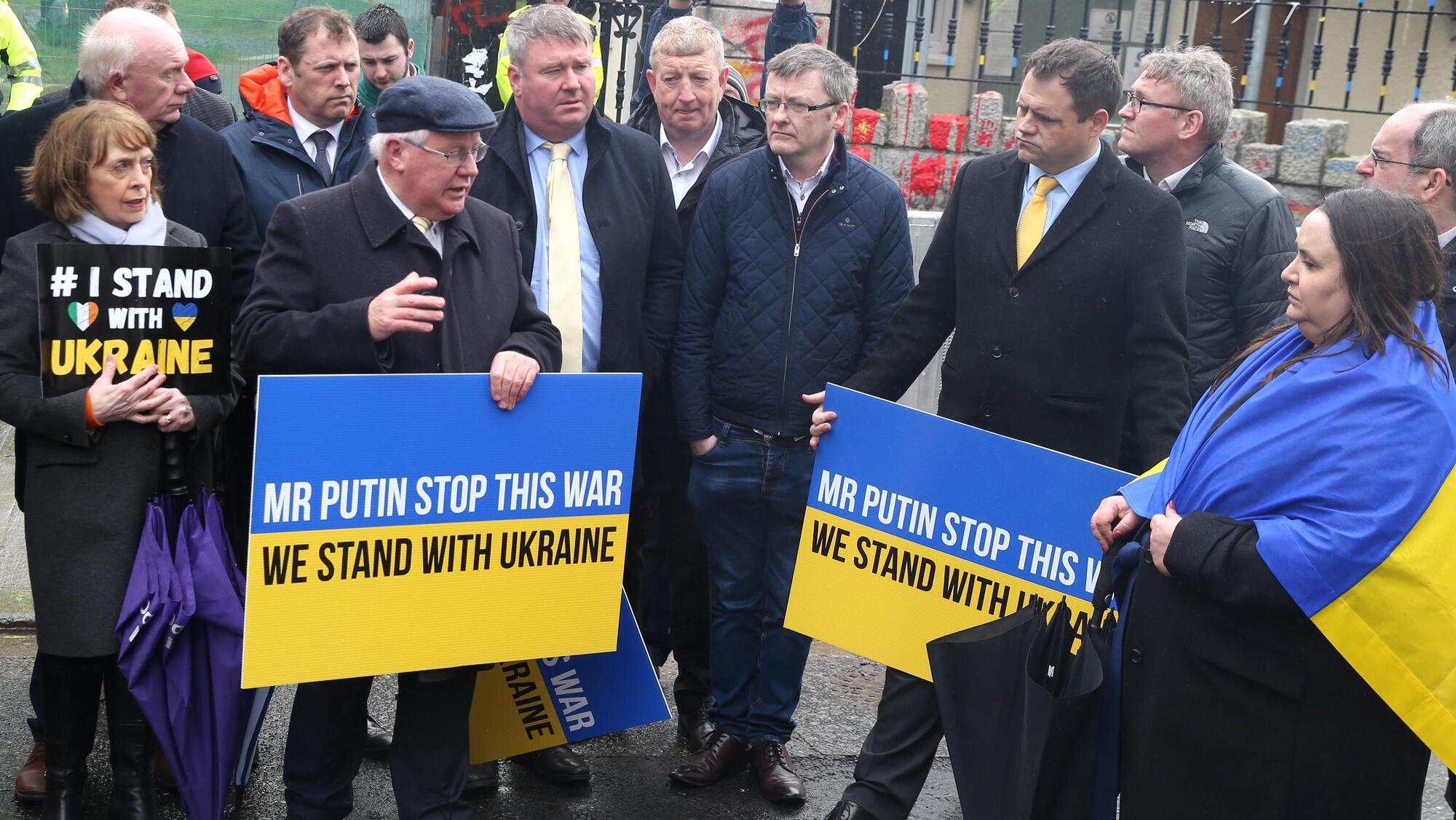
Ukrainian ambassador Larysa Gerasko (right) was joined last week by TDs from across the Dáil including Róisín Shortall, Seán Ó Fearghaíl, David Cullinane, and Neale Richmond during a protest at the Russian embassy on Orwell Rd, Dublin. Picture: Stephen Collins
Catherine Connolly is one of the more able deputies in the Dáil. The Independent Galway West TD is also highly regarded across the House for her integrity. Customarily, she cuts through the dross and rhetoric to deal with the meat of any issue. All of which made her contribution to Leaders Questions on March 10 very surprising.
The subject was the recent discussion over Irish neutrality. Addressing Micheál Martin, she said that his comments along with “well-placed articles” were “telling us to get rid out of neutrality”.
She went on: “Neutrality has been under threat by every single representative of the establishment for a long time… in the middle of a crisis where we should be using all our efforts to help the Ukrainian people — with whom I stand in solidarity — we are being deflected by various voices who infantilise and demonise people and TDs who speak out, telling us we should grow up, that we should be a voice for war and more death.”
The Taoiseach responded by saying he never said that we should get rid of neutrality.
“Sorry if I’m wrong,” Connolly replied.
“You know you’re wrong, which is a disingenuous way to behave,” Martin said.
The comments from Connolly were completely out of character.

She accused Martin, with absolutely no evidence, of saying something highly controversial which he never uttered; she said that articles in the media were “well placed”, implying the authors were following a politician’s instructions rather than acting independently; she suggested that some people were cynically using the Ukraine crisis to pursue a long-standing personal agenda, again without any evidence. And she characterised those who question the status of Ireland’s neutrality as displaying “a voice for war and more death”.
The overarching inference was that anybody who disagreed with her take on neutrality was acting in bad faith, from a point of low morals, and with no thought for the loss of human life.
There was no acceptance in her contribution that some people might genuinely have been shocked at Russia’s invasion of Ukraine, fearful for the future of democratic societies, and asking whether this should prompt a rethink on Ireland’s role in a precarious world.
The Galway West TD’s contribution was one of the more civil to surface in recent weeks on the subject of neutrality.

It did, however, conflate with the general tenor of opposition to even re-evaluating where this country stands in the wake of the slaughter in Ukraine. That tenor is largely concerned with attacking anybody who suggests that things have changed. In footballing parlance, it’s a case of playing the man and not the ball. For a matter of such importance, the displacing of reason with emotion — principally anger — is a worrying development.
Last Monday, columnist Una Mullally had a go at Fine Gael TD Neale Richmond, who suggested on radio that maybe Ireland should send missiles to assist Ukraine’s defence. He did this, Mullally opined, “with the embarrassing hard man air of a lad jonesing to wear a flak jacket for a photo op”. He was engaging in “ridiculously stupid militaristic rhetoric” and “spoofing a macho fantasy of Ireland’s military weight”.
Richmond, it’s fair to say, has the cut of a south Dublin rugby jock. That is not a crime. Ok, maybe it should be. But fitting the bill for an extra in a Ross O’Carroll-Kelly sketch does not render him some jingoistic, sub-Boris Johnson clown. Nothing that Richmond said could be interpreted as adopting the kind of macho militaristic pose known to populist politicians in some countries.
His suggestion, while controversial and impractical, is probably coming from the same place as the anger, despair, and impotence felt by many who are daily observing the desecration of a fellow European democracy. Disagree with him by all means, but why cast him as a wannabe Rambo playing out a little boy’s fantasy rather than a public representative acting in good faith?
Online, the usual gang of cowards and clowns have been spitting bile in this vein, but it has gone way beyond them. One particular line emanating from Twitter has been repeated ad nauseum. Here’s the version from comedian Tadhg Hickey who has, in other respects, shown himself to be an astute observer of life.
“I wonder if the politicians and journalists giddily agitating for Ireland to abandon its neutrality intend of sending themselves or their children to the battlefields,” he tweeted.
This frames the issue as one that has been generated exclusively by politicians and journalists, who are salivating at the prospect of sending young people from working class backgrounds off to fight foreign wars.
I wonder if the politicians and journalists giddily agitating for Ireland to abandon its neutrality intend on sending themselves or their children to the battlefields?
— Tehran Tadhg (@TadhgHickey) March 12, 2022
Somebody, it would appear, is confusing Ireland in the 21st century with imperialist Britain in the late 19th. That the scenario presented is ludicrous is not the point. What matters is that in today’s world some people read it, like the sound of it, and believe it sums up the whole issue.
Then we have Sinn Féin, grappling furiously to the cliff face, en route to the high moral ground on this issue. The party’s spokesperson on health, David Cullinane, during an online exchange this week, very reasonably said he hoped any debate would be “respectful”.
The message obviously didn’t filter through the tightly-controlled organisation as the social media Shinner brigade are apparently all strict ideological pacifists with not the slightest hint of irony.
Here’s one example from the multitude, leading party figure Enda Fanning, tweeting from the cliff face.
“There’s something pretty sick about all the lads pushing a pro-Nato, anti-neutrality agenda daily on the backs of the horrors in Ukraine,” he tweeted last week. “And the lads include those ‘objective’ journos, columnists and radio shock jocks out there.”
Now, it’s understandable that the Shinners are feeling let down on this matter. Putin didn’t turn out to be the benign guy with an air of revolutionary chic that they had supposed him to be. Deflecting from their ill-judged dalliance is understandable. Perhaps now they might re-evaluate their oft-expressed admiration and support for dictators elsewhere in places like Cuba. (The revolution there, lads, ended circa 1962. Ask any of the locals who have ever sought out civil rights since).
Things have changed. There is an argument to be made that this country needs to examine its role, particularly its relation to the defence of fellow democracies in western Europe. There is an argument to maintain the status quo. What appears to be a small cohort of voices suggest that Ireland should align with Nato, but that will never, correctly in my view, wash with the public.
The time has come to examine all of these options.
Reducing the debate to trotting out populist tropes may suit some people, but it does nothing to further the values our democracy espouses.