Elaine Loughlin: A century after independence, we still carry so much shame
Equality is doled out in different measures for children with a disability or illness, or those born into poverty or homelessness
Elaine Loughlin: A century after independence, we still carry so much shame

As a small, rain-battered nation on the western edge of Europe we have a lot to be proud of. St Patrick’s week reminds us of that.

But a century after gaining independence, we still carry so much shame.

Shame that the forward-thinking and inclusive Proclamation written by the leaders of 1916 which vowed to “cherish all the children of the nation equally” is not yet a reality.

In the year 2022, many children realise that equality is doled out in different measures.

Those with a disability or an illness, those born into poverty or homelessness, those who witness domestic abuse or violence will have to fight significantly harder in life.

In many cases, what should be an automatic right becomes a battle.

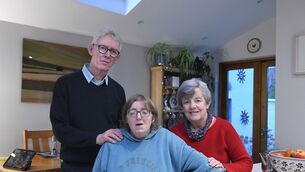
Adam Terry and his mum Christine: ‘Nobody is coming to find me in the lost and found,’ he said. Picture: courtesy of Brian O’Connell

A cynic might suggest that for too long the State has relied on the fact that parents and guardians are already too thinly stretched and too worn out to take on yet another fight for what should be a given.

There is the well-known story of Adam Terry, the boy who was forced to publicly plead for urgent scoliosis surgery after painful years on a waiting list.

“I have moments now and then where I start crying... every day I have less abilities. Nobody is coming out to find me in the lost and found. To be honest, sometimes I feel like I’m crying myself to sleep because it’s so unfair. It just makes me angry and frustrated and sad,” he told Claire Byrne’s radio show last year.

After four years, Adam thankfully underwent surgery to straighten his spine at Crumlin children’s hospital last October when his case was widely reported on and raised in the Dáil.

But if this country is to truly cherish each child equally, we would never have heard Adam’s voice on the national airwaves.

Then there is Calum Geary, the profoundly deaf child who has sat in his mainstream classroom struggling without the support of an interpreter as his twin brother progresses along with the other kids.

“I love my country, but my country doesn’t love my son,” said Calum’s father Andrew.

There was relief when Education Minister Norma Foley recently announced the creation of a new role of sign language interpreter in our schools, but it has been an eight-year fight for the family of the Cork child.

With Calum now in sixth class, the Irish sign language communication support worker positions are finally materialising just a few months before he leaves primary education.

Calum Geary with his identical twin Donnacha.

Calum Geary should not have been a name that has been printed many times in this paper and elsewhere.

On Saturday, the Irish Examiner reported that the parents of young people with disabilities are being expected to attend training courses so they can carry out therapies on their own children who remain on long waiting lists.

Parents have been told that if they don’t attend courses relating to everything from speech and language therapy to physiotherapy, they will be taken off the HSE waiting list as they are deemed to be no longer requiring these professional supports.

"Things at home can be quite stressful,” one mother told this paper.

I have no problem working alongside a therapist, but I am not a therapist and I’m certainly not paid to be one.

“I’m one person, but you are expected to do the job of eight or nine different people and you just can’t do it, I have suffered burnout in the past,” added the mother, who has three children with disabilities.

The article prompted other struggling parents to vent their frustration online.

“No news for us. This has been the level of intervention from HSE since we started our journey in 2017. I have an Ikea shelf full of photocopies to prove it,” one mother wrote on Twitter.

Many parents say they have no issue supporting the work carried out by trained therapists, but asking them to become a replacement for this professional support and treatment is unacceptable.

Others spoke of the two-tier system which divides children along the lines of wealth.

Homeless and poverty are escalating in our society.

Parents who can afford to pay up to €2,000 for a private dialogistic appointment and join what still can be a long list for private services get the supports, while others wait.

It is not just in our health service where equality is hard-won for some.

Last month, the chief executive of Dublin Simon Community, Sam McGuinness, expressed "dismay” at the further rise in the number of people in emergency accommodation.

In the last week of January, there were 1,119 families in emergency accommodation, 42 more than the previous month.

A total of 2,563 children or dependents and 1,111 young people between the ages of 18 and 24 were living in temporary homeless accommodation.

Reacting to the figures, Mr McGuinness spoke of families attending soup kitchens to save on food.

In 2022, growing up in a place you can call home is still an aspiration for many of our children.

It’s among the shameful black marks that have blotted this State’s 100-year existence — from the horrors that went on in mother and baby homes and industrial schools to the abuse inflicted on some of our most vulnerable, like in the Grace case, to more recent revelations of major failings in the South Kerry Child and Mental Health Services.

This week, as our politicians pull on the green jersey to promote Ireland around the globe, they should be reminded of the words of Clarke, Connolly, MacDiarmada, McDonagh, Pearse, Plunkett, and Casement.

“The Republic guarantees religious and civil liberty, equal rights, and equal opportunities to all its citizens, and declares its resolve to pursue the happiness and prosperity of the whole nation and of all its parts, cherishing all the children of the nation equally.”

This week in years gone by

1922

March 17: Pro and anti-Treaty politicians used St Patrick's Day to hold meetings across the country. Reporting on the speech given by Michael Collins in Skibbereen, The Cork Examiner stated that he remembered the previous year when "the hangman was busy and very few of his audience expected to be there that day. He himself certainly did not expect it, and they did not expect to see their friends — the Black and Tans and the British soldiers — sailing away."

1942

March 17: With war raging in Europe, Taoiseach Éamon de Valera made a St Patrick's Day broadcast warning the nation to gird itself to face "hardship, stern discipline and sacrifice" and called on every man of military age to offer himself for service.

1971

March 17: Jack Lynch travelled to the White House where he met with President Richard Nixon. "Apart from the military bands, marching units and artillery salute, the 73 girl choir of the capital city's St Patrick's Academy was on hand to serenade Mr and Mrs Lynch and Mr Nixon and his wife," The Cork Examiner reported. The performance included a rendition of 'When Irish Eyes are Smiling'.

2009

March 17: Under the headline 'Is Feidir Linn', it was reported that there had been speculation that Barack Obama might scrap the St Patrick's Day White House events but the opposite turned out to be the case when he met then Taoiseach Brian Cowen. Then political correspondent Paul O'Brien wrote: "The two have a lot in common. They're both young men facing huge challenges and have problems with bankers. But Obama preferred to dwell on another bond they shared - their Offaly roots."

What to look out for 

The Dáil is on recess this week and it will be especially quiet as ministers jet off across the globe for St Patrick's events. This year a promotional programme of 33 high-level visits abroad has been organised including:

The US and Canada

Taoiseach Michael Martin with British PM Boris Johnson iahead of his trip to US for St Patrick's Day. Picture: Andrew Matthews/PA Wire.

Taoiseach Micheál Martin will spend five days in Washington, including a meeting in the Oval Office with President Joe Biden and the annual shamrock ceremony in the White House.

Ministers Eamon Ryan and Roderic O'Gorman are travelling to New York. Michael McGrath flies to San Francisco before travelling to Vancouver in Canada and Charlie McConalogue will also be in Canada. Norma Foley is in Boston; Helen McEntee is due to visit Savannah and Stephen Donnelly has been sent to Austin.

South America

Tánaiste Leo Varadkar left Ireland last week as part of his trip to Colombia and Chile. Catherine Martin will fly the Irish flag in Argentina and Colm Brophy is in Mexico.

Europe

Paschal Donohoe is travelling to the Netherlands as well as London. Pippa Hackett is taking part in events in Greece; Thomas Byrne is in Italy; Damien English is in Sweden and Seán Fleming will do a tour of the north of England and Scotland.

Anne Rabbitte will visit UN camps on the Romanian border with Ukraine and Josepha Madigan is in Slovenia.

Rest of the world

Darragh O'Brien is due to attend an Expo in the UAE, while Robert Troy is visiting India.

Peter Burke is representing the country in Japan and South Korea. Hildegarde Naughton has the longest distance to travel as she visits Australia and New Zealand.

Simon Coveney will remain on call here and will attend engagements on the island of Ireland.

Did you know?

Thomas Francis Meagher.

The Irish tricolour was first flown publicly in Waterford City in March 1848 when Thomas Francis Meagher, a Young Ireland leader unfurled it from the Wolfe Tone Confederate Club. 

Meagher strongly believed in encouraging Irish Catholics and Protestants to join forces in the fight for independence. In February 1848, he made a famous speech, where he said: “What strength have I to beat my way towards that bold headland, upon which I have sworn to plant the flag I have rescued from the wreck?”

  • 'On The Plinth' appears each week in Tuesday's Irish Examiner (in print and online). Make sure you are up to speed on the major political stories by signing up to the On The Plinth politics newsletter HERE .
x

More in this section

Revoiced

Newsletter

Had a busy week? Sign up for some of the best reads from the week gone by. Selected just for you.

Cookie Policy Privacy Policy Brand Safety FAQ Help Contact Us Terms and Conditions

© Examiner Echo Group Limited