Mick Clifford: These two women stood up for themselves. Their victory may be a tipping point
The Labour Court has vindicated Julia Marciniak and Lenka Laiermanova and the campaign they initiated about tips in the hospitality industry may end up written into the law of the land
Mick Clifford: These two women stood up for themselves. Their victory may be a tipping point

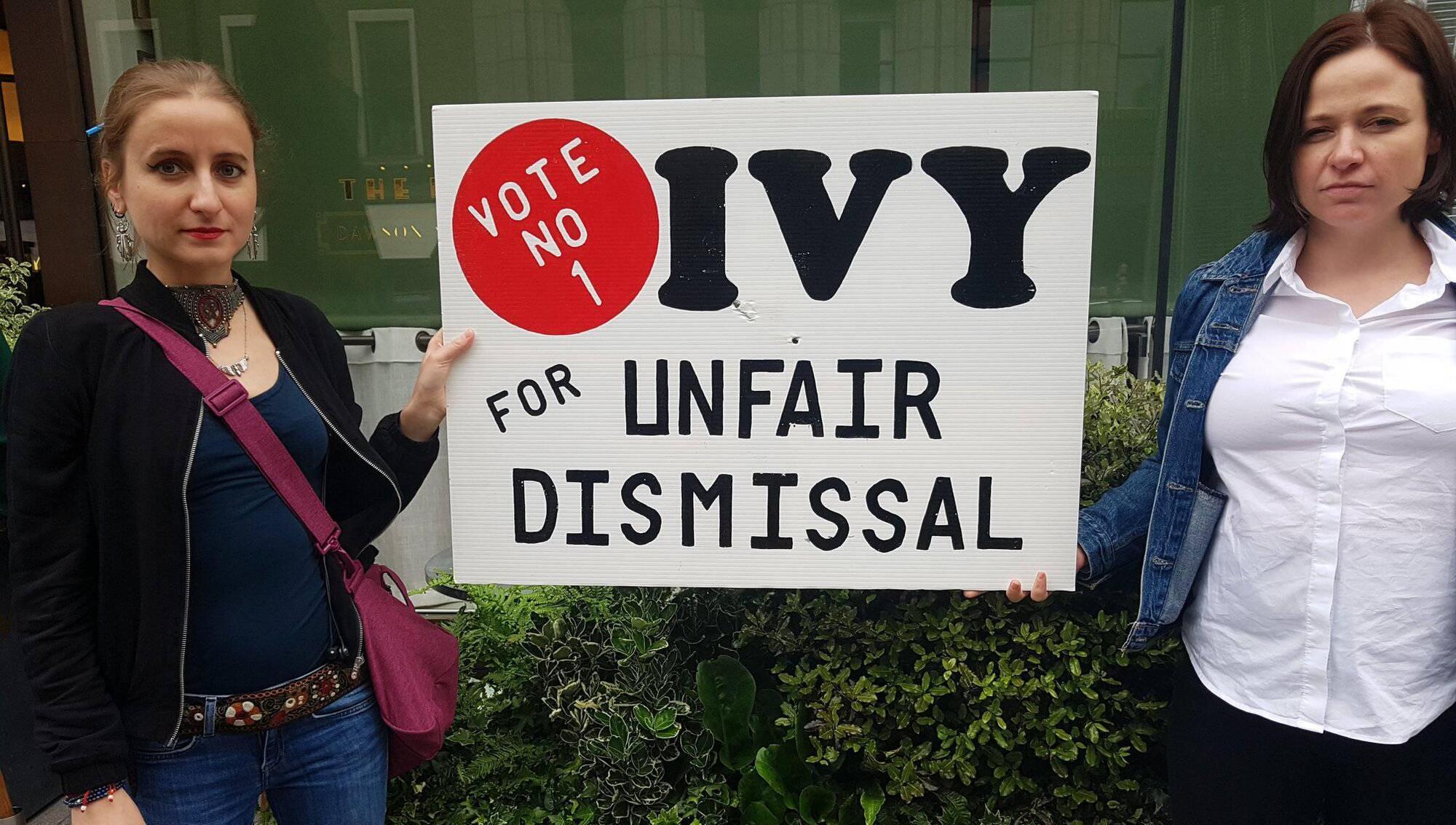
Julia Marciniak and Lenka Laiermanova learned that The Ivy in Dublin was making up their wages out of their tips. This week, the Labour Court ruled that the restaurant had dismissed them for trade union activity and ordered it to pay them compensation of €2,016 and €7,924 respectively. Picture: Unite Trade Union/Facebook

Sometimes the little guy wins. Most of us who are fortunate enough to enjoy a meal out like to tip the waiting staff. Tipping isn’t part of our culture as it is in places like the USA but it has, since eating out has become a genuine feature of life here over the last 30 years, come into vogue. On one level it is a sign of appreciation but it is also a recognition that the hospitality industry is in the low paid sector.

Last week, two women who worked as waiting staff had a major victory. The Labour Court ruled that Julia Marciniak and Lenka Laiermanova had been dismissed from their waiting service jobs because of trade union activity.

The two women had been employed by The Ivy restaurant on Dublin’s Dawson St in 2018 on a contract basis. Within a few months, it became obvious that the tips they received from customers were used to make up their agreed rate of pay.

They protested and were promised a resolution. None came and both approached the trade union Unite for advice, joined up, and urged others to do likewise. Over the following months, both were dismissed on what the Labour Court ruled was effectively trumped-up charges.

'[The Labour Court ruling] shows that there is justice out there for people who are not treated properly,' says Julia Marciniak, one of the former waitresses at The Ivy, who now works as a co-ordinator for Unite in the hospitality industry. 

In each of the two cases, the court stated: “The allegations of ‘misconduct’ were an attempt to hide the real reason for her dismissal which was because of her trade union activities.”

Proving dismissal for trade union activities is extremely difficult. In this case, the two women were determined to stand up for their rights. Through the union, they approached a lawyer who, according to Unite officer Brendan Ogle, agreed to take on their case but said they wouldn’t have much chance of winning. The pair said thanks but no thanks. They didn’t want to be represented by anybody who thought the game was lost before they ran out on the pitch. So they were represented by the union.

“It’s a notoriously high bar to clear,” Ogle told the Irish Examiner. “But Julia and Lenka took on project impossible and they won.”

When they were sacked, a protest took place outside the restaurant and the media coverage led to controversy over the whole area of tipping. The public at large were awakened to the fact that staff in restaurants didn’t necessarily get the money that was left for them.

It should be acknowledged that the majority of business owners are entirely honourable in this respect but there will always be a few. 

Women started a process that may lead to a new law

Between the jigs and the reels at the time the two sacked women were able to arrange a meeting with then social protection minister Regina Doherty. Out of that came a new law designed to ensure that tips — mainly in the hospitality industry — will be retained by the staff for which the money is intended. 

The Payment of Wages (Tips and Gratuities) Bill is being steered through the Oireachtas by Enterprise, Trade, and Employment Minister Leo Varadkar. 

As an aside, there is a lovely subplot to this yarn with the coming together of Messrs Ogle and Varadkar. Once upon a time not long ago, these two gents were seen as outliers on the political spectrum, the former considered to be a Red creeping out from under the bed, and the latter a thrusting young Tory of the Thatcherite variety. 

'[Proving dismissal for trade union activities] is a notoriously high bar to clear but Julia and Lenka took on project impossible and they won,' says Brendan Ogle of the Unite trade union. Picture: RollingNews.ie

The caricatures were little more than handy fodder for those who opposed their views but in any event, here, the pair are marching in lockstep to ensure that low-paid workers will not be exploited.

One outstanding concern with the bill is the issue of service charges. Everybody is accustomed to seeing the addition of a service charge to a bill which quite often influences customers to leave a smaller tip, if any. 

Most people tend to believe that this service charge is just another form of a tip but that is not necessarily so, and it can be used to contribute to wages for staff rather than passed on as a gratuity.

Senators shed light on gratuities issue

In the Seanad debate, Sinn Féin’s Paul Gavan said that the concept of a service change came about in 1951 as a result of a strike in hotels in Dublin that went on for several months. “The solution was a collective agreement between unions and hotels to introduce a service charge,” he said.

“The service charge would be owned by the employees through the trade unions and distributed through the trade unions. That is how service charges came about.

“They were to ensure justice and better pay for workers in hotels in Dublin.”

The charge has come a long way since then and is now distributed at the discretion of the employer. Labour Party senator Marie Sherlock also touched on the issue. 

“The public would be horrified to know that service charges are not contained within the definition of a tip or gratuity,” she said:  

For years, we have been duped into thinking we were paying something extra towards the service and not for the service itself.

The minister said he would be open to amendments in this and other areas during the second stage reading of the bill.

The whole episode is a positive development in marshalling the rights of low paid workers, many of whom were walloped disproportionately by the pandemic.

Julia Marciniak, who now works as a co-ordinator for Unite in the hospitality industry, says that the result is a major victory for workers’ rights. “It shows that there is justice out there for people who are not treated properly,” she said.

“It means that workers do not have to be afraid to join a trade union if they believe that they should do it.”

On a completely separate matter, veteran journalist Paddy Murray died last Thursday at the age of 68. 

Paddy worked in newspapers for nearly 50 years and throughout the pandemic he wrote a column in The Irish Times about how he, who was highly immunocompromised, was managing. He also spoke on radio about his health struggles. Last year his memoir, And Finally — A Journalist’s Life in 250 Stories was published.

I met Paddy on my first day in journalism 28 years ago. He and his partner, Connie Clinton, were flying high in their respective careers. Connie was the first female sports editor in Irish media. 

As a couple, they were bursting with talent and personality, but for me at the time their outstanding feature was their kindness. 

The subsequent years dealt them savage blows with health issues but Paddy wrote that he always considered himself lucky. He also wrote movingly about the centrality in his life of Connie and their daughter Charlotte.

For people like Paddy, who knew his time was limited, the pandemic was particularly harsh.

On Thursday, the clock caught up with him. Ar dheis Dé go raibh a h-anam.

x

More in this section

Revoiced

Newsletter

Sign up to the best reads of the week from irishexaminer.com selected just for you.

Cookie Policy Privacy Policy Brand Safety FAQ Help Contact Us Terms and Conditions

© Examiner Echo Group Limited