Maeve Higgins: US must offer a new home to the Afghans its war has cruelly displaced
The US need to take responsibility for their marauding these past two decades. One way to do that is to stop invading other countries, another is to offer the unfortunate people they’ve been complicit in displacing a new home
Maeve Higgins: US must offer a new home to the Afghans its war has cruelly displaced

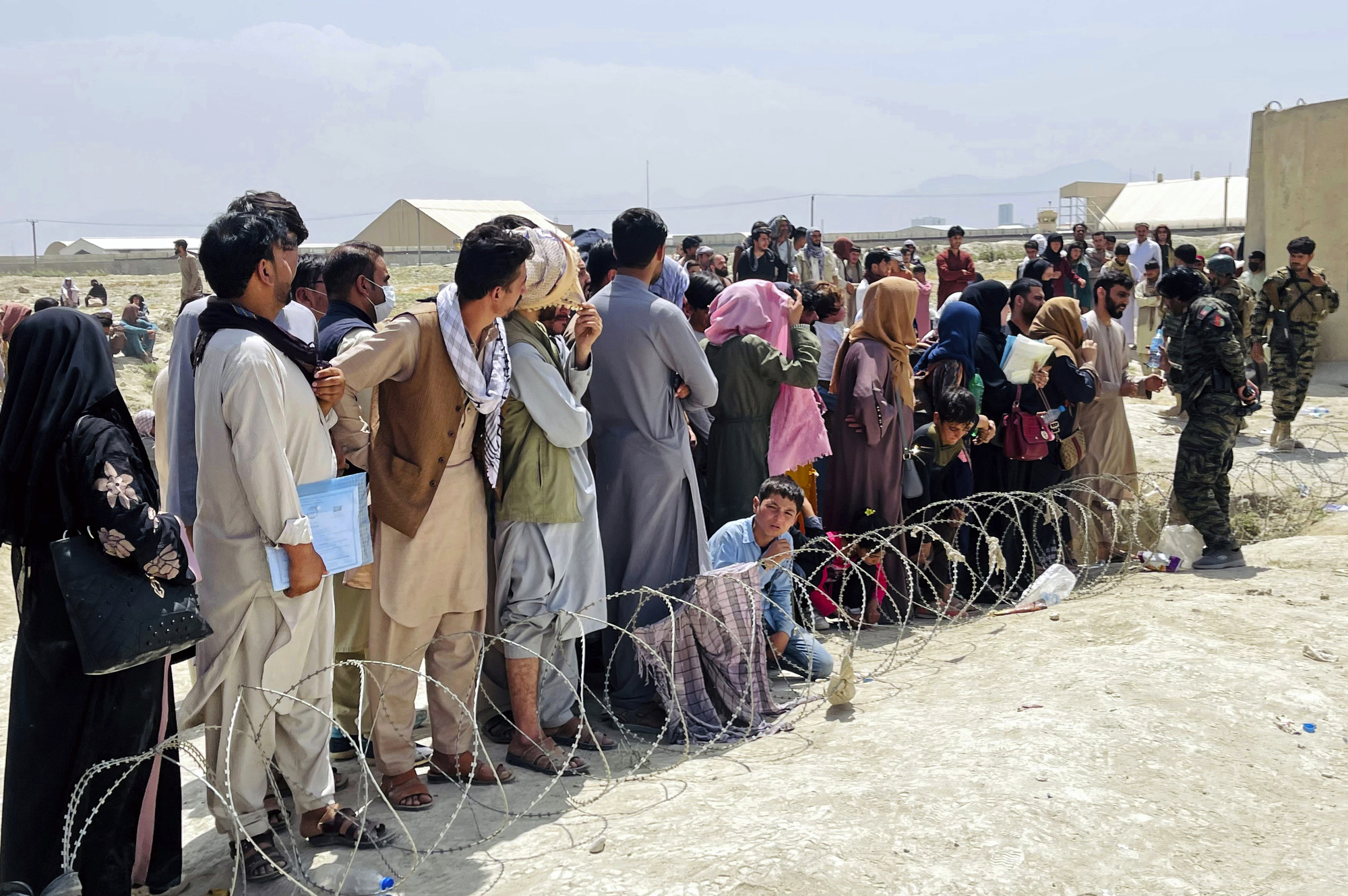
Afghan security guards try and maintain order as hundreds of people gather outside the international airport in Kabul, Afghanistan, Tuesday, Aug. 17, 2021. The Taliban declared an “amnesty” across Afghanistan and urged women to join their government Tuesday, seeking to convince a wary population that they have changed a day after deadly chaos gripped the main airport as desperate crowds tried to flee the country. (AP Photo)

PERHAPS you, too, were struck dumb by the sight of Afghans falling to their deaths from a US military aircraft, as it flew out of Kabul airport, while the city fell to the Taliban. I saw that footage and I had no words. 

Later, somebody else’s words did come to mind, the poet Warsan Shire’s: 

No one leaves home unless

home is the mouth of a shark. 

You only run for the border

when you see the whole city running as well.

Kabul is the mouth of a shark, but there are few places to run. The country is under Taliban control, and Afghanistan’s neighbours, like Iran and Pakistan, require passports and visas from Afghans, documents laughably out of reach for most of them. 

Even if you do get an Afghan passport, it is, unfortunately, one of the weakest you can possess, in no way allowing you to move freely across other nations the way a US or European passport does. Crossing borders without permission is dangerous and close to impossible, with persistent reports of Iranian border guards shooting at those who try. 

So you stay trapped and vulnerable, awaiting your fate, unless something extraordinary happens.

The US have made excruciatingly deadly choices in Afghanistan over the past 20 years, beginning with its invasion under the auspices of their ‘War on Terror’. 

The US have failed in every way, aside from making relatively few men a whole lot wealthier: Men that include warlords, weapons manufacturers, and military contractors. 

Exact numbers of casualties are difficult to come by, but a study by Brown University puts losses in the Afghan security forces at 69,000 and estimates that 51,000 civilians and the same number of militants have been killed. 3,500 coalition soldiers have died since 2001, two-thirds of them Americans.

According to the UN, some five million people have fled and not been able to return home, either displaced within Afghanistan or finding refuge within the region. Now, the US has left and the government they backed has crumbled, delivering the people into the brutal oppression inevitable under Taliban rule.

It’s impossible to put this right, but the US could do that one extraordinary thing. The US could take action to save many Afghan people’s lives: It could let them in.

On August 16, the Afghanistan-born novelist Khaled Hosseini tweeted, “The United States has a moral obligation: Admit as many Afghan refugees as possible.” 

I agree with Mr Hosseini, the US does have a moral obligation to do exactly that. 

It also has a long and inglorious record of ignoring its moral obligations when it comes to refugees, particularly those fleeing Iraq, Afghanistan, and all of the other countries targeted, or impacted, in secondary ways, by the US’s ‘War on Terror’. The US once resettled more refugees than any other country, but that impulse, often a political one, is part of history now. 

The Migration Policy Institute notes that in 2020 the US resettled fewer than 12,000 refugees, a far cry from the 70,000 to 80,000 resettled annually just a few years earlier. 207,000 refugees were welcomed in 1980, the year the formal US resettlement programme began. 

Obviously, the Covid-19 pandemic meant global restrictions on movement, so the number of people on the move in 2020 was smaller than in previous years. But the main reason people were not allowed in was because of Donald Trump, whose administration increased vetting procedures and reduced to record lows the number of refugees accepted annually.

It is the president who decides, in consultation with Congress, how many refugees the US will take in any given year. Joe Biden’s administration has pledged to reverse the downward trend and after public backlash to his initial wavering on the number, he increased the limit for resettlement of refugees this year and next. 

In the case of Iraq and in the case of Afghanistan, the US did much of the displacing. It was their bombs and their troops who turned ‘home’ in some sites into an active warzone; in others, a precarious and dangerous place to build a future. 

Mr Biden wanted to increase the numbers from the record low of 15,000 people, set by Trump, to 62,500 people. However, because of the Trump-era destruction of systems and organisations that once assisted in refugee resettlement, as well as extra challenges caused by Covid-19, it looks unlikely that those slots will be filled. 

This is a tragedy, when there are more displaced people than at any time since the Second World War. ‘Displaced’ is a clean and blameless word to use for the complex reality faced by those who have lost everything.

To return to Warsan Shire, and her poem 'Home'

Home

You only leave home 

when home won’t let you stay. 

No one leaves home unless home chases you.

In the case of Iraq and in the case of Afghanistan, the US did much of the displacing. It was their bombs and their troops who turned ‘home’ in some sites into an active warzone; in others, a precarious and dangerous place to build a future. 

Using the sick alchemy of war, the US has turned people across the region into refugees since 2001, at the same time as allowing fewer and fewer Iraqis and Afghans to reach safety in the US. Will that change now, as it must?

Today sees a frenzied and justifiable push from some US politicians and refugee advocates to rescue those Afghans deemed in most danger from the Taliban — people who worked with the US and their allies within Afghanistan. That push finally reached Mr Biden, who addressed criticism for his lack of urgency in getting those Afghans out of the country before the Taliban could reach them.

He passed the buck, stating this week, “So, part of the answer is some of the Afghans did not want to leave it, still hopeful for their country. And part of it is because the Afghan government ... discouraged us from organising a mass exodus to avoid triggering — as they said — a crisis of confidence.” 

The US have made excruciatingly deadly choices in Afghanistan over the past 20 years, beginning with its invasion under the auspices of their ‘War on Terror’. Photo: AP/Rahmat Gul

Excuses made, now we hear US officials state that the government is prepared to take more than 20,000 Afghans — who are candidates for special immigrant visas — to US bases, the plan being to process the paperwork there and resettle them down the line.

The Pentagon’s director for defence intelligence, Garry Reid, said officials are working to create capacity to support refugee relocation at temporary sites. “Our military embrace the opportunity to recognise their contributions to combined operations in Afghanistan by welcoming them into the US.” He added, “At this point, we’re looking to establish 22,000 spaces. We can expand if we need to.”

They need to expand that, immediately. The US secretary of state, Antony Blinken, toed the same line, saying last week, “We’ll continue to welcome Afghan immigrants and refugees as our neighbours in gratitude for helping us despite the danger. We won’t forget it.” 

A selective memory is not good enough. Not only does the US need to step up to protect their own, they need to take responsibility for their marauding these past two decades, and accept that they destabilised the lives of millions of people in Afghanistan and Iraq. One way to do that is to stop invading other countries.

Another is to graciously assist the unfortunate people they’ve been complicit in displacing, to offer them a new home: One that is not in the mouth of a shark.

x

More in this section

Revoiced

Newsletter

Sign up to the best reads of the week from irishexaminer.com selected just for you.

Cookie Policy Privacy Policy Brand Safety FAQ Help Contact Us Terms and Conditions

© Examiner Echo Group Limited