Michael Moynihan: Civic pride, civic paint – how street art can keep culture alive
The effect of so much public art is uplifting and enlivening for the city as a whole; they’re accessible and relatable for the vast majority of people going about their daily lives, writes Michael Moynihan
Michael Moynihan: Civic pride, civic paint – how street art can keep culture alive

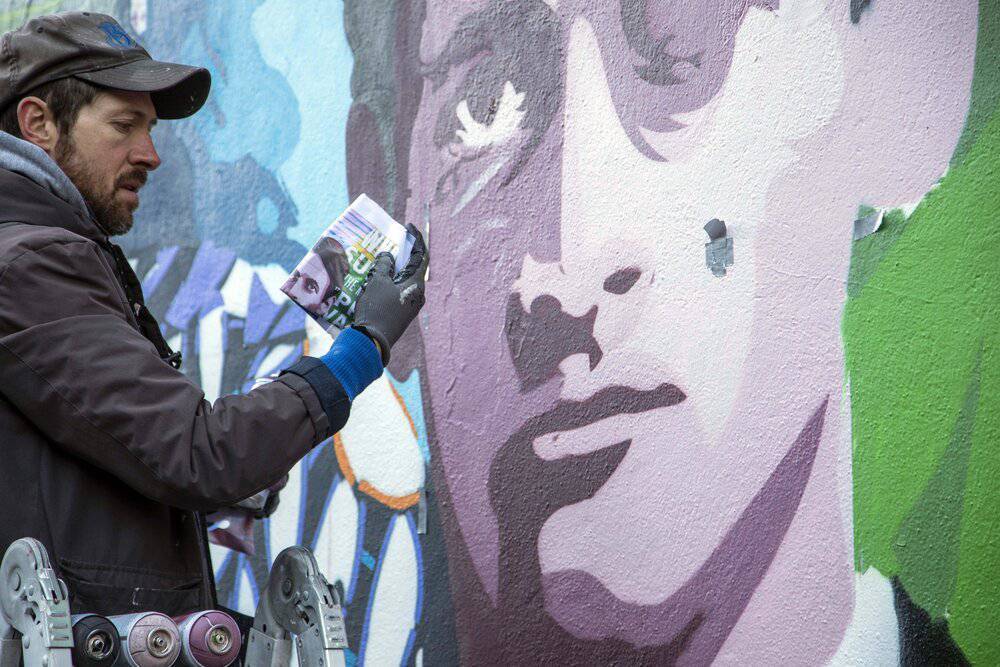
Artist Garreth Joyce working on his mural on Liberty Street in Cork City centre as part of the Ardú Street Art initiative. Picture: Clare Keogh 

Civic pride is a slippery beast. In Cork, it’s a default position but also difficult to nail down, because its expression can range around the spectrum of acceptability.

An expat pal of mine in Dublin has a particular loathing for the performative Leesider in the capital, hyper-exaggerating his Corkness for effect, and having seen some crass samples of the genre I can only agree.

But there are better examples available as well.

When you roll in from Blackpool and come to the existential crisis at the traffic lights across from the entrance to Murphy’s Brewery – left for MacCurtain Street, straight on for the quays? – you’ll see a large electrical box decorated with a painting of a reggae superstar in a Glen Rovers jersey: He lives in the Glen, it says.

There are plenty of other examples of such street art – the mural of Terence MacSwiney telling us it is not those who inflict the most but those who can endure the most on Liberty Street, the Allez Les Rouges mural to be found on Carey’s Lane – but I needed more. I needed to find the man responsible.

“I’d come back from Berlin and had been working primarily in graphic design,” Garreth Joyce told me.

“There was a call-out in the paper in 2015 or so from the group who began Reimagine Cork, looking for people to come and paint something.

“So I went down the alley off North Main Street and painted a basic enough Irish map with some text, some Gaeilge, right in the middle of it, a typical Irish expression about all of us living in each other’s shadow.

“I enjoyed it, it was a good experience, but I didn’t think too much of it when I finished.”

A man stops to look at artist Garreth Joyce at work on his mural titled 'Those who suffer the most will prevail'. Picture: Clare Keogh

Small acorns, mighty oaks. Because Joyce had included that Irish text, the people in Gael Taca asked if he could do some more work for them, and then the lads from the People’s Republic of Cork (PROC) saw what he’d done with Gael Taca. Joyce was soon doing more and more street art.

“One of the pieces I really like is the one on Carey’s Lane, in the Huguenot Quarter. I worked with Martin O'Donoghue from the Cork Opera House, and Paul McGurk from Cork City Hall.

“They came up with the brief, to celebrate the Huguenot quarter and that heritage in the city, and that’s where the ‘Allez Les Rouges’ came in.

“The ‘Welcome to Cork, Friendliest City in Europe’ mural on the Lower Glanmire Road came out of Cork winning an award for being one of the friendliest cities in the world (in a Condé Nast Traveller survey).

“That’s how it all came about, it was all very fluid. I didn’t see myself originally as a muralist.”

Fair enough, but what about the work in a slightly smaller scale? The boxes with Cillian Murphy and Roy Keane, Seán Óg Ó hAilpín and Christy Ring?

And Bob Marley?

“To be honest, those boxes – a lot of the ideas came from the People’s Republic lads. They’d say, ‘I have this idea or that idea’ for those, and we’d look at what worked, I’d see if I could illustrate them and see if we could add to them, and if we could, then that was great.

“As for the Marley one, that was the lads (from PROC) saying that Bob had originally come from the northside, so it would be the ideal place for a picture of him in a Glen jersey.

“It’s a funny one. When I was asked about it, I’d just say that Bob Marley was huge when I was growing up, everyone was listening to him, and there were certain connections that went beyond being directly related, there was an attitude thing involved.”

Uplifting and enlivening

The effect of so much public art is uplifting and enlivening for the city as a whole; they’re accessible and relatable for the vast majority of people going about their daily lives, but that doesn’t mean they’re easily produced.

“For me, the more time you have to research the better,” said Joyce.

“Something like the Bob Marley box is different, you can just find an image, but when I started I was using stencils a lot, so I had to illustrate the image, turn it into a stencil and then cut it out.

“The piece in the Huguenot Quarter, though, could have taken two months in terms of researching on the computer, putting ideas together, and then the practical part of creating the stencil and painting the piece – it took about six days to paint in total and maybe three or four days to prepare.

“People wouldn’t really realise what’s involved, but the more research you can do the better, that makes the piece what it is.

“People think sometimes you can do these things almost magically, but there’s a lot of work involved, start to finish. I love it, obviously, but I find that sometimes people don’t understand the level of work that’s needed.”

With that in mind, I was surprised he didn’t sign the pieces; having invested that kind of time and effort into them, an artist is entitled to the recognition, surely?

“I was learning as I was doing the boxes, and I was reluctant to sign them. And I didn’t have a name to really put on them.

“People don’t necessarily associate me with them though what I find is on social media people make the connection — ‘oh, you did those?’ — and the reaction’s always good, always positive.

“I’ve rarely had negative comments about anything I’ve worked on, I could number those [negatives] on the fingers on one hand, honestly.

“I still work on it. I’ve learned a lot this year while I’ve been doing work that isn’t really my work to the same extent — if I’m working with a school, for instance, the ideas and the style are dictated by the students.

“And I’m happy to work with lots of ideas, but there’s also a sense of ‘this is my thing and this is how I want to do it’, not in an arrogant sense but maybe in a way where I can take a break, reassess, and develop my own thing.

“The work that I did in the Huguenot Quarter is the kind of work I’d like to do. I want to continue exploring that, there’s so much to develop on the technical side.”

Back to the Huguenot Quarter – and back to civic pride. Joyce’s art does immense work in creating that awareness within Cork of the city’s heritage, but it’s all the more powerful for its accessibility, and the fact that it filters through to citizens and visitors alike in a subtle way. The pride people take in Cork is reflected back to them by the physical environment of the city.

“I’ve never thought of it that way,” said Joyce.

“Being proud of your city and its history to put something up like that, but maybe deep down that’s it, that these things are worth celebrating, things which are still alive in our culture – things which street art can help to keep alive.”

gwjoyce.com

x

More in this section

Revoiced

Newsletter

Sign up to the best reads of the week from irishexaminer.com selected just for you.

Cookie Policy Privacy Policy Brand Safety FAQ Help Contact Us Terms and Conditions

© Examiner Echo Group Limited