Compassion must guide how we deal with gender identity issues
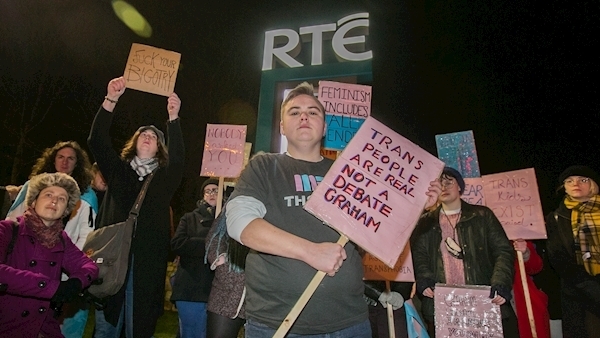
WHILE watching the Prime Time special on transgender issues in Ireland, a third-level student of my acquaintance remarked that, during her university debates, students are asked as a matter of course to give their name “and what pronoun you prefer to be addressed as”, writes
This comment was made in a “by the way” manner , nothing sensational, in the same way that you hear that younger generation bandy about the word pansexual.
Revealing my age and stage in life, I did have to refer to Google to check out exactly what ‘pansexual’ was and discovered, in a nutshell, that it means not being limited in sexual choice with regard to biological sex, gender, or gender identity. It appears to be a whole new pansexual world out there.
Except that, for many people, it is simply that things have moved on enough for them to be able to state that they are transgender, a term which broadly describes people who identify as having a different gender from the sex assigned to them at birth. This is a hugely vulnerable population in our communities, with high rates of suicide and a huge level of worry among parents who fear for the future wellbeing of a transgender child.
Tuesday night’s Prime Time report by Eithne O’Brien did a very good job of explaining where the issue is at in Ireland, as opposed to in the UK, where they are going hammer and tongs on certain aspects of it. The British debate is especially toxic on social media, being rife for whipping up prejudice and fear. Sadly, it is so in-your-face and vitriolic no one ends up any the wiser.
Prime Time was obviously angling for some of that controversy action by deciding to include comedy writer Graham Linehan as a contributor. Linehan, of Fr Ted fame, has serious form when it comes to controversy around this issue. He was given a verbal harassment warning by British police after being reported by a trans activist over social media comments last year. As many of those who objected to his appearance pointed out, he is neither a doctor nor someone who is transgender.
But those sort of narrow strictures smack of censorship. Clearly he was included to whip up an audience — with plenty of controversy preceeding the airing of the programme and a protest taking place at RTÉ. When it came down to it, he did raise issues that are unpalatable to some people, but that doesn’t mean he should be shut down.
The debate in the UK has, on one side, those who advocate for “gender self-identification”: The belief that the world should take at face value a person’s declaration of their own gender identity. On the other side are those who argue the primacy of biological sex. Their concerns include protections for women being eroded, including from male violence, by allowing trans women into female-only spaces. This does not simply concern gender-neutral toilets, but also, for instance, prisons.
Other examples of how it’s all shaping up include a leading UK cancer charity, tweeting that cervical screening was relevant for everyone aged 25-64 “with a cervix”. No mention of women. Or the campaign group which donates sanitary products to asylum seekers referring to “menstruators” rather than “women” — all in the name of trans inclusivity.
Talking about this issue is not easy and there are a number of terms that are difficult to remember and there is a fear of inadvertently causing offensive or using the wrong pronoun. I don’t know if it is a generational thing but it does feel impossible, for instance, to get my head around the notion of referring to an individual who identifies as non-binary — neither male nor female — as they, rather than he or she.
It’s also worth saying that, at the moment, Brexit-soaked Britain appears to be in a place where it would fight with its toenails on any given issue. It’s such a relief to say we’re not in that place. In fact, after the marriage equality referendum and the abortion referendum, I think it can safely be said we are in a compassionate place at present.
Without much ado at all a few years ago we introduced the Gender Recognition Act 2015. It allows over-18s to decide their own gender identity without the backing of a medical professional or gender reassignment treatment. Since then, 393 adults have been granted gender recognition certs — 216 from male to female; 163 female to male.
Instinctively though, it feels as if a recent Private Members Bill, which passed second stage in the Seanad, which would allow 16- and 17-year-olds to change gender without parental consent, is not a good idea. This legislation may never reach the end of the line but it does show that maybe, in contrast to the UK, we need to have more debate here. There is also a Government- ordered review which recommends that under-18s have a right to such a certificate with their parents consent.
Compassion is an all-important first position here for those parents and young people struggling with gender identity and wondering what is the best way forward. Your child may have the eventual relief of finally being able to identify as their chosen gender, as opposed to the one they were identified with at birth, but there is the certain knowledge, given the societal norms, that a hard road lies ahead.
They struggle with the lack of medical and psychological support services available. Demand is growing each year. To deal with this huge demand, the Tavistock Gender Identity Clinic in London runs a satellite service in Our Lady’s Hospital for Sick Children in Dublin every month. According to Prime Time, 35 Irish children were referred there for treatment in 2017 compared to just one child in 2011.
No one is certain whether this is because it previously went largely unspoken about or ignored, if people now feel better able to express it, or if there is an element of it being an issue that is currently over identified with.
Expressing that particular thought drives some instantly to rage, but we simply cannot ignore that some children go through a transgender stage and often simply grow out of it, while others most definitely do not. It is estimated that 30% of children with gender dysphoria (a term used to describe those who feel one’s emotional identity to be opposite to their biological sex) or identity disorder may have some form of autism forms another part of the discussion.
Also, in the UK, that four times as many girls as boys have gender dysphoria needs examination. This is a question that can be endlessly speculated on — not least that teenage girls are more vulnerable and highly susceptible to mental health difficulties.
None of it is easy to understand or to explain, but this is an area where we have a duty to listen very carefully. A survey conducted by Transgender Equality Network Ireland showed almost 80% of those questioned had considered suicide, and a similar figure avoided some public places or situations for fear of harassment. We went some way towards that this week but need to lose the overreactions.