Look around Europe — can you tell me World War I is over?
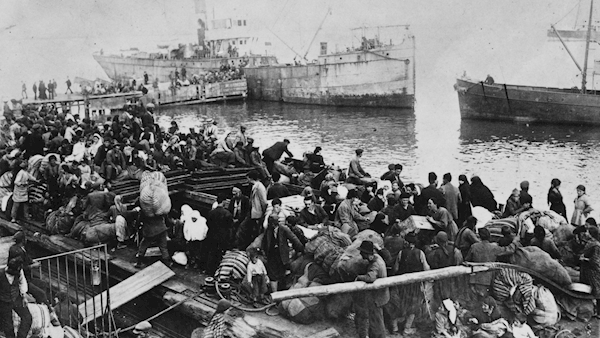
Among the worst atrocities carried out in the so-called inter-war period happened during the tussle for territory between the Greeks and Turks, writes
WE’VE spent this year commemorating the end of the First World War as it is were over, but it is still going on. The centenaries of post-war struggles, such as those in Greece, Turkey, the Arab countries, and indeed in Northern Ireland will be harder to commemorate because they haunt us still.
Greece and Turkey still fight over Cyprus. And what is the crisis in the Middle East but falling shrapnel from the defeat of the Ottoman Empire in the Great War?
The carving up of Ottoman lands between France and England by Francois Georges-Picot and Mark Sykes in 1916 is at the heart of much of the unrest which has bedeviled the region ever since.
This is remembered throughout the Arab world as a betrayal.The terms of Sykes-Picot showed clearly that promising independence to the Arabs was just a ruse to gain Arab support against the Ottomans. Further, in 1917 the British made the Balfour Declaration which pledged support for a permanent home for the Jewish people in Palestine. From this came the ethnically-based state — the ethno-state — of Israel.
“You don’t have to explain Sykes/Picot to any child in the Middle East,” says Robert Gerwarth, author of The Vanquished: Why The First World War Failed To End (Penguin). Indeed, one of the most tragic reflections of Ottoman humiliation is the aim of Islamic State to return to a multi-ethnic Muslim caliphate.
Originally a Berliner, now professor of modern history at UCD and director of its Centre for War Studies, Gerwarth traces his passion for the history of the European wars of the 20th century to his experience as a child, watching the Berlin Wall come down.
For Berliners, the Second World War had failed to end too. This war had its roots deep in the humiliation of Germany by the Allied Powers in the aftermath of the Great War. One of the most interesting things about the book is how Hitler becomes as much a product of his times as a one-off freak.
This is a reading of history which made emotional sense to those of us who are middle-aged and had parents and grand-parents who remembered the Second World War.
It is time to admit now that it makes no real sense, however.
Hitler could not have been a one-off. His ideal, an ethno-state “cleansed” of what was not German, was part of what followed the collapse of the great land empires in Europe and beyond.
The end of the Ottomans, the Romanovs and the Habsburgs, is usually regarded as the inevitable collapse of out-dated political systems to be replaced by modern nation-states. As Gerwarth reminds us, this is the lens through which those very nation-states regard themselves. For all their faults, the land empires were multi-ethnic and multi-faith. They were replaced by ethno-states.
Take the Ottoman Empire, for example, which had welcomed the Jews from Spain and had vast Christian territories in the Balkans. The rump-state that is the Turkish republic was founded by Ataturk on ethnic Turkishness. Often lauded in the West because he created a “secular” state, it is fascinating that Gerwarth considers Ataturk was a major role-model for Hitler whose hideous anti-semitism, which to a British or Irish schoolchild seemed to come from nowhere, is shown by Gerwarth to have been endemic in 20th-century Europe.
In Russia the Tsarist regime had been anti-semitic, but I had no idea that anti-semitism was such a hallmark of the White Russian movement, with the Bolshevik Revolution seen as a Jewish conspiracy.
The Ukrainian resistance was no less repulsively anti-semitic and committed atrocities such as that in 1919 in Proskurov which saw the slaughter of 2,000 Jewish civilians. Young children and old people were butchered for fun, women were raped in front of their husbands and then cut to pieces.
I didn’t know, before I read Gerwarth’s book, that David Ben-Gurion, the first prime minister of the state of Israel, had once been a convinced Ottoman, looking for rights for Jews within the multi-ethnic empire. He recruited a Jewish volunteer force to support the Ottomans in the Great War.
He was following the fashion of the times by becoming an advocate for a Jewish ethno-state, after the Balfour Declaration. In 1918 he joined the Jewish Legion to support the Allied war effort.
Among the worst atrocities carried out in the so-called inter-war period happened during the tussle for territory between the Greeks and the Turks. Again, it was the British who encouraged the Greeks to try to retake the ancient Greek land of Asia Minor or Anatolia.
Most of this land had been Ottoman since the 1400s. The British sentiment was anti-Ottoman, anti-Muslim and based — I think — on an ideological concept of the classical roots of their own Western civilisation. There was a blood-bath. Greek troops attacked Turkish civilians in a process which the Red Cross described in 1921 as the attempted “extermination” of the Muslim population. The Turks, with a more able leader in Ataturk, gave as good as they got.
Possibly the most horrific moment of the whole debacle was the descent of Turkish troops on the city of Smyrna in 1922. Much of the Christian population was literally driven into the sea while British war ships sat in the bay and did nothing to save them.
The massive “population exchanges” which were agreed between Greece and Turkey saw hundreds of thousands of impoverished and traumatised refugees descend on both countries. Gerwarth points out that this influx of refugees, as well as the movements of people caused by World War II, are still remembered with horror and that this is behind some of the anti-immigrant sentiment being expressed today in some parts of Europe.
Who could ever have credited Hitler with inventing ethnic cleansing? Granted, the Nazis brought to their task an efficiency and a scientific precision which was unique. Salonica, the story of how a great, multi-ethnic city which had welcomed the Jews expelled from 15th-century Spain was “cleansed” of its Jews by the Nazis within five weeks.
Nowadays Salonica is Thessaloniki, Greece’s second city. Once famous for its minarets, there isn’t a single mosque left and barely a trace of its Muslim past remains.
As an Irishwoman of my generation perhaps it is not surprising that I always saw the birth of the nation-state in the wake of the First World War as entirely positive. While the Irish State had some elements of the ethno-state, there was also some protection of the rights of minorities and the murder of 13 Protestants in Dunmanway in 1922 hardly constitutes widespread ethnic cleansing.
But if you want a true ethno-state, look no further than Northern Ireland, at least until the civil rights movement. It is the spoke in the UK’s wheels as it attempts to roll out of the EU which is the only multi-ethnic, multi-faith confederation of nations we have in Europe.
Can you really tell me that the the First World War is over?