Democracy is suffering for the lack of a robust, combative opposition
We're holding the government to account. We’re only acting in the national interest. There’s a need for a bipartisan approach. How often do we hear those phrases nowadays?
They have become a substitute for real politics, and they’re a large part of the reason why the centre of democratic politics is being hollowed out.
There’s seldom been a time in the world, or the bit we know anyway, when active political opposition mattered so much. Or was so uselessly invisible.
There’s something pretty fundamental going on in our politics these days, and I sometimes wonder if I’m the only one who finds it worrying.
Not just our politics, but immediately across the Irish Sea, and on the far side of the Atlantic, too. It’s an insidious kind of thing, but the longer it lasts, the more democratic politics is becoming undermined.
The death of opposition, I call it. It’s a form of politics where the job of government is to get on and run the country, and the job of opposition is to whinge a lot.
They — the opposition, that is — spend all their time using the sort of clichés I listed above. And they don’t do a lot else.
Yes, the opposition has to hold the government to account. And, yes, there are times when they have to be responsible in the national interest, and where a major national crisis demands a considered, less partisan approach.
But the real democratic job of any opposition party — the core job it has to do — is to oppose. Their job, in a democracy, is to want to replace the government with something better: With better ideas, better leadership, better communication.
They’re supposed to fight, to expose, to attack, and to do it as parliamentarians, deploying effective strategies and tactics and delivering powerful alternative messages.
When that happens, politics commands the attention of the people. The more po-faced commentators will write disapprovingly about instability and the like, but the people will be following their politics much more closely, and participating in it daily.
Throughout the 1980s and 1990s in Ireland, despite the fact that there was at least one issue that commanded cross-party support and attention — the peace process — politics was a hard-fought business.
And all the political parties had large and active memberships. Now they all bemoan the fact that young people don’t turn up to meetings, but without ever stopping to wonder how the meetings became so meaningless.
In the UK, people are facing an existential issue, one of those once-in-a-lifetime political issues that will shape the future of a generation.
For want of any effective opposition, people have had to take to the streets in their tens of thousands.
The marches you see broadcast from London aren’t ordinary street protests. They’re people in their millions, pleading with the political system to get off its backside.
And, especially, I think, pleading with the Labour Party in opposition to start doing its job.
In the last 70 years, there surely hasn’t been a worse British government. It’s made up of a single political party that might as well be three parties, it’s so hopelessly divided.
And it’s supported in parliament by a tiny party from Northern Ireland that is entirely out of touch with the expressed needs of the people it claims to represent.
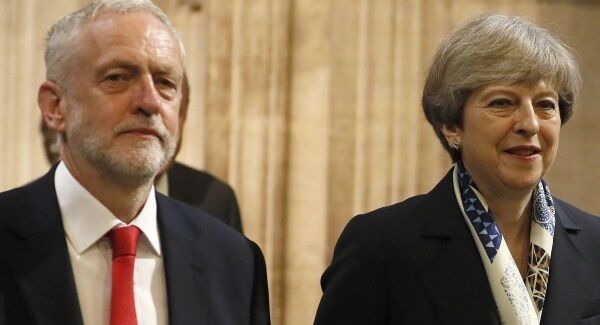
Any opposition worth its salt would have swept this shower out of office long ago. The British Labour Party under Jeremy Corbyn looks like a frightened rabbit at the prospect of being asked to take responsibility.
There are now government ministers wandering around, wondering what parliament should do after Theresa May is defeated, whenever she puts her Brexit deal to a vote.
The entire cabinet has accepted defeat before it happens, and five or six ministers are quoted in yesterday’s Guardian about the possibility of free votes in the House of Commons, as part of the next phase of ‘how do we get out of this mess?’
"This is a constitutional crisis and the Prime Minister is the architect of it."
— Channel 4 News (@Channel4News) December 17, 2018
Jeremy Corbyn says Theresa May is "leading the most shambolic and chaotic government in modern British history". pic.twitter.com/1eeQrdnsdR
In all of this, there isn’t a peep out of Corbyn. He should be calling for one thing, and one thing only: The resignation of the government. But he seems unable to get the words out of his mouth.
And that’s why millions of people are marching forlornly, looking for answers that Labour ought to be supplying.
Then, there is the US. All the experts over there seem to think that the worst president the country has ever had, now well-established as a thoroughly despicable human being, has a rattling good chance of being re-elected.
And why? Because the opposition is so bloody awful.
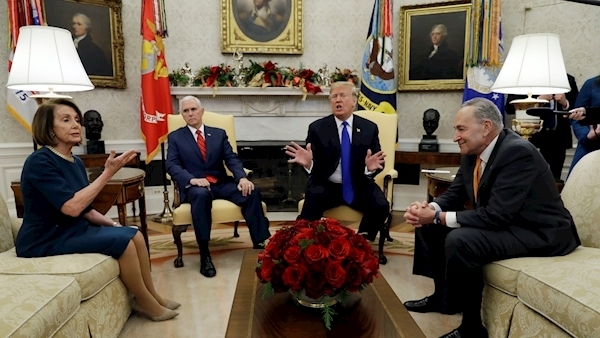
Did you see the Democratic leaders of the Senate and Congress, Chuck Schumer and Nancy Pelosi, having a so-called dialogue in the Oval Office with Donald Trump in the last few days?
It was utterly bizarre: Schumer grinning and talking nonsense, Pelosi spouting procedural guff, and Trump dominating the camera, talking directly to his base.
How anyone thought this was an effective way of showing Trump up for what he is is beyond me.
In a little under two years, the Democrats are going to have to fight Trump in an election, and they have no leader, no voice, no clear constituency.
There are states where he has to be beaten if a Democrat candidate is to win back the electoral college, and it can be done. No-one is focusing on those states; there is no strategy.
If they are to win, they have to give a high-energy candidate a full 18 months to get out there, and they don’t appear to have a clue how to go about it.
Don’t tell me they’re going to beat Trump by trying to harry him in Congress, or even by trying to impeach him. They’re precisely the battles he loves to fight.
He has spent the first two years of his term campaigning in the country, and so far he’s doing it on his own.
He can only be beaten by someone who starts to attract the same kind of crowds, who takes him on where it hurts, and who can reconnect to the disaffected voters that Trump has managed to divide and conquer.
An opposition strategy in the US would be focusing every ounce of its energy on finding and resourcing that candidate. Instead, they’re doing their level best to hand Trump the next election.
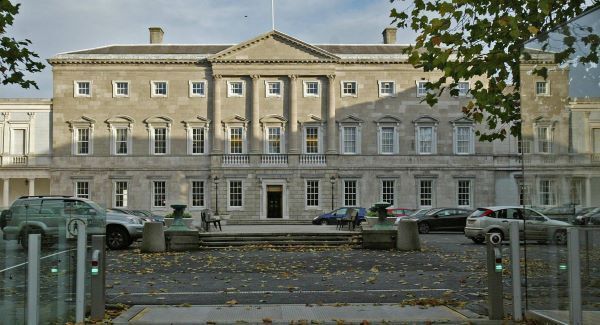
And what about us? Is our politics completely dead? We have a confidence-and-supply agreement that appears to be capable of turning a blind eye to children in homelessness and elderly people on hospital trollies.
It’s not designed to keep the Government on its toes. Its primary purpose seems to be to ensure the opposition is as comfortable as possible.
Sure, the parliamentary arithmetic is messy. The inarticulate and lifeless opposition we have makes it almost certain that it will remain that way.
I’ve never known a time when the opposition in Dáil Eireann was so reluctant to really go for it. And when the life goes out of active democratic politics, other, angrier, more divisive forces take over. That’s the risk we’re running.

CONNECT WITH US TODAY



Be the first to know the latest news and updates










