George HW Bush has died and with him the ‘American century’

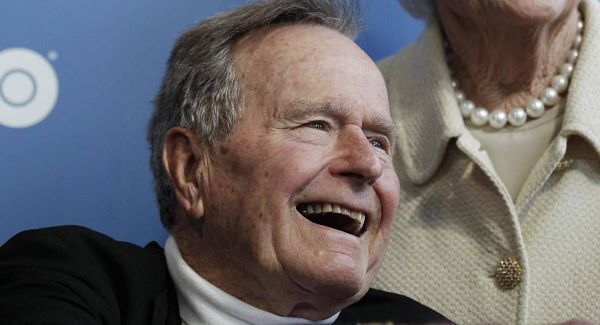
What Bush, the 41st US president, lived long enough to see is the end of the post-Second World War era, writes .
George H W Bush’s funeral in Washington DC today signifies a much more profound changing of the guard than the death of just one president. To understand the ultimate significance of his passing, go back to John F. Kennedy’s inaugural address, in 1961.
In words that will likely never be forgotten, he proclaimed: “Let the word go forth, from this time and place, to friend and foe alike, that the torch has been passed to a new generation of Americans — born in this century, tempered by war, disciplined by a hard and bitter peace, proud of our ancient heritage — and unwilling to witness or permit the slow undoing of those human rights to which this nation has always been committed, and to which we are committed today, at home and around the world.”
That new generation of Americans included Bush, who was just seven years younger than Kennedy. Both served as junior officers in the Second World War and were born in the 20th century, Kennedy in 1917 and Bush in 1924. When Kennedy delivered that famous speech, his predecessor, Dwight Eisenhower, born in 1890, sat nearby. So, too, did Eisenhower’s predecessor, Harry Truman, born in 1884. Eisenhower had been the supreme allied commander and Truman commander-in-chief. Kennedy, aged just 42, represented generational and cultural change. With Bush’s passing, that era is now over and they are gone. In a sense, today’s funeral is a eulogy for the American century.
Coincidence tying historical figures together is interesting, of course. And if Bush is given the honours of a deceased president today, the effective influence of his generation had long since waned. What Bush lived long enough to see is the end of the post-Second World War era. The American century is over and so, too, is the Pax Americana, which, in current US president, Donald Trump, is a grotesque caricature of what it was at its best.
Romanticising American power in the second-half of the 20th century would be a mistake. But if in Vietnam and elsewhere it frequently failed to uphold its own ideals, there was enough of the spirit Kennedy spoke of to ensure that the ideal of America as a city upon a hill was credible and that it endured. It was an ideal that shone particularly brightly in comparison to every other alternative. That is something that might be remembered by those who travelled another road and made anti-Americanism their default position.
It was given to Bush, the youngest US navy pilot when he enlisted to serve in the war, and US liaison to China in 1974-75, to be president when the Berlin Wall came down, in 1989. The defeat of communism was a great achievement and a liberating moment. What was not anticipated was the forces it unleashed, including globalisation. There was a massive accretion of power by large corporations and a corresponding, corrosive alienation from metropolitan centres of political power, which left communities displaced.
The supra-narrative of the nineties and the noughties was not one many on the margins saw themselves reflected in. Whether it was Cool Britannia in Tony Blair’s Britain, a seemingly compulsory exuberance in boom-time Ireland, or the rusting industrial heartlands in Bush’s and Bill Clinton’s America, something fundamental was displaced beneath the surface, and it was a sense of solidarity and continuity.
An able, ambitious man, who climbed from one important post to another in the Richard Nixon and Gerald Ford administrations, Bush was part of the advance guard of the opening towards China. In a decades-old Cold War, it made sense to ally with China as a counterpoint to the Soviet Union. Decades, and one economic miracle later, there has been no opening-up or democratisation in what by some predictions will be the world’s largest economy within 15 years. China is not just an economic power, it is an authoritarian one. Increasingly, it is challenging American hegemony globally, not least in the Pacific, but also in Africa.
Brexit, Trump, Putin, Erdogan, Orbán, and more: That’s not how the future looked when the wall fell in 1989. Liberal democracy, after a starry start, faltered in one country and then another. Older, deeper forces, which needed the apparent certainty of authority, as an antidote to dislocation, re-emerged or mutated. It is too soon to say whether what we are going through globally are growing pains of a new era or something darker. David Attenborough’s apocalyptic prophecy that climate change could lead to the collapse of civilisations, and the extinction of “much of the natural world”, puts superficial issues such as politics and economics into perspective.
Except it is a synergy of both that is threatening harm of a scale simply too large for most of us to comprehend.
Closer to home, another fundamental change in the world Bush led is the faltering of, even the disintegration of, the north Atlantic political alliance. The rise of China, and the continuing, relative decline of Britain, are factors in that. But Trump and Brexit accentuated a trend. Ireland, firmly in Europe, was also tactically and profitably in the slipstream of that Anglo-American relationship. Its Indian summer was the partnership between Margaret Thatcher and Bush. She was in the final, dominatrix phase of her premiership then. He was the unchallenged leader of a briefly unipolar world. Now, there is a dispersion of power globally, a hiatus in the solidarity of the EU, and the effective abandonment by Trump of the role that had characterised the US since the Second World War. It is hard to recognise the peace and world order that Bush and Kennedy fought for in their youth and solidified in their prime. There is a sense, today, of ashes to ashes, and dust to dust.
There is comfort, too. The world of their youth was infinitely more perilous than ours. Running water and medicine, or at least much more of it, is transformative. Our present-day ogres are pallid by comparison to Hitler and Stalin. If some of the hope promised when George H W Bush was president has vanished, much remains.
What seems certain, however, is that there are watersheds, before which time seems characterised by continuity and after which nothing is ever likely to be the same again. Our election in 2011 was one such event. It was politically dramatic, but its ultimate influence will be cultural change.
Trump’s election was another. The cosmopolitanism of the Clintons, unmoored to values that spoke to the dislocated, saw a collapse of an apparently stable normal into values that do not belong in the city upon a hill.
Bush, unlike Kennedy, was not a great orator. But he was a talented statesman and leader. There seemed to be an authenticity about him.
More often than not, his actions spoke for his values. The world would be a better place with a little more of what he had to offer.
What Bush, the 41st US president, lived long enough to see is the end of the post-Second World War era

CONNECT WITH US TODAY



Be the first to know the latest news and updates