Ducks delight in glare of the supermoon
Maybe the ducks instinctively knew the supermoon was coming, writes Damien Enright

Ducks delight in glare of the supermoon

Last night, November 14, as darkness fell and the moon rose in a clear sky, brighter and bigger than I can recall ever seeing it, thousands of duck rode on the black and silver waters of the bay, rafts and drifts of ducks, the most distant like black lines drawn across the surface between me and the streets lights of the silent village stretched along the shore, no traffic passing.

I’d seen them earlier in the late evening light and been amazed at their numbers. I tried counting a section of one hundred, and multiplying up, but it was hopeless. The density in places, and scatterings in others, made my ‘scientific method’ useless. There were many thousands. Like the brightness of the moon above, the sight was new to me. I have never seen even half that number of duck on the bay.

The tide was especially high and the bay especially full, with hardly a metre of wetland along the margins left unflooded. Perhaps the absolute stillness, the unseasonable warmth and the brightness of a moon that was full when at its closest to Earth for 69 years inspired the gathering.

Maybe they instinctively knew the supermoon was coming, like migratory birds sense the weather in advance, and chose that night for a celebration of their numbers.

Earlier, as the light yellowed, I had watched godwits crowd into a few square metres of reeds above the tide, the only roost still not inundated. They were remarkably unafraid as I passed within yards and stopped and snapped a picture, the individuals still alert making no fuss to wake their companions, standing with heads under wings nearby.

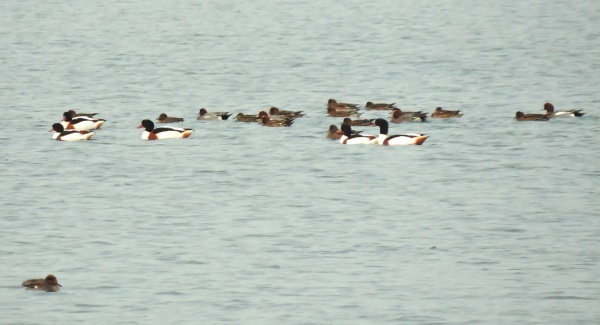
Minutes later, before the light changed from yellow to half-dark and to a sunset of pink, candy-floss clouds rolling like breaking waves across the sky, I could still distinguish the colours and species of the ducks with the naked eye. Most visible were the flotillas of shelduck, white wings and breasts like beacons moving among the dark, squat thousands of mallard, widgeon and teal, hard to know one from the other in the dying light. Sometimes, the white bulge of the breasts of hunkered-down shovellers, their heavy, spatula-shaped beaks resting on them, would show low in the water. Groups of the same species swam together and mingling with others, cruised slowly up the bay — but in fact stayed almost stationary, facing into the outgoing tide, vast islands of birds.

Later, in the first hour of darkness, the moon rose and loomed over the bobbing multitudes. The sky was clear, with the Milky Way flowing across it like a million sparklers in a star-lit cascade. We’ve had the privilege of many cold, sharp, diamond-winking skies for weeks now.

The star-encrusted heavens, a poet pal called them, and I could see what he meant. And, then, the supermoon came up, to cap it all. It was sight to see while it lasted. I don’t imagine I’ll around for the next viewing in 2034. For many of my generation, it would have been a once in a lifetime event.

It was a pity that, later, clouds crept in from the south-west and veiled the glory and our supermoon became a wraith moving between them, or seeming to. They thickened, and she (for the moon, like the Earth, is feminine) became a ghost, lost in the cloud seas. She has been represented as a brave huntress but, also, in every language of the world, through all of human time, as a wraith, a lost soul.

In terms of science, ‘she’ is simply a ball of rock, not a chaste and distant woman, and it is, of course, the winds of heaven (the stratosphere) driving the clouds across her face that make her appear to sail, elusively, in and out of sight. However, let us indulge our imagination.

The other night, at the perigee — the closest orbit of moon to Earth —she was resplendent and wore a crown, an azure ring around her circumference. For us Earthlings, she appeared 14% larger and 30% brighter than a full moon at the apogee — her farthest point from Earth — when she would be called a micromoon.

Later this month, November 29, a micromoon will be born in the distant heavens. The first sliver of reflected sunlight will gleam on the rock ball 400,000km from Earth — (160,000km farther into space than our supermoon, now departed) but at first you’ll need a telescope to see it.

She’ll be new-born, a slip of her future glory as the sun once more floods her earthward side with light.

x

More in this section

Revoiced

Newsletter

Had a busy week? Sign up for some of the best reads from the week gone by. Selected just for you.

Cookie Policy Privacy Policy Brand Safety FAQ Help Contact Us Terms and Conditions

© Examiner Echo Group Limited