Portuguese man-of-war jellyfish arrive like an armada in Irish waters
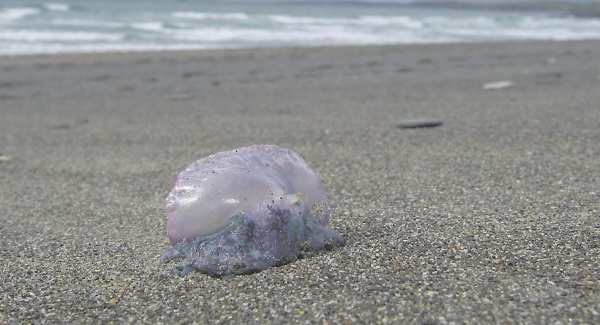

Reports over the last few weeks suggest that 2016 will be another one for the records. Southwest winds, blowing over seas warmed in a changing climate, drive these armadas towards our shores. Like the unfortunate Spanish sailors of 1588, men-of-war come to grief along the coast from Cork to Donegal.
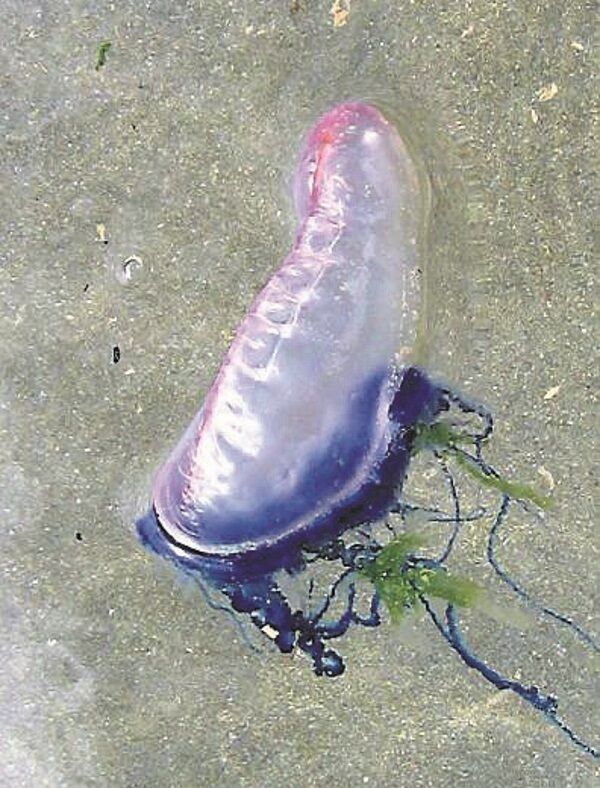
Ships are feminine but warships are an exception. The Tirpitz Scharnhorst and Bismarck were famous battleships, while American aircraft-carriers are called after Presidents. Will a USS Hillary Clinton break the gender mould? According to Reddall’s Fact Fancy and Fable (1892), a ‘man-of-war’ was originally a sailing vessel full of armed men. The term came to refer to heavily-armed manoeuvrable frigates developed during the 16th Century. Fully-rigged Portuguese ones had a characteristic shape; the inflated purple-blue bladders, being found among the flotsam and jetsam on our tide-lines today, resemble them. These semi-transparent balloons belong to one of the most intriguing creatures to visit Irish waters.
People refer to the Portuguese man-of-war, erroneously, as a ‘jellyfish’; it has the nasty sting which defines jellyfish in the public mind. An elusive creature, it’s very difficult to study. You can’t tag and track a man-of-war, nor can you keep one in an aquarium; this ocean dweller doesn’t take to captivity. Nobody even knows how long the creature lives but it’s clear that the man-of-war isn’t a jellyfish. Nor is it a single organism but an association of creatures, known as ‘polyps’, working together.
Polyps are little soft-bodied organisms, usually anchored to something and extending sensitive tentacles to locate and harvest food. The tentacles discharge tiny poisoned arrows to disable or kill prey. The polyps of a Portuguese man-of-war remain autonomous individuals, but are dependent on each other like Siamese twins joined at the hip. They operate in the manner of a ship’s crew; each member doing a particular job. The division of labour resembles that of a honey-bee colony. The queen bee produces eggs while attendants see to her needs. Some worker bees collect pollen, others make honey or clean the hive, while ‘nurse’ bees build honeycombs and look after the larvae. The drones’ only task is to mate with queens during nuptial flights.
Karl Marx, impressed by honey-bee organisation, would have been equally so with the man-of-war. Some polyps work to move the colony about, erecting its most conspicuous feature; the inflatable bladder which acts as a sail. The balloon, extending up to 15cm above the water, may also be a sunscreen to block harmful UV radiation. The bag can be deflated and submerged if danger threatens. In the core body of the colony, underwater, other polyps are engaged in digestion and reproduction.
The armed tentacles, used for defence and hunting prey, extend for tens of metres below the colony. They will sting a swimmer who blunders into them. By all accounts, this is an extremely painful experience but tabloid claims of ‘lethal deadly killers’ are exaggerated. Fatalities occur occasionally among people who are susceptible to anaphylactic shock, just as they do following bee or wasp stings. If you happen upon a man-of-war on the beach, don’t handle it with bare hands; even severed tentacle can sting. A species of fish has developed immunity to the arrows. It lives among the tentacles, using them for security. A substance on the surface of the fish’s body is being studied in the hope of developing a protective cream for human swimmers.
We humans dominate the planet, largely because we learned to cooperate with each other for mutual benefit. Only a few creatures, social insects, termites, lions, wolves, and chimps among them, have developed this unique ability. That a so-called ‘primitive’ creature, from a phylum largely unchanged for over 500 million years, managed to do so, is remarkable.

CONNECT WITH US TODAY



Be the first to know the latest news and updates