We have more to fear from our lack of accountability than from globalisation
Most ministers become the manure that composts the bureaucratic undergrowth, writes Gerard Howlin.
We have more to fear from our lack of accountability than from globalisation

Today’s political and economic news is dominated by the decision of the EU Commission that Ireland gave favourable tax treatment to Apple, amounting to €13 billion since 1991. It is rooted in decisions taken by the Revenue Commissioners and based on allegations of giving unfair competitive advantage to one company over others. It is complicated and has been on the go for years. In all probability, it has years to go before a final conclusion.

As an example of technocratic conundrums which beset politicians when national governments struggle to persuasively govern in a globalised economic order, the Apple case is a classic. The vote for Brexit, the emergence of Trump and yearning to ban the burkini example reductio ad absurdum responses, offered with increasing desperation and decreasing credibility. Because global trends cannot be effectively controlled locally, locals prefer to take hold of the lever that is nearest and pull hard. Better to do something, than nothing, if only to relieve the frustration of pitiable powerless. An act of destruction is at least action.

Powerlessness — to one degree or another — was largely the state of mind of the general populace before the First World War. Putting the matter positively, obedience was held to be a virtue. Government was mainly a matter for others. For the great majority, the furthest horizons were local.

Certainly, there were global trends albeit less powerful and not as obviously connected in the localised world, before globalisation. The context of the Apple case, is it arrives exactly at the juncture when global trends, underlined by the failures of multinational institutions to address them, is leading to further radical destabilisation within national politics globally. In other words, multinational corporations have proven more efficient than multilateral government organisations, supposedly policing them. In turn from the UN to the EU, scorn is heaped and in countries like Britain, both its internal cohesion and its external relations are threatened with a downward vortex, which over time will make its constituent parts weaker, and those angry, left-behind Brexit voters, ever more left-behind.

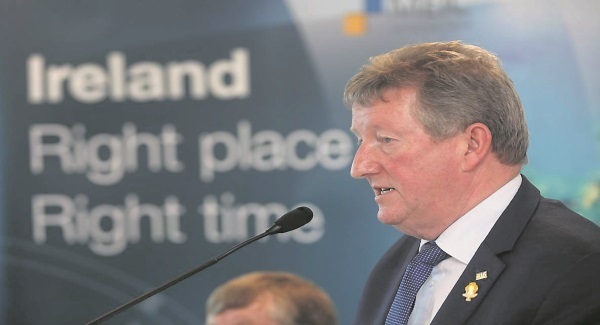
The prevailing anti-political mood is poison ivy. It is creeping up around trees it ultimately toxifies and fells. It is, however, the bandwagon which all want to get on board. The main headline in this newspaper on Monday was a call by a newly-elected independent TD and now minister of state responsible for the Office of Public Works, Sean Canney, for term limits on TDs. A 10-year limit is his suggestion: “I don’t think I have the divine right to be [a TD] for 20 or 30 years”.

Well I agree. In fact, you haven’t a divine right to be a TD at all. You have to get elected first, then re-elected. In the last election 38% of all TDs, including Sean Canney, were new. In 2011 that figure was 45%. Those very high figures do not account for the churn of TDs returning to the Dáil after an absence, almost invariably caused by them losing their seat previously. In the four elections from 1992 to 2007 new TDs on average accounted for more than 22% of those elected. In that 15 years, just more than 90% of the composition of the Dáil was entirely new. And, that was before the tsunami of 2011.

We have a problem but it is not the one identified by Sean Canney.

He is, however, grappling with the underlying one. A persuasive advocate for his community in east Galway, he is now responsible for the OPW, which is technocratic and bureaucratic and which is responsible for delivering for places afflicted by flooding across the country. I purposely say responsible, because in almost no meaningful sense, is he really in charge.

Our public institutions’ expertise at passing responsibility upwards, is in inverse proportion to their willingness or capacity to take political direction downward. Perseverance can be a little testing when faced with the prospect of a minister in office for a full five years. Faced with the two-year tenure of Minister Canney, the clock is the best friend of the status quo.

Sean Canney
Sean Canney

It is extraordinary and alas extraordinarily common, that a man who laboured for years for next to nothing on Galway County Council, having achieved office now, should so completely misunderstand the true nature of challenges which are odds-on, likely to defeat him. It is not the power of politicians that is overweening or their tenure that is over-long. It is their relative powerlessness in the face of the mediocrity of the permanent bureaucracy, which they lack either the skills, the will, or the time to challenge effectively. Most ministers become the manure that composts the bureaucratic undergrowth. In the modern political conversation term limits have their origin in Newt Gingrich’s 1984 Contract with America, which successfully overturned 40 years of Democrat control in the House of Representatives, characterised by the influence of extraordinarily powerful committee chairmen. It is the modern basis for Trump talk.

In an Irish context it is both completely misplaced, but entirely understandable. Alienation requires a response. One clear public response has been to change political representation with increasing frequency. Another, but clearly lacking, would be to firstly challenge, then resource and finally hold to account public services, including regulatory ones, to a much higher standard. Much public cynicism and frustration comes from a lack of accountability, of which political accountability is only a top-layer and too frequently a token votive offering, in lieu of the real thing, by those who unlike Minister Canney enjoy real power and whose tenure is truly unlimited.

We are neither helpless nor hapless. The misunderstanding is that globalisation is our enemy and the local is permanently disempowered. Globalisation is Ireland’s friend. The Global Innovation Index ranks Ireland as the 7th most innovative country in the world. After a disastrous economic crash, rooted in political unwillingness to hold key statutory functions to effective account, as well as Government overspending over years, our economy has rebounded to more than two million jobs. The undermining disconnect is twofold. The opaqueness of our governance and the mediocrity of its operational delivery breeds alienation locally. Local alienation demands further political evisceration. It is a downward spiral.

We can’t change the world. But we can be excellent at some things. Attracting multinational companies is one; encouraging confidence in our political system is another. Political accountability is one aspect. But the greater challenge, which politicians shy away from, is holding public services to effective account. The economic crash was singularly dislocating. The lingering poison ivy which toxifies public opinion is the mediocrity of the administration of public services. Curiously, one of the few political survivors over decades, Michael Noonan is now our point man on Apple. The irony is that he will now defend Ireland from without, with a political enthusiasm, he never committed to reforming it, from within.

More in this section

Revoiced

Newsletter

Sign up to the best reads of the week from irishexaminer.com selected just for you.

Cookie Policy Privacy Policy Brand Safety FAQ Help Contact Us Terms and Conditions

© Examiner Echo Group Limited