West Cork homes the spellbinding dance of the house martin bird from tropical Africa
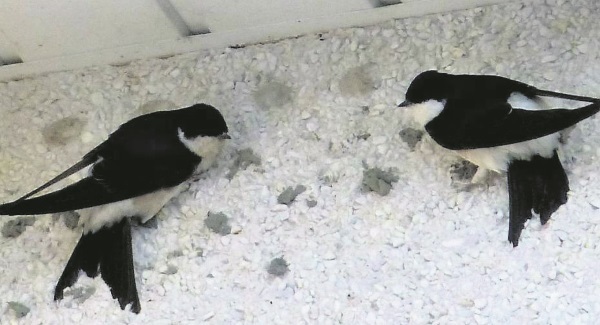
They bring a fascinating and heartening insight to the natural world for anyone who cares to look up at them, and their instinctive determination to build a family home and raise a clutch of offspring born in Ireland is to be admired. It is likely that they were born in similar ‘mud huts’ under the same fascia board themselves.
The ‘huts’ resemble something out of traditional Africa, domed shapes constructed of natural material, mud and straw, stuck firmly to the wall with their own saliva.
It’s a small (or very big) miracle, when one comes to think of it. Birds weighing no more than 20g flying 7,000km to a specific 8sq m or 10sq m of house-front in another hemisphere and then assuming the role of masons, to build, from nothing but the materials immediately available — the estuary mud and the leaving from the silage cutters — a durable nursery in which to raise their young.
The programming in those small bodies, those small brains, is awesome. The timing of the flight, the reading of the weather, the endless kilometres flown over desert, savannah, mountain and sea, the tactics by which they compete with, and triumph over, storms and predators, the pinpoint accuracy of arrival at the destination, the survival and the success of procreating and rearing a new generation that will guarantee their species continuance — and, in the process, give humans something to look up to every year as we pass.
They swoop and dive, they flutter upwards and descend like falling arrows. They perform loop-the-loop and formation flights, spiralling skyward together, almost touching in the air. They seem, at times, to glory in their aerobatics, to duck and dive and plane and glide for the sheer hell of it. And perhaps that is the case.
It is clear that other birds — for example, rooks at evening — sometimes fly about the sky for reasons of sociability alone, having nothing to do with feeding, so why not martins?
However, from the time the chicks hatch, the flights are purposeful and not a wingbeat is wasted as they whizz from nest to air and air to nest, bearing insects caught on the wing, feeding the hungry fledglings which, to the fascination of passersby, soon begin to pop their heads out of the nest door and, as time goes by and they grow bigger, even open the door wider so that we earthbound creatures can see three, or four, or five small heads protruding, pink gapes open as the parents arrive after yet another tireless trip, their beaks full of insects to fatten their young.
It is sad indeed that some householders don’t appreciate the resilience, dedication and beauty of the martins’ parenting or, indeed, of the birds themselves. In towns and villages, some property owners object to these temporary squatters high up on their house fronts. They fail to see the miracles and view the nests as no more than lumps of mud defacing their fine fascias, which they would prefer to be characterless and spotless rather than to be nurseries for graceful life.
So, they call in the power-hosers, and have the cleverly-crafted mud huts blown off the pebble-dashing, and the chicks blasted out of them to fall 8m or 10m to the ground, there to die slowly if they are not already dead from the impact of the water, the heart-stopping shock or the fall.
In conurbations all over Ireland, some residents tolerate and nurture the martins, some abhor the tarnishing of their property, albeit that tarnishing is for a brief season only. The nests are built in May and are gone, scheduled by nature’s inbuilt obsolescence, by September.
Last year, in our village, when a nest was inadvertently blown apart by a power hose, three saviours arrived. They deserve to be named and cited for services to nature and the continuity of house martins swooping over our bay and village skies, Ruth Murphy, Peter Wolstenhome and Adrian Gannon. Together, they re-pinned the remains to the wall with lettuce wire and screws, and the parents returned, and the clutch was reared.
This year, when a nest was blown to smithereens, they sought another in which to lodge the chicks, hoping they’d be adopted. They found a swallow’s nest, with eggs. And, so far, the swallows are feeding the two pin-feathered martins that survived.
CONNECT WITH US TODAY



Be the first to know the latest news and updates











